TimManBlog

Whatever I'm Thinking

Archive for the category “Politics”

A Better Primary Election Schedule

Hat tip to @TheTonyLee for help on this idea.

Anyone looking at the schedule for the 2012 GOP Presidential primary season will see a mish-mash of states and dates that most resembles a plate of spaghetti thrown at the dining room wall. On some election days there will be only one state’s primary scheduled, while on others there will be two or three, and on yet others there may be as many as ten states’ primaries scheduled.

That’s only one problem. Geographically speaking, primary dates are all over the map. In many cases states far apart host their primaries on the very same day, making it very difficult for a candidate to campaign effectively in each. For example, Arizona and Michigan hold their primaries on February 28. Are the candidates going to fly from Phoenix to Detroit then back to Tucson then back to Grand Rapids? Or, consider the logistics for Super Tuesday (March 6) where voters go to the polls in the far Northeast (Massachusetts), in the Deep South (Georgia), in the Midwest (Ohio), in the Southwest (Oklahoma), and in the Far West (Idaho and Alaska). Then after the exhaustion of Super Tuesday the candidates can turn the full weight of their campaign energies on little Kansas, which is the only state to hold its caucus on March 10.

How many Americans understand all this? Does it make good sense to anyone?

Ladies and Gentlemen, and pundits, there has to be a better way!

I’d like to see presidential candidates campaign through as many states as possible with the same intensity that they currently do in Iowa and New Hampshire. To do this we need to cut down the candidates travel time drastically. We also need to allow them to maximize the reach of their media purchases by consolidating election schedules around existing media markets.

To accomplish these goals I propose changing the future scheduling of presidential primaries and caucuses. The new schedule will consist of four weeks of single-state elections followed week after week by regional primaries in which neighboring states are clustered together to vote on the same day.  This scheme will shorten the primary season as a whole, cut down on wasteful travel, consolidate media markets for spending efficiency, and generally make sense to the American people.

Here are the details.

First, we can keep intact the scheduling of the first four states’ elections. Iowa, New Hampshire, South Carolina and Nevada can each have its own primary/caucus on its own day a week apart. This is more than just traditional; it is actually regionally equitable since these four states each represent one of the country’s four main regions.

Second, the remaining group of 46 states (plus the District of Columbia) would be separated into 12 defined regions, each of which will hold its elections a week apart. States will vote on the same day as other states within its region.

Now for the fun part. These regions will be loosely based on NCAA athletic conferences, of which most red-blooded Americans are familiar. Happily this lends itself to memorable names — there will be an ACC Primary, an Ivy League Primary, a Big-10 Primary and so forth. This may sound flippant at first, but any change will be more easily embraced when its terms are more familiar to the people.

For the first presidential election cycle the order in which each region will vote will be determined randomly; then rotated in each subsequent cycle in much the same way that the NFL rotates inter-divisional matchups. No region will always vote first and no region will always vote last.

I also recommend that the first election be moved back to the first week of February. With the new scheduling there is no longer any reason to move this process up to the frigid month of January.

Here is a sample election schedule.  Again, the first four weeks of the schedule would remain the same in each presidential election cycle:

Week 1: Iowa

Week 2: New Hampshire

Week 3: South Carolina. South Carolina has been first among Southern states in many other ways, why not in elections as well.

Week 4: Nevada. So far we’ve had a Midwestern state, a Northeastern state, and a Southern state. Somebody has to be first in the West and Nevada seems to want the title.

Weeks 5 through 16 would consist of regional primaries. Here are my groupings. Again, the actual order in which each region would vote would be chosen at random at first and then rotated in each subsequent presidential cycle.

A) The Ivy League Primary. States of Maine, Vermont, Massachusetts, Rhode Island and Connecticut. Total population of 13,128,395. Major media markets would include Boston, Providence and Hartford. This primary will have the second-smallest population of the 12 regions.

B) The Big East Primary. States of New York, Pennsylvania and New Jersey. Total population of 40,872,375. Major media markets would include New York City, Philadelphia, Syracuse, Buffalo and Pittsburgh. This primary will have the largest population of any of the 12 regions, but I don’t want to separate New Jersey since its media markets are really the New York City and Philadelphia media markets.

C) The ACC Primary. States of Delaware, Maryland, West Virginia, Virginia and North Carolina plus the District of Columbia. Total population of 26,662,710. Major media markets would include Baltimore, Washington, Richmond, Raleigh/Durham and Charlotte. Note that West Virginia is included here although traditionally it is included in the Big East football conference. However, geographically West Virginia shares more of its border with Virginia that any Big East state and its population of almost 2 million would be insignificant if combined with the Big East’s 40 million.

D) SEC East Primary. States of Georgia and Florida. Total population of 28,488,963. Major media markets included are Miami, Tampa, Jacksonville and Atlanta. Originally I wanted to keep the whole SEC together but the total population would have exceeded 47 million.

E) SEC West Primary. States of Tennessee, Alabama, Mississippi and Louisiana. Total population of 18,626,510. Major media markets would include Nashville, Memphis, Birmingham and New Orleans. Note that I exclude the states of Kentucky and Arkansas from the SEC regions entirely. More on that later.

F) Big-10 East Primary. States of Michigan, Ohio, Indiana and Kentucky. Total population of 32,243,313. Major media markets would include Detroit, Cleveland, Columbus, Cincinnati, Indianapolis and Louisville. I’d use the Big-10’s “Legends” and “Leaders” monikers if they made any geographic sense whatsoever, but they don’t. I’ve included the state of Kentucky in this Big-10 primary to accommodate the many media markets that straddle the Ohio River between Kentucky and Indiana and Ohio, such as Cincinnati, Louisville and Evansville.

G) Big-10 West Primary. States of Wisconsin, Illinois and Minnesota. Total population of 23,821,543. Major media markets would include Milwaukee, Chicago and Minneapolis/St. Paul.

H) Big-12 Primary. States of North Dakota, South Dakota, Nebraska, Kansas, Oklahoma, Missouri and Arkansas. Total population of 18,822,426. Major media markets would include Omaha, Kansas City, St. Louis, Little Rock, Wichita, Tulsa and Oklahoma City. It makes sense to include Missouri here because the Kansas City media market straddles Missouri and Kansas. Also I think Arkansas belongs here in the Big-12 primary with its trans-Mississippi neighbors. Don’t even tell me that the Big-12 football conference is breaking up because I don’t care. The Big-12 will live on in the spirit of the Plains.

I) The Texas Primary. State of Texas only. Total population of 25,145,561. Major media markets would include Houston, Dallas, San Antonio and El Paso. The large population means a one-state primary makes sense.

J) The Big Sky Primary. States of Montana, Wyoming, Colorado, New Mexico, Idaho, Utah and Arizona. Total population of 19,364,900. Major media markets include Denver, Albuquerque, Phoenix, Tucson, Salt Lake City and Boise. I realize that ‘Big Sky’ really only refers to the state of Montana but the name “Big Sky Primary” is so much better than the bland and pedantic “Mountain West Primary.”

K) The California Primary. State of California only. Total population of 37,253,956. Major media markets would include Los Angeles, San Diego, San Francisco and Sacramento. Like Texas, the large single-state population means that a one-state primary makes sense. As it is this will be the second-most populous primary following the Big East Primary which has 40 million.

L) The RainWater Primary. States of Washington, Oregon, Alaska and Hawaii. Total population of 12,626,146. Major media markets would include Seattle, Spokane, Portland and Honolulu. This region will have the smallest population of any of the 12 regions. Hopefully candidates will be able to campaign in Hawaii a bit. The state of Hawaii fits easily here since the Little League World Series organizers also group Hawaii with the Northwest region in their annual summer baseball tournament. There really isn’t a unique football conference to lend its name to this regional primary so I chose the crummy name RainWater because I used to live in Portland and I don’t like it there anymore.

This is my scheme. Comments are welcome.

As it was with NCAA athletic conferences, these regional primaries can only come about with the consent and cooperation of state governments. I have no illusion that central Federal authority can or will impose any such plan.
What I’d like to Hear from Newt Tonight

Now I’d like to offer some unpaid and unsolicited advice to Newt Gingrich.

Newt should apologize to Mitt Romney for his comments about Romney’s work at Bain Capital. Here’s what Newt said:

 “I would just say that if Governor Romney would like to give back all the money he’s earned from bankrupting companies and laying off employees over his years at Bain Capital, that I would be glad to listen to him.”

That is not a fair criticism. It is not consistent with Newt’s professed politcal philosophy, nor is it consistent with Newt’s own past operations as independent consultant.

Rather, these are angry and petulant remarks made in the heat of campaign battle and have become the subject of numerous news and opinion articles.

Newt will certainly be asked about them in the Sioux City debate tonight. Here’s what I think Newt should say:

“I’m sorry. I shouldn’t have said that. I spoke in anger in response to remarks which were unfair to me. As a businessman Mitt Romney should be free to conduct his business in a way he best sees fit. His tenure at Bain Capital included both successes and a few failures.  All businesses do, mine included.”

“This campaign should be about substance, about issues and about concrete actions to be taken upon inauguration in January. I intend to stay on that path from here forward.”

Let’s see if Newt takes my advice tonight. An apology would suit him well. It might even distinguish him.

A Ruling Congress

Steve Hayward of AEI and has an excellent piece in today’s PowerLine blog regarding Newt Gingrich, last night’s Presidential debate, and the proper relation between Congress, the Presidency, and the American people.

After a recap of the Presidential debate highlights Steve delves into a deeper consideration of the nature of the office:

Over much of the last generation or two—more or less since Republicans started dominating the presidency starting with Richard Nixon’s election in 1968—conservatives have tended to be president-centric.  This was especially true when Reagan was President, and there was a legitimate reason to resist the many ways in which Congress had aggrandized its power in the aftermath of Watergate.

So by force of habit conservatives have come to rely upon the President to lead their movement. Remember those conservatives who grumbled that G.W. Bush was only “conservative in some areas” but deferred to his policy leadership anyway? Can you say Medicare Part D?

It has not always been so.  Steve goes on:

But once upon a time, 50 years ago or so, many leading conservatives championed Congress as the pre-eminent branch of our government, as the Founders did.  After All, there’s a reason the first article of the Constitution is about Congress, not the President.  Partly this was a reasonable reaction to the liberals who championed the presidency as the institution for transforming America, following the teachings of Woodrow Wilson, the example of Franklin Roosevelt, and the orgasmic promise of John F. Kennedy.  (You think I exaggerate?  In 1961, Herman Finer, a leading political scientist of the time, wrote: “The presidency is the incarnation of the American people, in a sacrament resembling that in which the wafer and the wine are seen to be the body and blood of Christ.”  I would think the ACLU would have a conniption fit over language like this today.)

In 1959, James Burnham, one of the great writers of that first generation of post-war conservatives (his best known book was Suicide of the West), published Congress and the American Tradition, which set out the argument that conservatives should champion a reinvigoration of Congress as a counterweight to the post-Wilson transformative “visionary” presidents.  In making the case for legislative supremacy, Burnham was merely reprising one side of a debate that stretches back to the arguments over the legislative-executive balance of power from the time of the Founding.  Among other things, Burnham argued, there is a difference between a strong president, and a strong presidency.  He was in favor of the former, but skeptical of the latter, in part because he perceived the paradox that attempts to have a strong presidency will actually result in weakening the office.  Cue Barack Obama, the frustrated miracle worker.

I think Hayward’s analysis is spot on. (Read the whole article here.) I’d just like to add my two cents.

As a practical matter advancing the concept of a return to a Ruling Congress might suit the GOP very well. This is because conservatives have a strong Congressional brain trust but a weak field of Presidential candidates.  Paul Ryan understands the Federal budget better than anyone.  Michele Bachmann regularly schools other candidates on the exact Congressional processes needed to repeal Obamacare. Eric Cantor, Tom Coburn, Jim DeMint, Rand Paul, Marco Rubio and many other GOP “stars” are well-known national names capable of carrying the conservative message through the media and to the general public.

Since future GOP policy leadership will apparently come from its Congressional delegation, why not emphasize that?

OWS as Class Warfare

Tip of the Hat to The Sage of Mount Airy.  Follow his blog.  I don’t believe he’s on Twitter.

The Sage links to Mark Steyn’s assessment of the Occupy Wall Street rioters:

What’s happening in Oakland is a logical exercise in class solidarity: The government class enthusiastically backing the breakdown of civil order is making common cause with the leisured varsity class, the thuggish union class, and the criminal class in order to stick it to what’s left of the beleaguered productive class. It’s a grand alliance of all those societal interests that wish to enjoy in perpetuity a lifestyle they are not willing to earn.

Read the whole thing here.

Occupy Wall Street as Superstition

You have to love this article by Abe Greenwald in Commentary. Here’s the thesis:

Watch any showdown between an articulate capitalist and an OWS-er. It’s not a political debate, but an anthropological event: present-day man reaching back through time to make contact with his primitive and superstitious ancestor.  The capitalist understands the benefits of the free market but the Occupier doesn’t have to. The shamans of socialism have told him that Wall Street is populated by evil spirits. He’s been warned of the capitalist’s use of incantation and alchemy.  If the capitalist seems to be making sense, it’s a spell. (And if the Tea Party seems to be comprised of thousands of voices it’s the wizardry of the all-powerful Koch brothers.) The Occupier will not engage a legitimate opponent because the opponent’s legitimacy is some sort of devilish illusion. Occupy Wall Street, therefore, literally has no need for logical argument.

Read the whole thing.

Please note that a fair observer of capitalism understands the limits of the free market as well as its benefits.

Most of us believe that the best form of government available to mankind is a modern democracy (or representative republic) and that the basis for such a government is rational discussion of issues amongst free and equal members.  Greenwald’s piece opens a Pandora’s Box. What if, hypothetically for now, rational discussion is impossible for a violently assertive segment of society?  In the past how did America deal with the American Nazi Party or the Communist Party or the KKK?

Well, for one thing we didn’t have a President excuse their actions as “broad-based frustration.”

In the end the superstitious will have to be made to accept the law and the politicians will have to be made to accept the will of the rational supermass of the people.  In the end the people will again demand a government with enough stomach to “Secure the Blessings of Liberty.”

Truth or Consequences — and Quixotic Occupy Wall Street

November 3, 2011

On the old game show “Truth or Consequences”, a contestant would be asked a question (“Truth”) and if answered incorrectly he would face the “Consequences.” Sometimes the Consequences could be an embarrassing stunt. At other times the Consequences could be happy ones — such as a chance to win money or a surprise reunion with a long-lost sibling. Host Bob Barker would often close the broadcast with the phrase “Hoping all your consequences are happy ones.”

In 1950, “Truth or Consequences” creator Ralph Edwards promised to do his national tv program from the first town that agreed to rename itself for the show. Hot Springs, New Mexico won the contest and promptly changed its name to “Truth or Consequences.” The game show is long gone but the town’s strange name remains today.

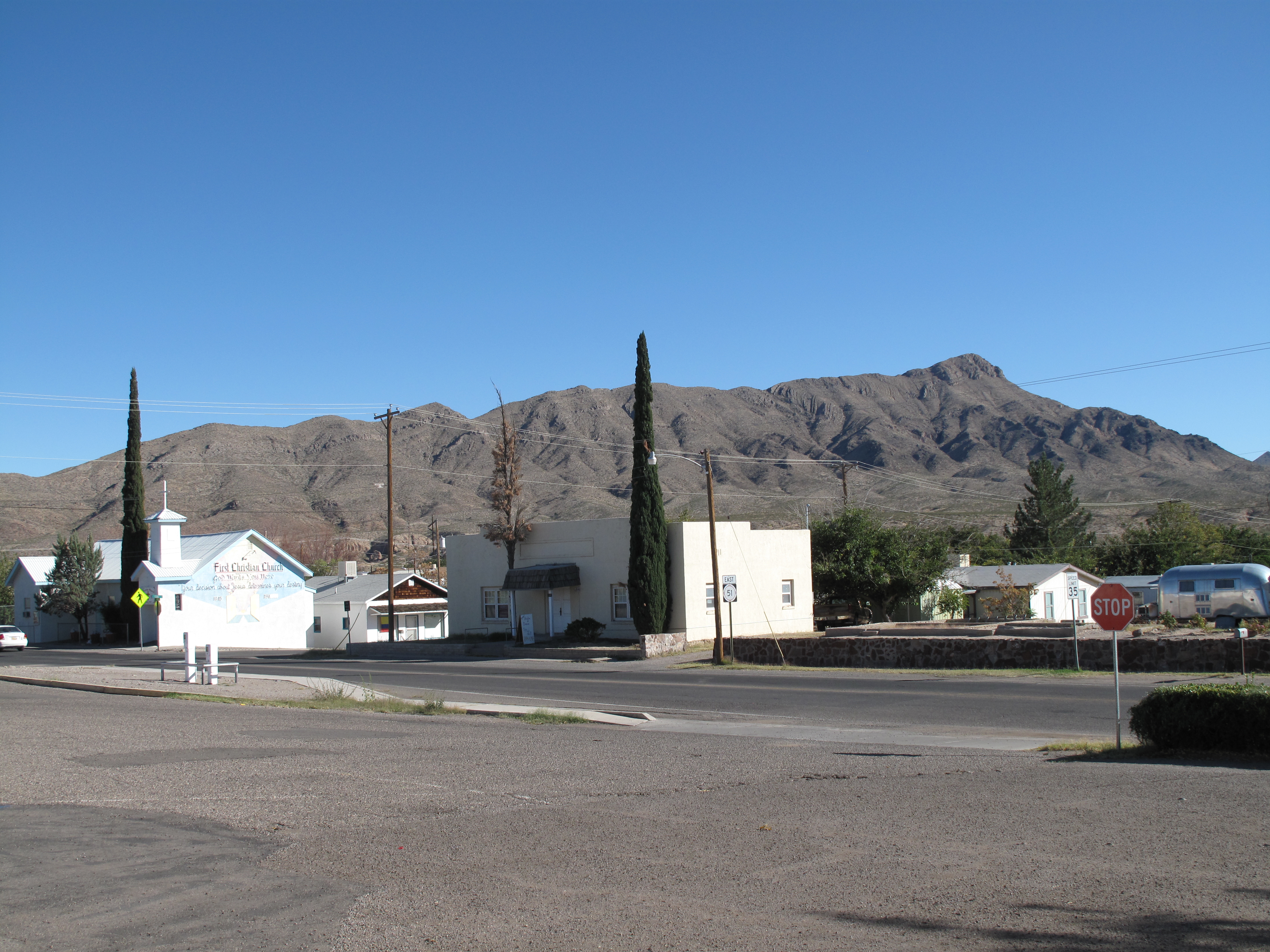
So, here’s the “Truth” of Truth or Consequences. “T or C” (as it’s known) is a dusty desert town of 7,000 people and the county seat of Sierra County, New Mexico. The nearby Rio Grande provides water and some recreation. Cactus patches speckle the rocky hillsides. The barren face of the Caballo Range towers in the distance, and beyond that lies the ancient Jornada del Muerto, or Journey of the Dead Man.

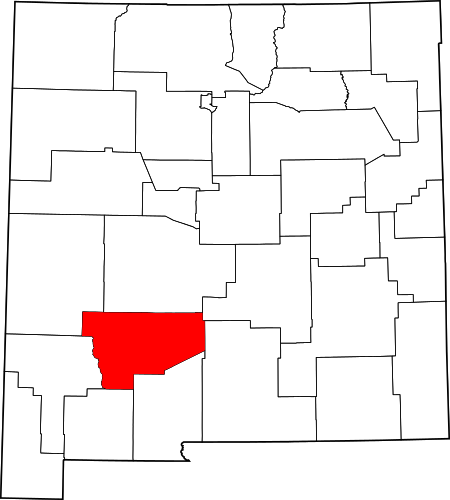
Sierra County in the state of New Mexico
Desert scene, Truth or Consequences, New Mexico

Desert towns can be odd and seem to stretch reality. Walking down Main Street feels like walking through a kaleidoscopic canyon. Storefronts are mostly trinket shops painted multiple pastel colors and the aroma of burned incense and marijuana fills the air around them.

Dust & Glitter, Truth or Consequences

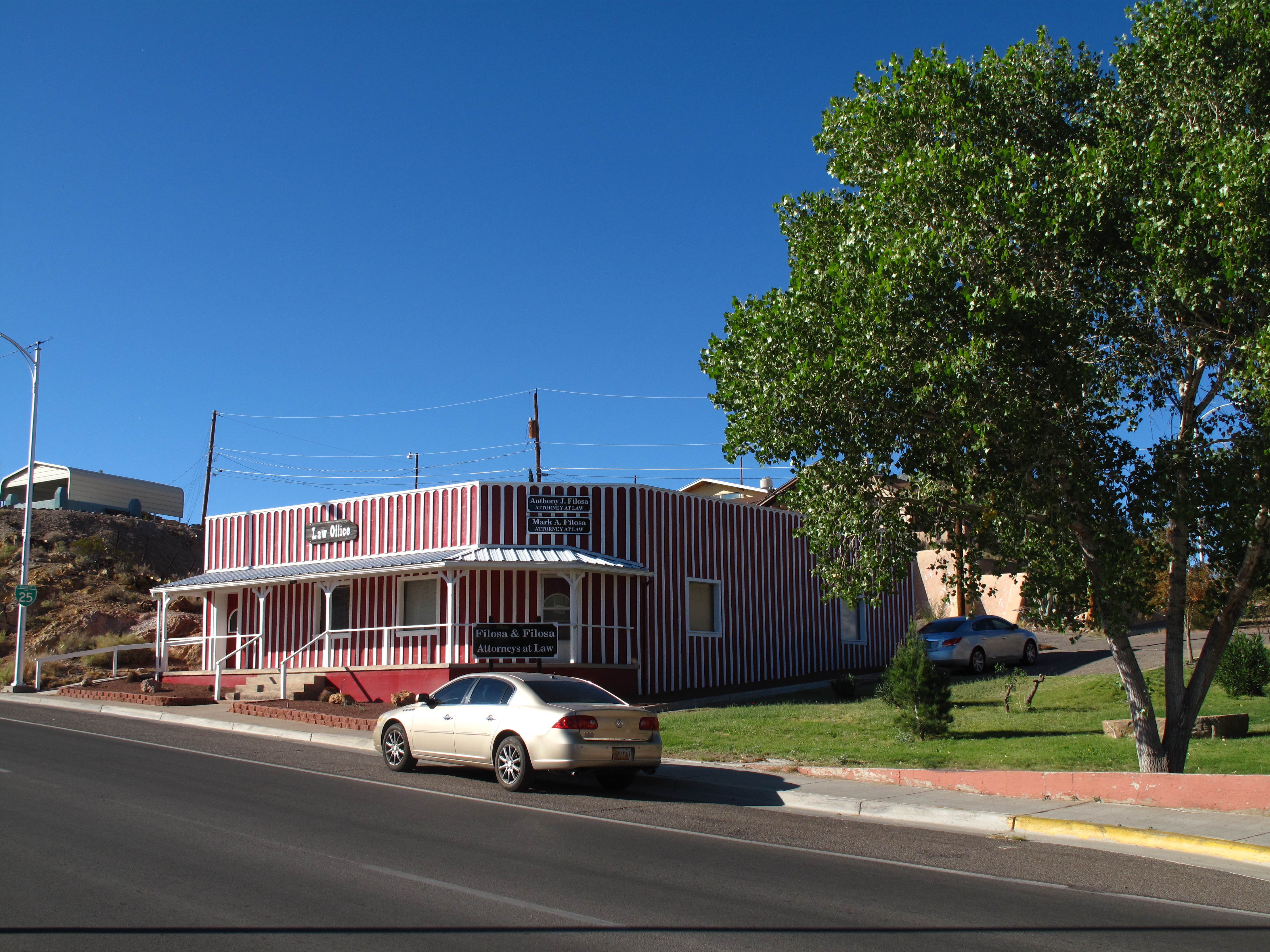
Across the street, a lawyer’s office is painted in red and white stripes as if it were a circus tent.

Lawyer’s offices, Truth or Consequences

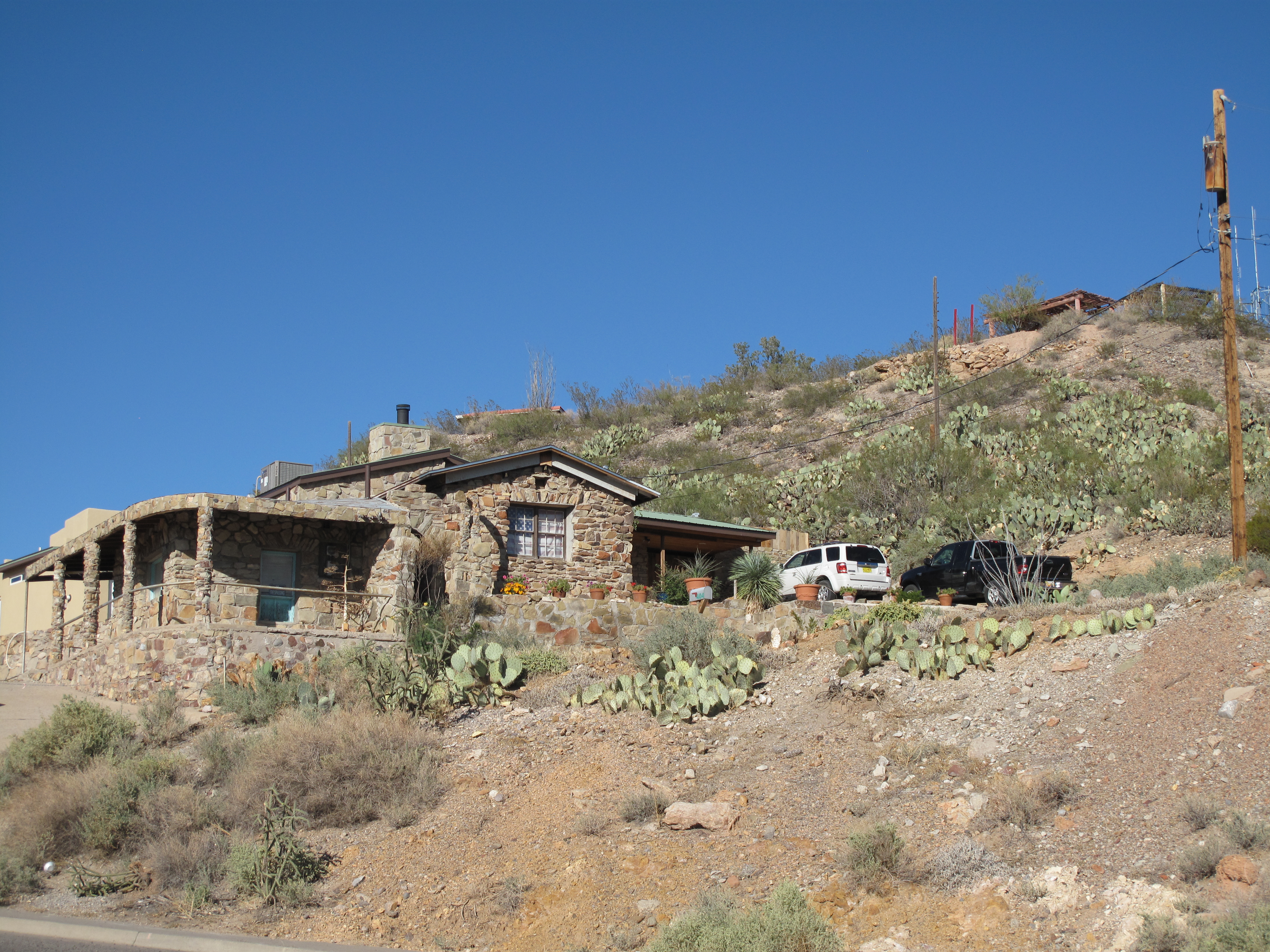
Homes built of rocks cling to the hillsides above Main Street; their porch supports are stacks of rocks.  Many of the residents seem to be retirees who came here for the blue skies and warm weather. Yet this isn’t a wealthy town, so presumably many of those might be retired schoolteachers living on state pensions.

Hillside rock home, Truth or Consequences

As I turned the corner onto Broadway, I found an open diner. I ordered some green chili or “chile verde” as New Mexicans call it. Chile verde is not simply a green version of chili con carne.  It’s a stew with meat (usually pork), potatoes or other vegetables, and chopped green chilies added for a kick. This is perhaps New Mexico’s signature food — each restaurant seems to have its own recipe. Although you can find red chili on most menus here, it is referred to as “Texas Red” and is delivered to your table with some under-the-breath derision.

I overheard some waitresses chatting among themselves.

One said, “I think [man’s name redacted] might just claim my youngest to be his real daughter.”

“The one in first grade now?” another waitress asked.

“Yes.”

“Oh, she looks just like him.”

So once upon a time there was a Truth and now there are Consequences.

On my way out of town I saw, incredibly, some Occupy Wall Street protesters! There were maybe 10 of them, all old hippies, holding signs in the town park at the corner of Main and Broadway. They seemed to be a quixotic bunch, protesting Wall Street in a town too small to have a three-story bank. As I slowly drove by, I could overhear one of them explain “right-wingers” this way: “It’s in their genes so they can’t resist the urge to hate.”  I’d hate to see the Occupy bunch turn into the next eugenics movement.

I tweeted about it later:

“I saw protesters today at Occupy Truth or Consequences New Mexico!! A dozen peyote-smoking middle-aged hippies. Truth!”

To my shock, I got an answer from one of them:

@que_taylor: “There were 18 of us and thank you for saying ‘middle'”

You’re welcome @que_taylor.  I looked up @que_taylor on twitter. She describes herself as “K Taylor: Math teacher, single mom with grandchildren, fan of humanitarians, love to re-post good tweets”. I looked up some of her other tweets. They weren’t as friendly as the one she sent to me:

“For one thing, #OWS are testing local police forces and local authorities; exposing the thugs and police-state mentalities.”

“Don’t put the bread in the oven until it’s done rising. #OWS is far larger than T-baggers. No need to get personal.”

@que_taylor and the Occupy Wall Street people in Truth or Consequences might be having a problem understanding Truth. The police force here doesn’t seem to be thugs or the leaders of a police state. In fact, their headquarters are in the Sierra County Courthouse just 200 yards away. Although the protesters are clearly visible from the courthouse the sheriff isn’t marching out with his shock troops.

Sierra County Courthouse, Truth or Consequences, New Mexico

OWS might also be having a problem understanding Consequences. If they really lived in a police state they wouldn’t be able to protest openly in the town park, and their bodies would likely wind up at the bottom of the nearby Rio Grande.

In the final analysis, OWS is simply demanding things for themselves that others have earned for themselves. I was in other parts of New Mexico the same week I was in Truth and Consequences.  Here are some alternative cause-and-effect scenarios.

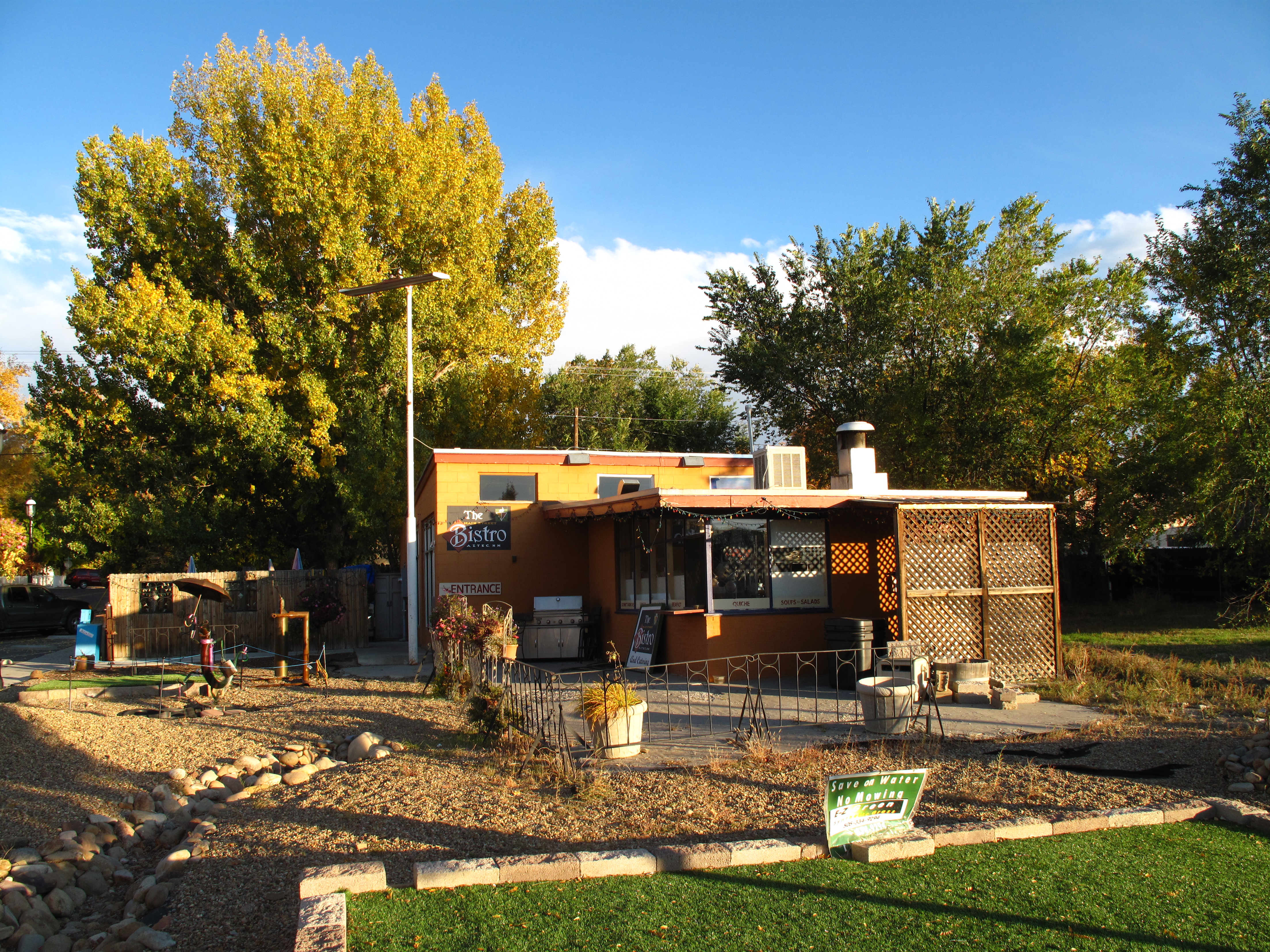
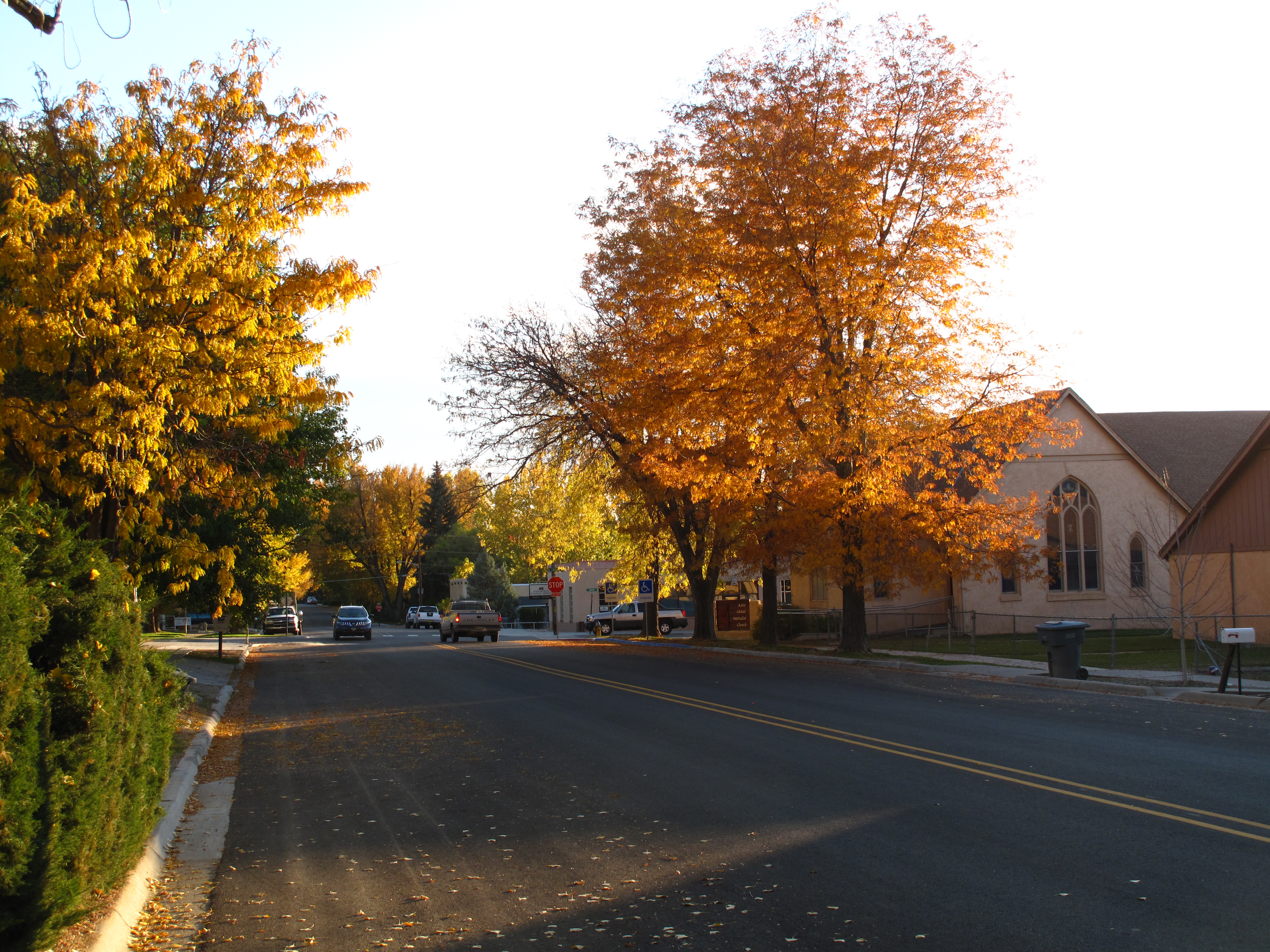
There’s a burgeoning energy industry in the northwestern corner of the state, near the desert towns of Farmington and Aztec.  Natural gas collection sites are dispersed among desert rocks and sagebrush. Pickup trucks servicing the sites invariably pass you at 15 miles above the highway speed limit. That’s all ok though. The ultimate consequence of the energy work is blooming desert towns with middle-class jobs and homes.

Main Street Bistro, Aztec, New Mexico
Residential Street, Aztec, New Mexico

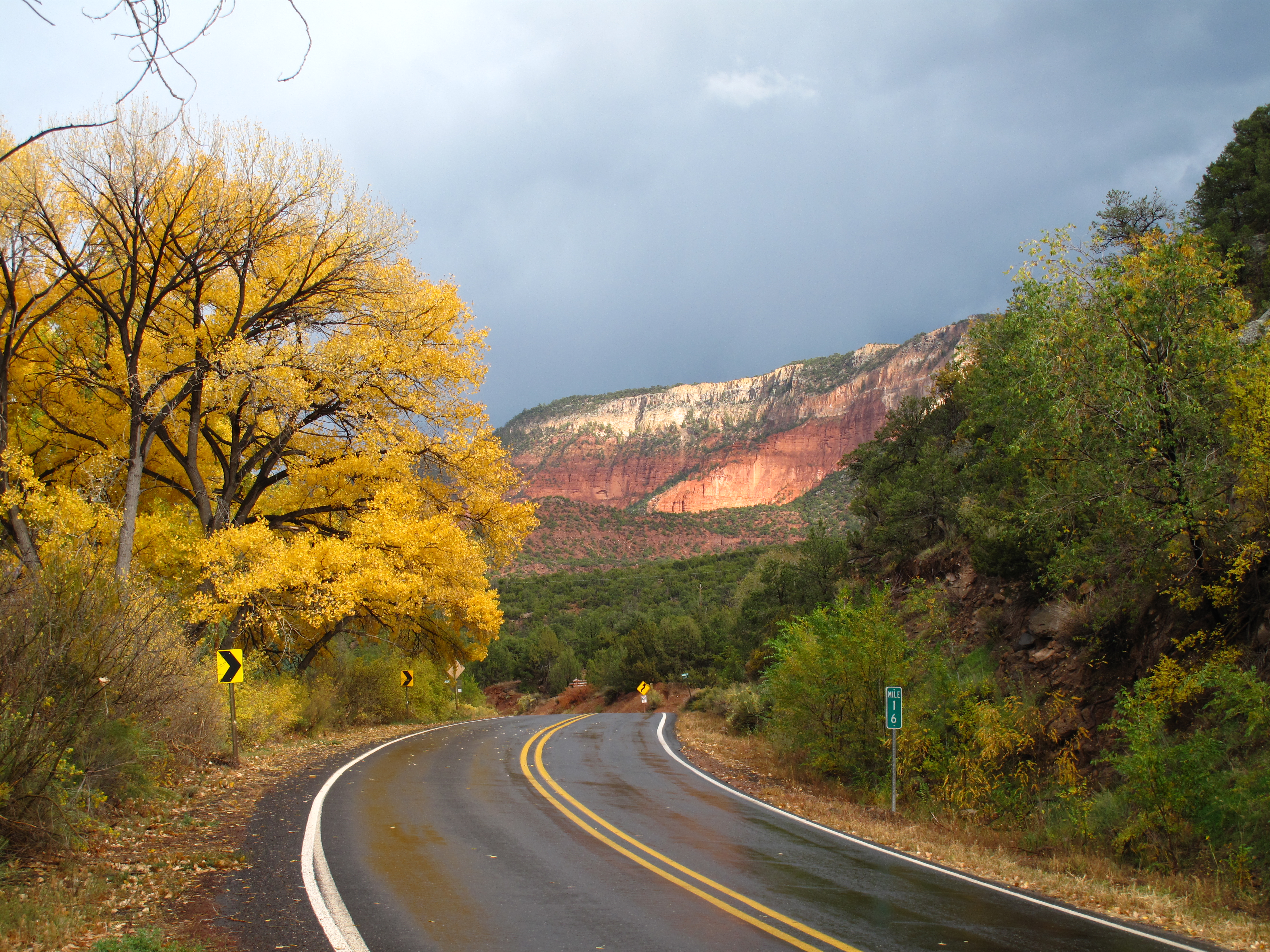
But suppose you don’t want a mortgage or a 9-to-5 job. Eschewing traditional occupations, both Jack Kerouac in the 1950s and the old mountain men of the 1830s chose to wander the countryside with a pack and a tough pair of boots. They demanded nothing from anyone. The consequences of such a life would include hiding under rock ledges during storms. However, after the rain stopped, they would be rewarded with sights like this:

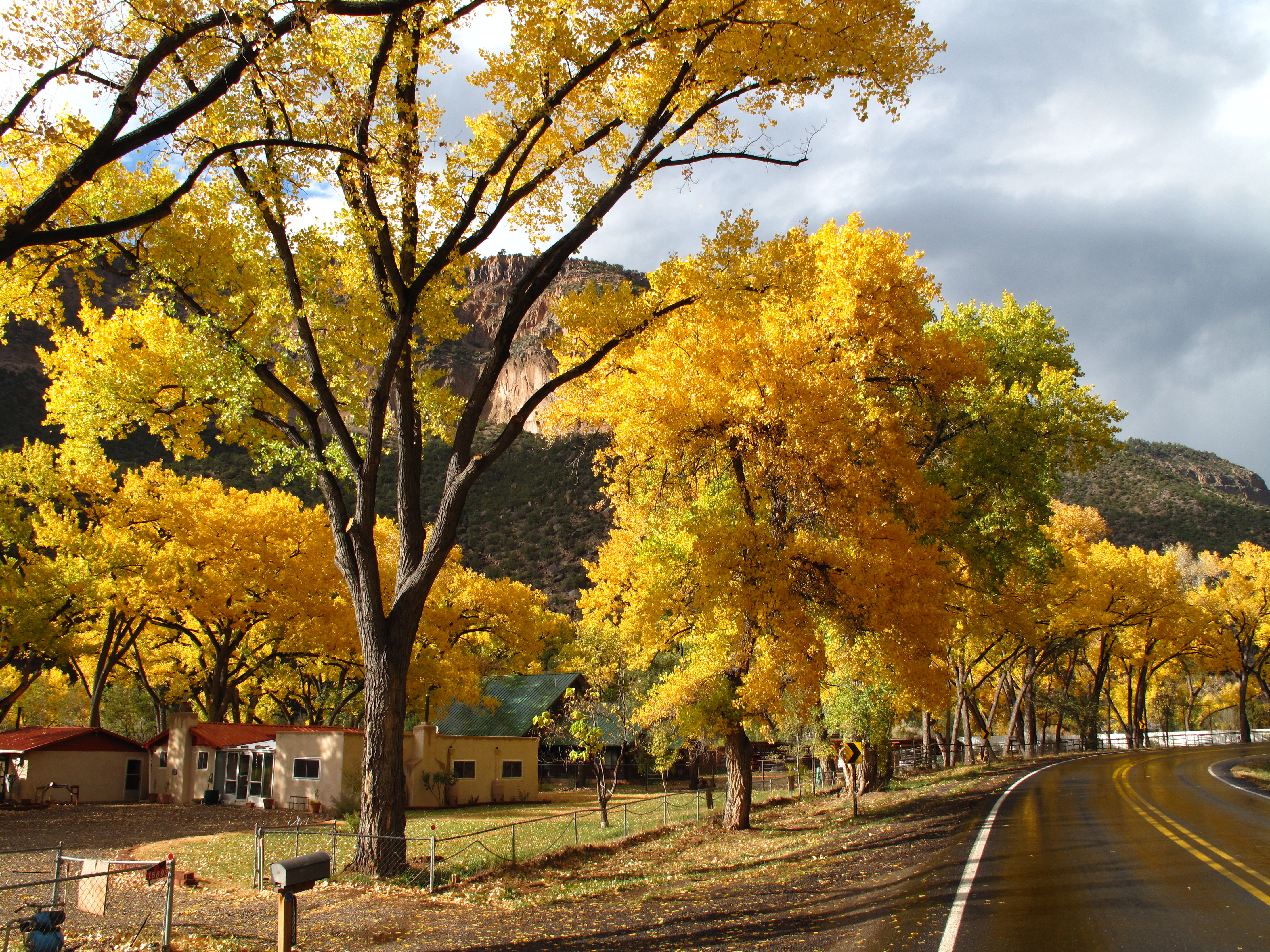
Foliage and homes near Jemez Springs, New Mexico
Jemez Canyon, New Mexico

So in the end, the vocal residents of Truth or Consequences don’t seem to have a firm grip on Truth. Because of that, they experience only imaginary Consequences. It’s sad and I feel sorry for those modern-day Don Quixotes.


A list of all photo posts from the American County Seats series in TimManBlog can be found here.

I’m trying to travel to all of America’s county courthouses, and each month a post about my visit to the most interesting county seats. It’s only a hobby — but donations are greatly appreciated to help defer my costs.
Thanks,
Tim

One-Time
Monthly
Yearly

Make a one-time donation

Make a monthly donation

Make a yearly donation

Choose an amount

¤5.00
¤15.00
¤100.00
¤5.00
¤15.00
¤100.00
¤5.00
¤15.00
¤100.00

Or enter a custom amount

¤

Your contribution is appreciated.

Your contribution is appreciated.

Your contribution is appreciated.

DonateDonate monthlyDonate yearly

Climate Change Common Sense

Charlie Martin at Pajamas Media writes a clean and sober review of what he calls another climate change food fight.

“The Berkeley Earth Project [BEST] reported that they were preparing four papers, one of which confirmed that there had been a general rise in global average earth-surface temperature over the last 200 years…The results weren’t really all that dramatic — the general response was ‘well, duh!’  It was the PR that was flawed.”

For some of that “flawed PR”, see the Yahoo! News story “Skeptic finds he now agrees global warming is real.”  As I see so often, a popular media outlet lazily distorts a story in order to reinforce their thought-template on the subject.  The debate is not about whether the Earth is warming; it’s about whether the cause has been human activity.  The Yahoo! article and most of the PR for the BEST studies misses this point.

Martin lists some examples of how the world was once warmer than it is today:

“In 200 CE there were wine grapes being grown in northern England, and about 1000 CE bread grains were being grown successfully in Greenland: is it really warmer than it was then?  Doesn’t look like it — but that makes trouble for the idea that we’re warming unusually.”

So it was a lot warmer back in 200 and 1000 than it is today — and warmth back then could not have been caused by SUVs.  Human-caused global warming seems like a passing hysteria that comes over us from time to time.  Anybody remember the saccharine scare?

This debate illustrates two human tendencies I’ve seen over the course of time:

First:  We emphasize our personal experiences over second-hand knowledge.  People remark that Hurricane Irene was exceptional even though hurricanes have hit New York many times before.  Same thing for the tornado outbreak in Alabama last Spring — we’ve seen similar tornado outbreaks before.  So we insist that today’s warming is an exceptional event because we never personally experienced the climates of the Middle Ages.

Second:  We tend to believe that we are the ultimate cause of events.  It’s an arrogant belief but it’s often true.  At one time there was a great plague and people believed their sinfulness was the cause of it.  Flagellants went from village to village whipping themselves as a form of penance.  When Muslim terrorists flew planes into buildings to knock them down and kill people, many asked “What did we do to make them hate us?”  Even if it casts us as EVIL, we like to believe that we are the ultimate cause of events because it gives us the ultimate hope of control over those same events.  It’s a similar impulse that propels the man-caused global warming belief:  since it is getting warmer it goes without saying that humans are the cause of it, not natural cycles or sunspots, etc.  Just ask Yahoo! News.

Post Navigation