TimManBlog

Whatever I'm Thinking

Archive for the category “Travel Posts”

The Little Norse Town of Decorah, Iowa


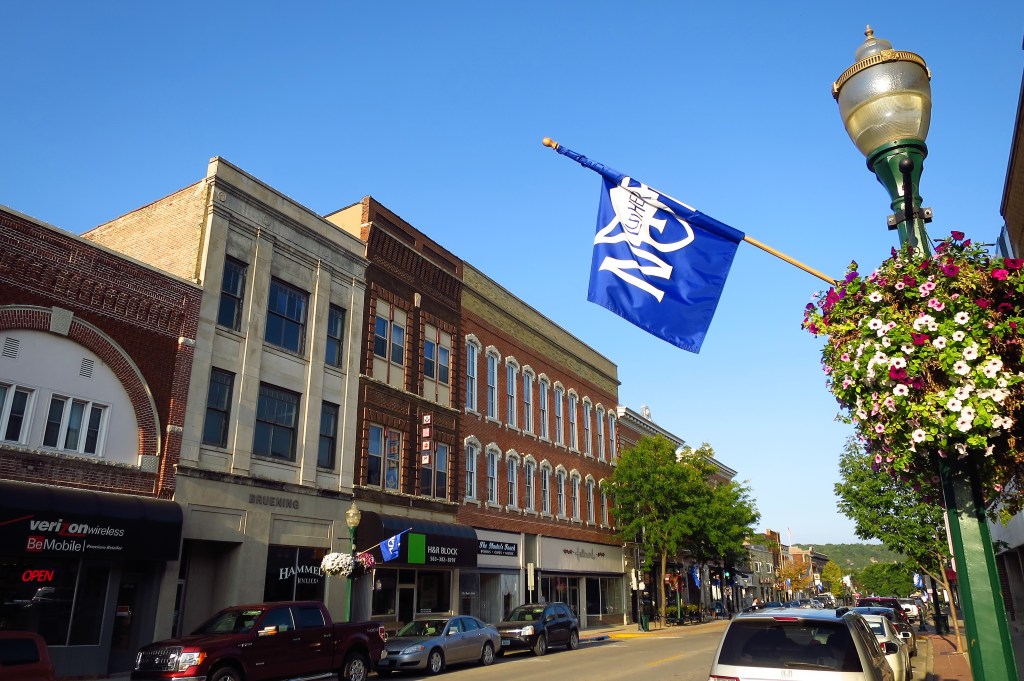
Water Street business district, Decorah, Iowa

August 31, 2019

I didn’t realize what treasures were in store for me when I arrived in Decorah, an otherwise un-notable black dot on the map of northeastern Iowa. Arriving at 4:15, I was just in time to find the Winneshiek County Courthouse and get inside before it closed at 4:30.

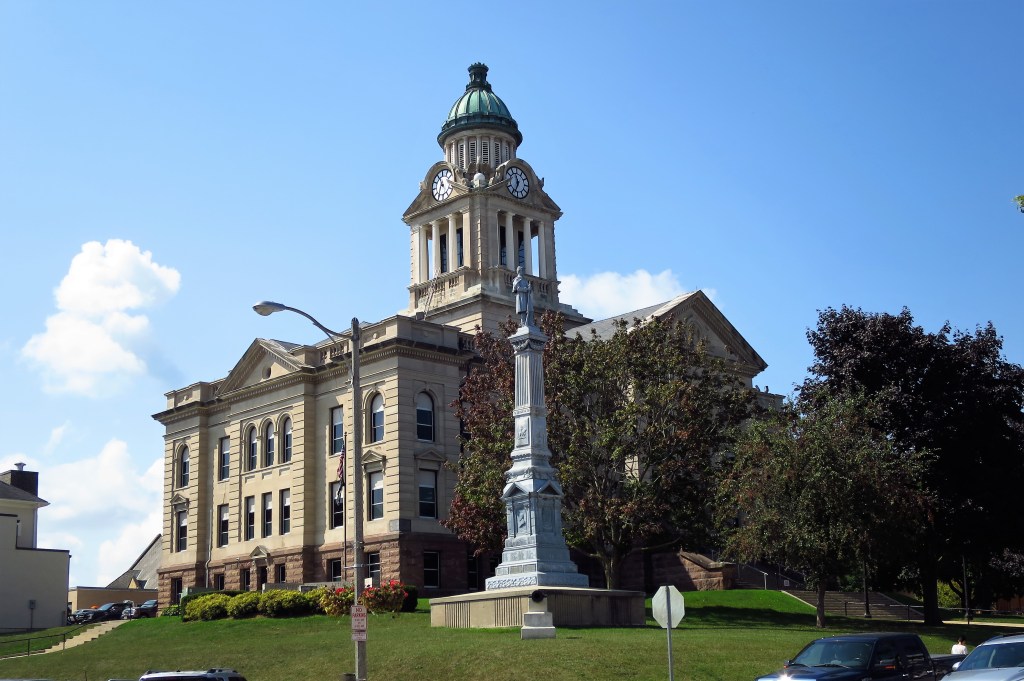
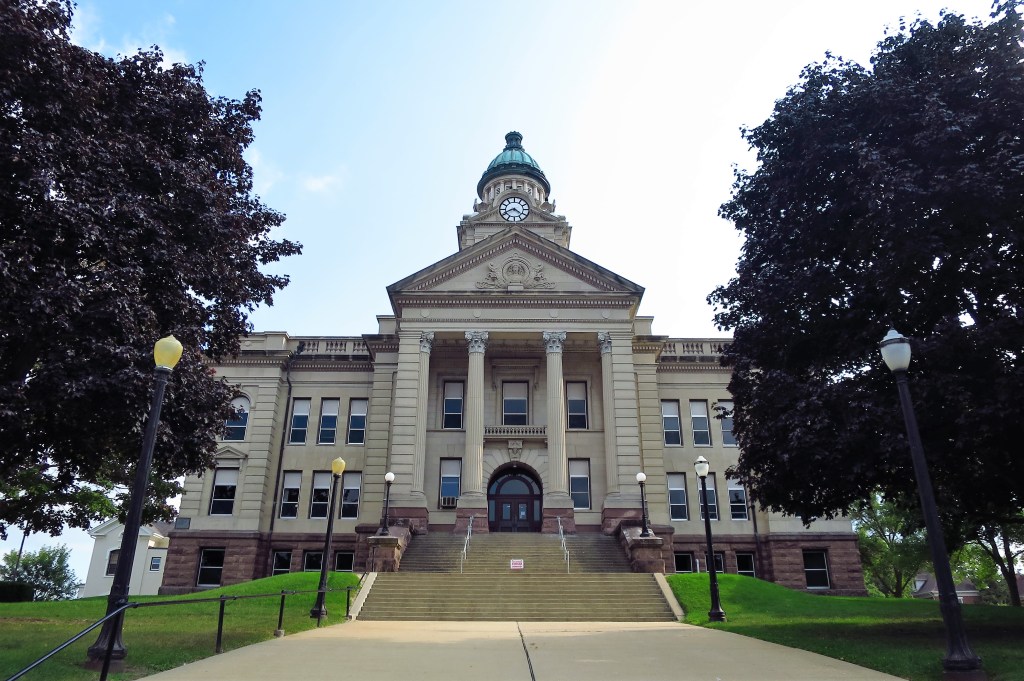
The courthouse was built in 1905, features three stories, a tall central cupola/clocktower, and a Union Civil War memorial dominating the front lawn. Brownstone blocks were used for the first floor while the second and third stories were built with Indiana Bedford limestone.

Winneshiek County Courthouse, Decorah, Iowa
Winneshiek County Courthouse, front entrance
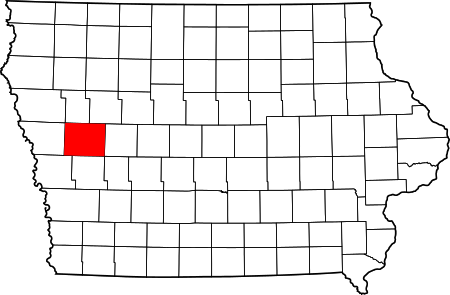
Winneshiek County in the state of Iowa

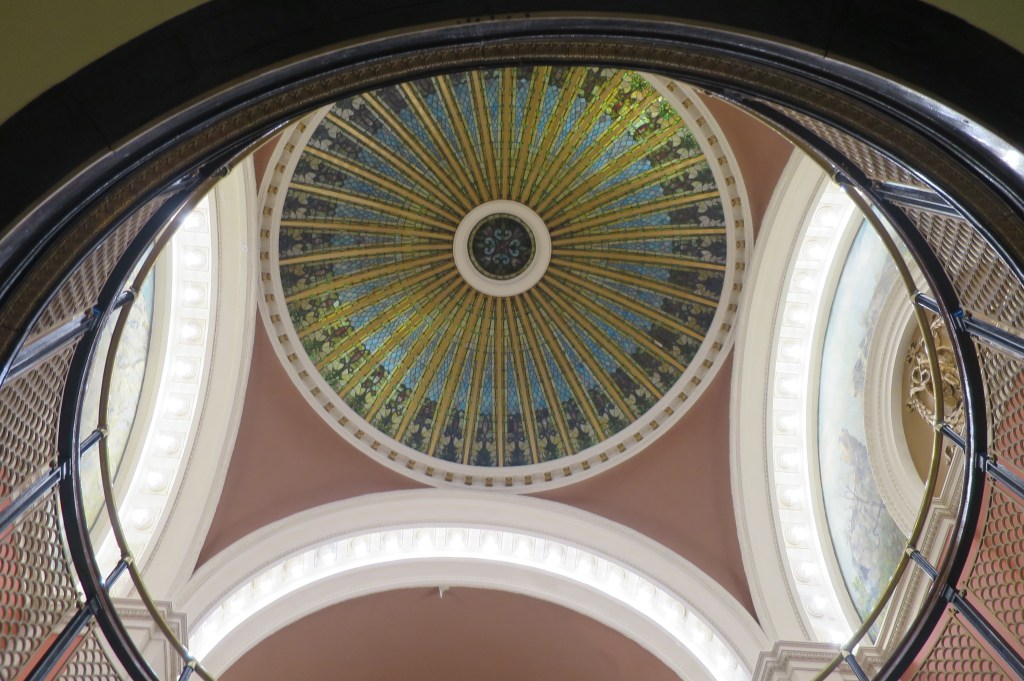
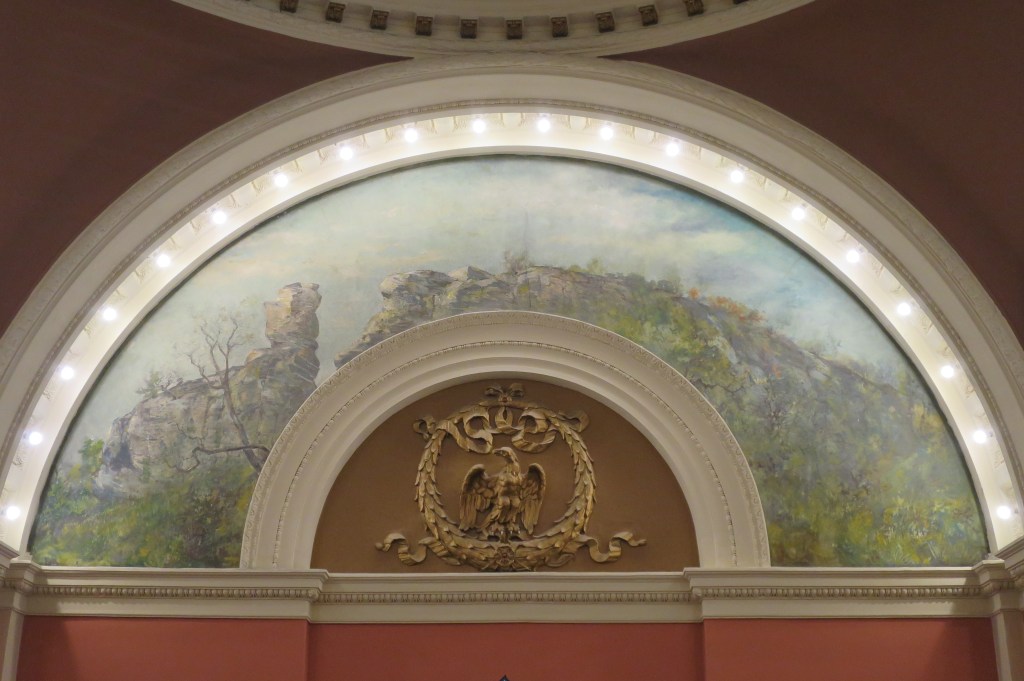
Once inside I quietly wandered around the ornate hallways of the old courthouse, hoping that I could avoid any security guards chasing away occupants before closing up. The interior walls of the courthouse are lined with brown granite. Glass designs adorned the underside of the courthouse cupola; gold leaf designs accented wall decorations.

Winneshiek County Courthouse, interior hallway
Winneshiek County Courthouse, underside of the cupola
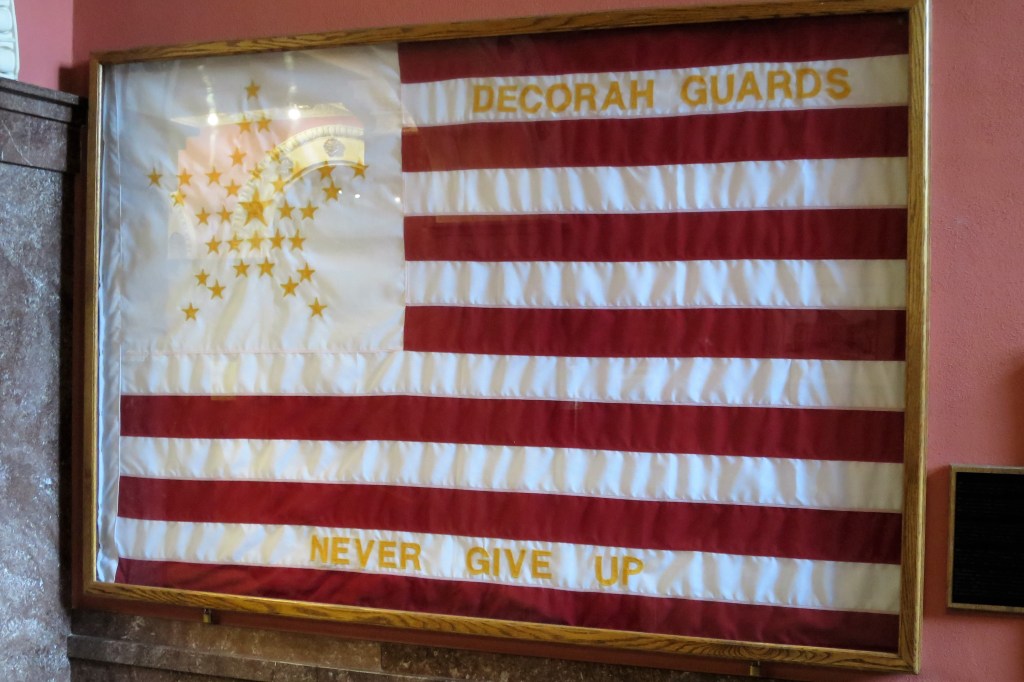
Perhaps referring to the local Civil War regiment?

Despite all the glitz and glamor I found on the upper floors, this photo of 1949 courthouse personnel quickly became my favorite. The difference in fashion between then and now is striking. The photo was taken 4 years after the end of World War II. One can only imagine the thoughts behind the smiling faces: relief, sadness at loss, and a return to normalcy and the good life.

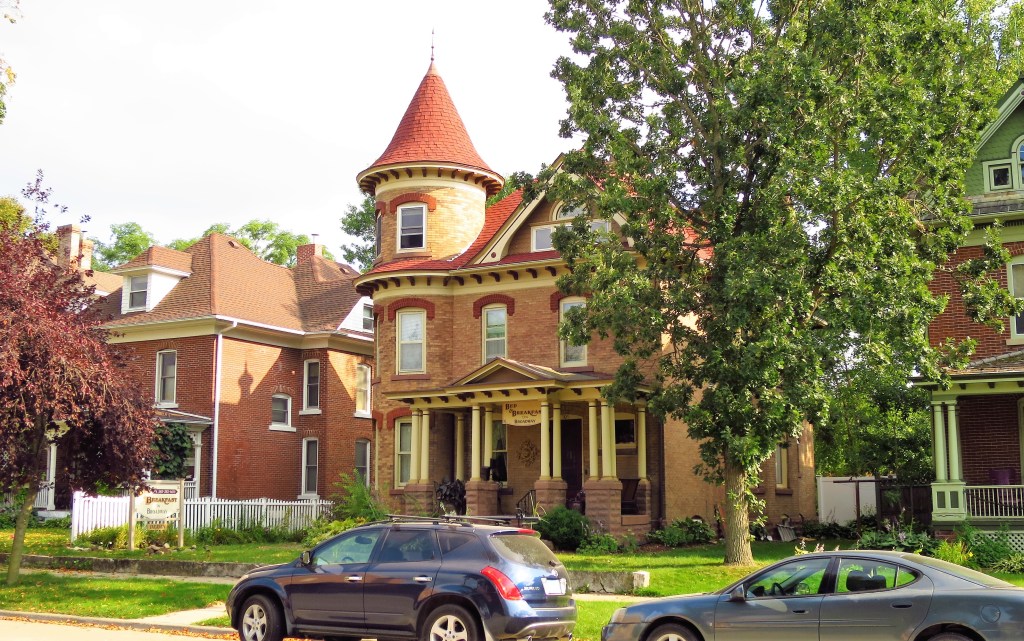
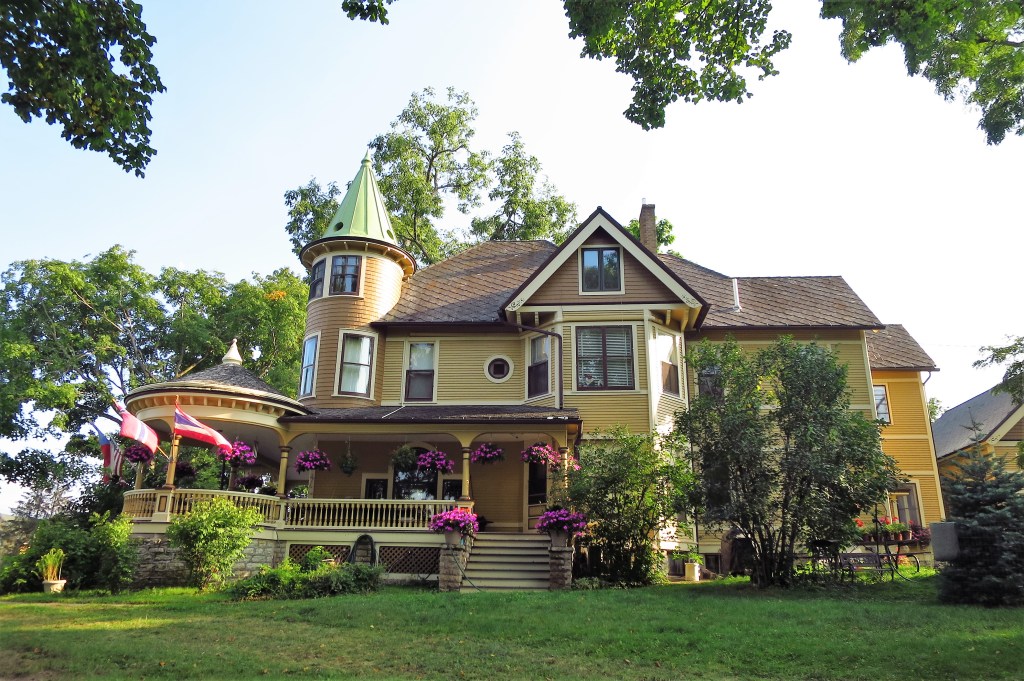
I was out of the building by 4:45, but it being the month of August I still had plenty of daylight to walk around town. West Broadway runs just behind the courthouse and is lined with magnificent houses considered part of the Decorah Historic District. I spent 30 to 40 minutes walking up and down the street photographing classic old mansions and posting the photos on Facebook. Several dozen of my Facebook friends enjoyed the tour along with me, giving the gallery likes and good comments. Some of these houses have been converted to bed and breakfasts (look them up if you like! link is here), while others are private homes.

“Bed and Breakfast on Broadway”
Home on West Broadway, Decorah, Iowa

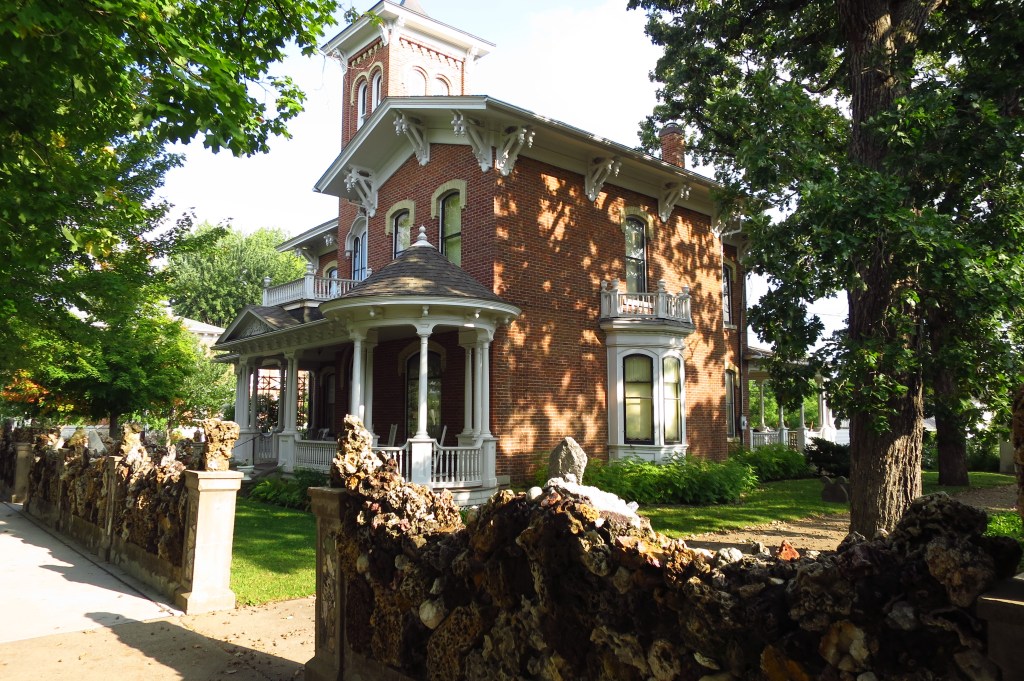
The most famous mansion was an Italianate villa called the Porter House Museum. The owner was not a railroad magnate (rather a dry goods merchant) but such was the prosperity among northern states after the Civil War that riches came to many.

Porter House Museum

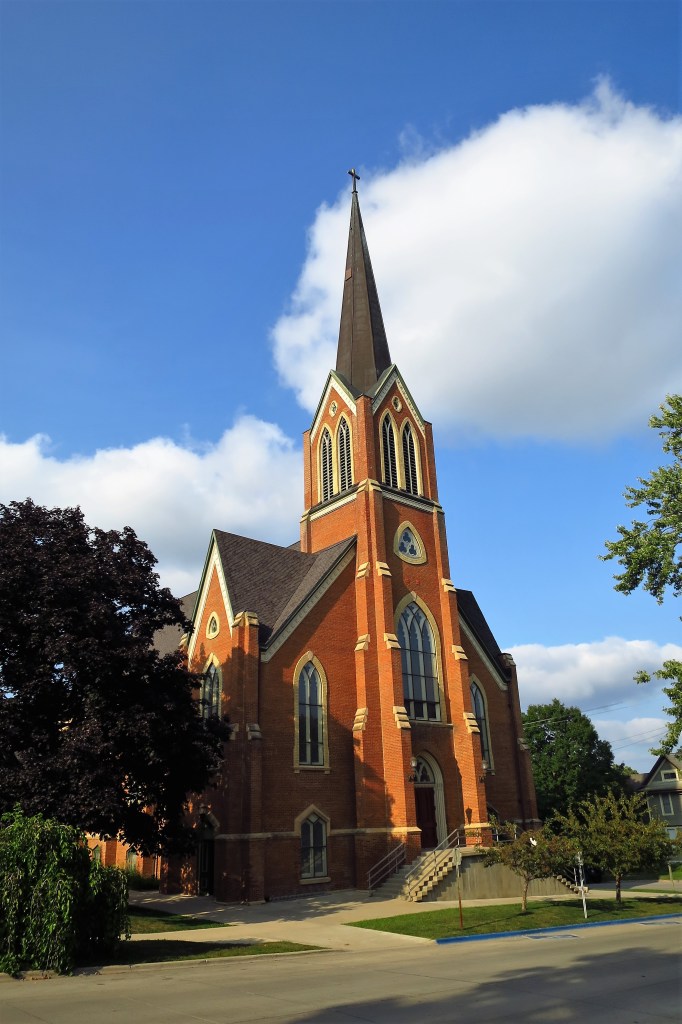
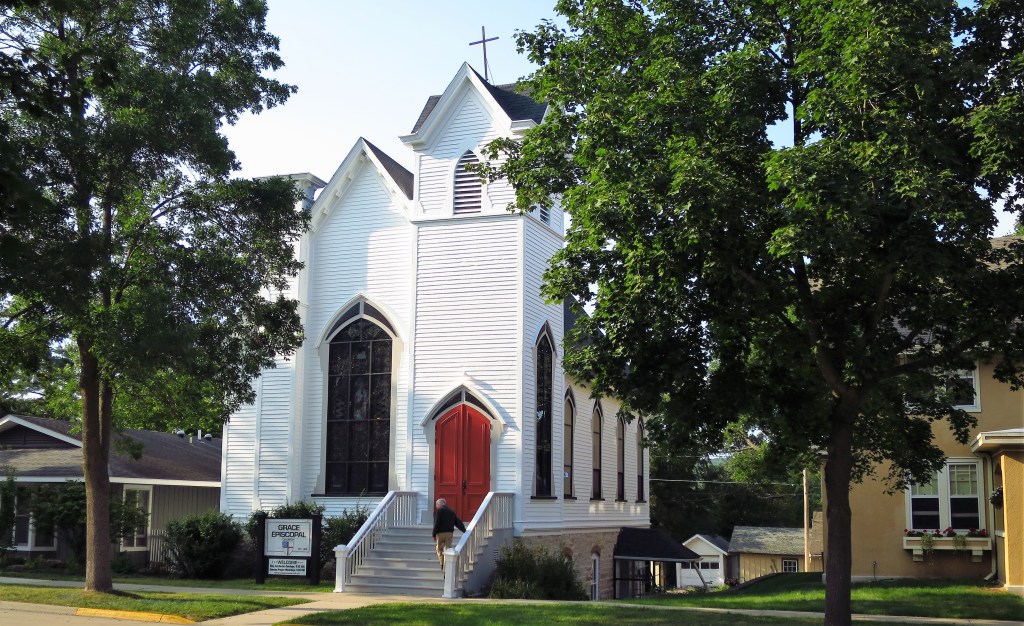
No fine American block would be complete without stately churches. The first church below is Lutheran, the next is Episcopalian.

First Lutheran Church
Grace Episcopal Church, Decorah, Iowa

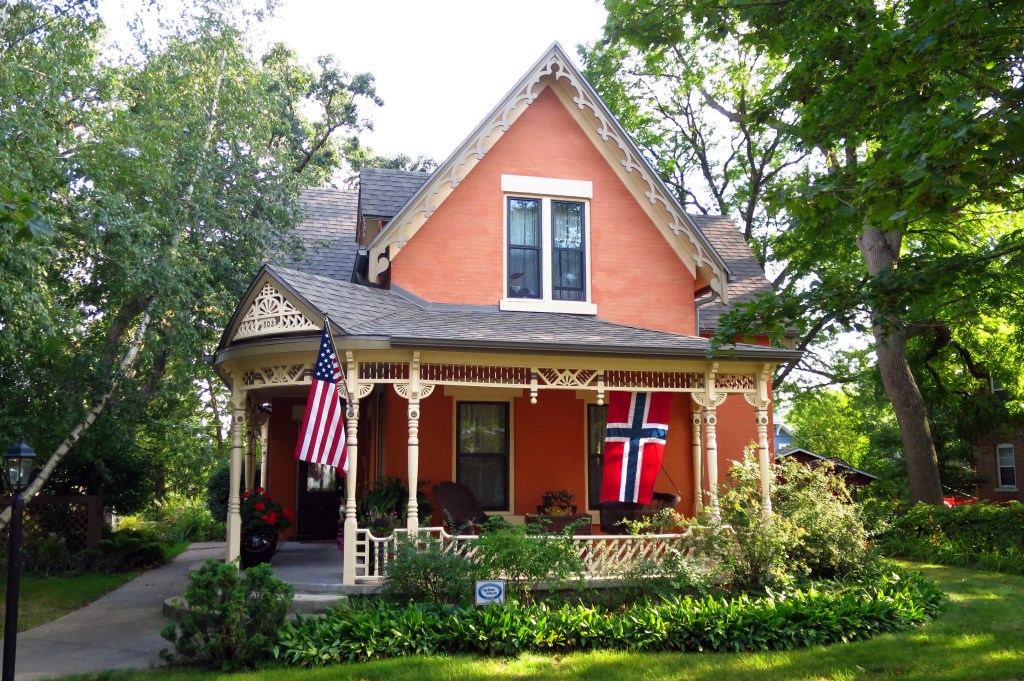
Many of these houses displayed Norwegian flags. Norwegian immigrants came to Decorah starting in the 1850s, prospering smartly.

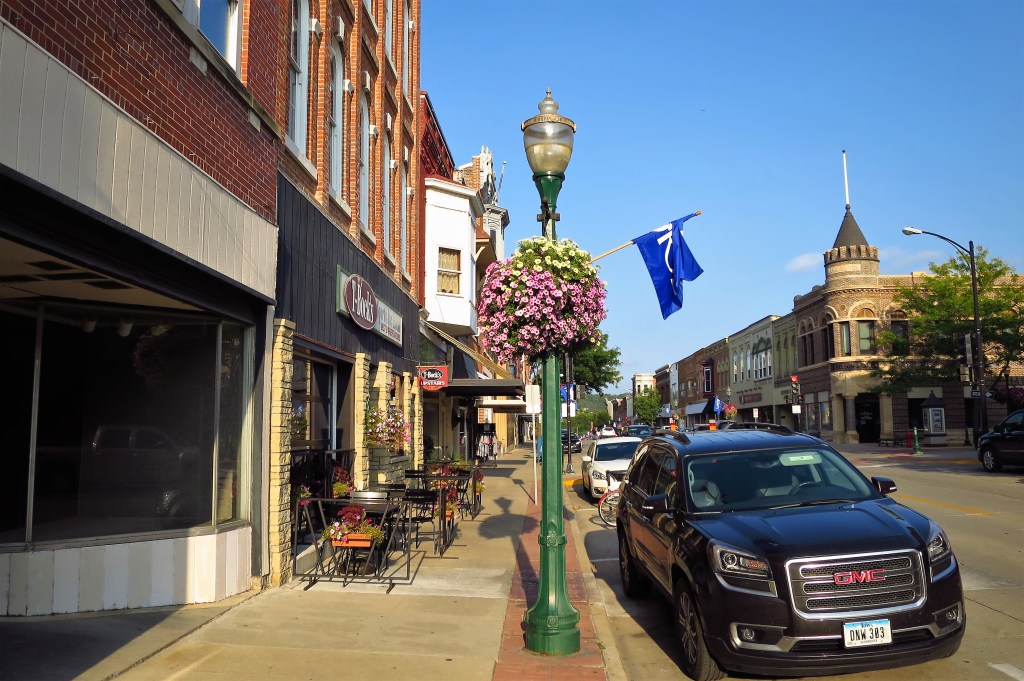
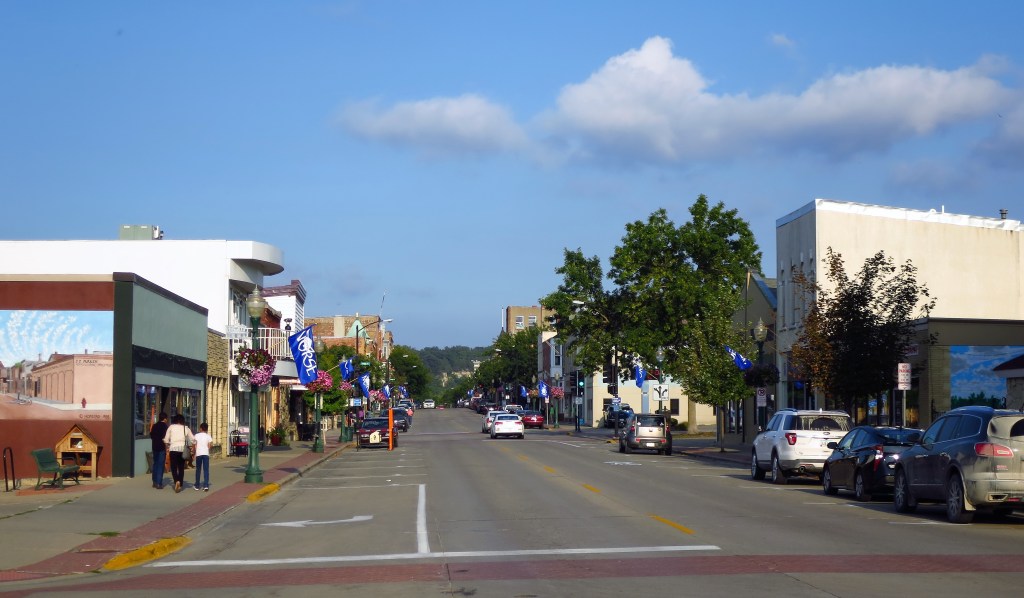
A few blocks below Broadway, Water Street is the business district in Decorah. The street is full of 19th-century architecture and reminders of the town’s Norwegian heritage. The royal blue flags lining the street say “Norse” and are probably a reference to Decorah’s Nordic Fest, held annually the last weekend of July, often drawing crowds of 50,000 or more.

Water Street business district

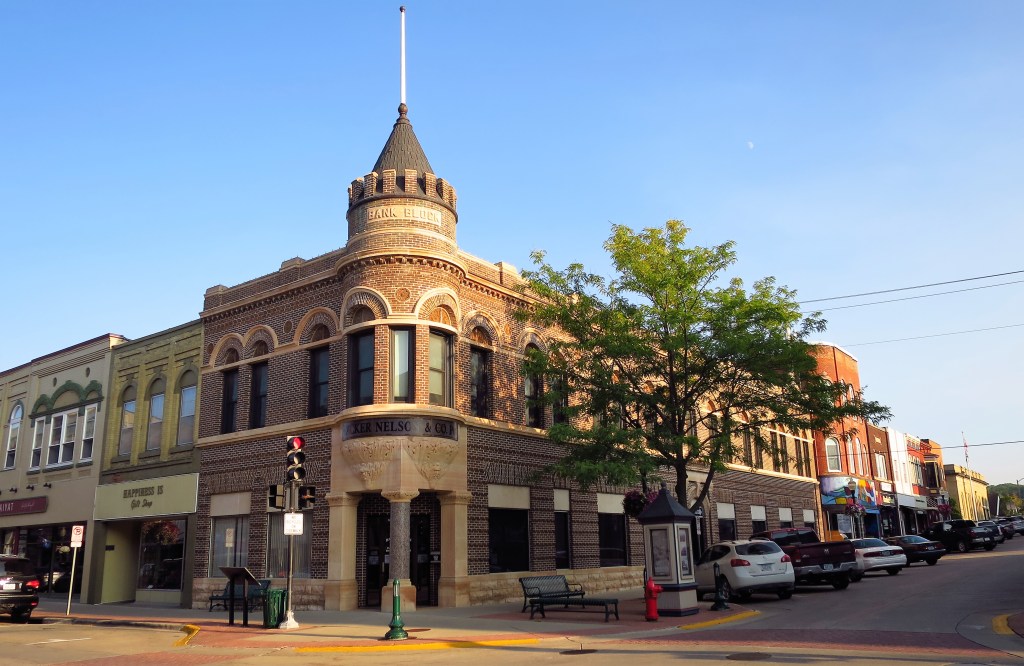
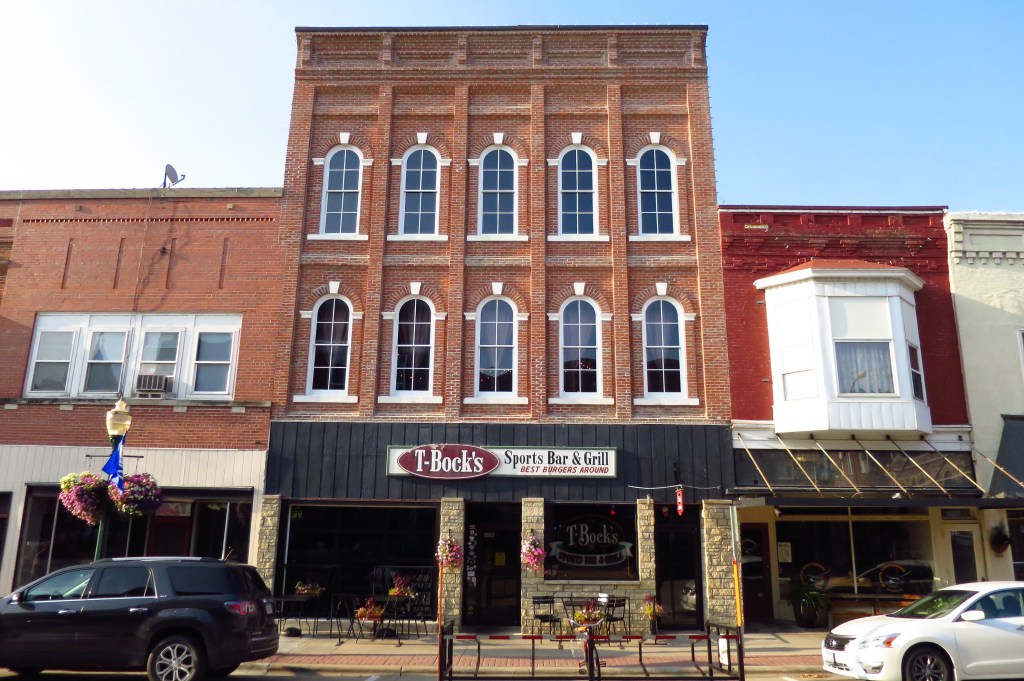
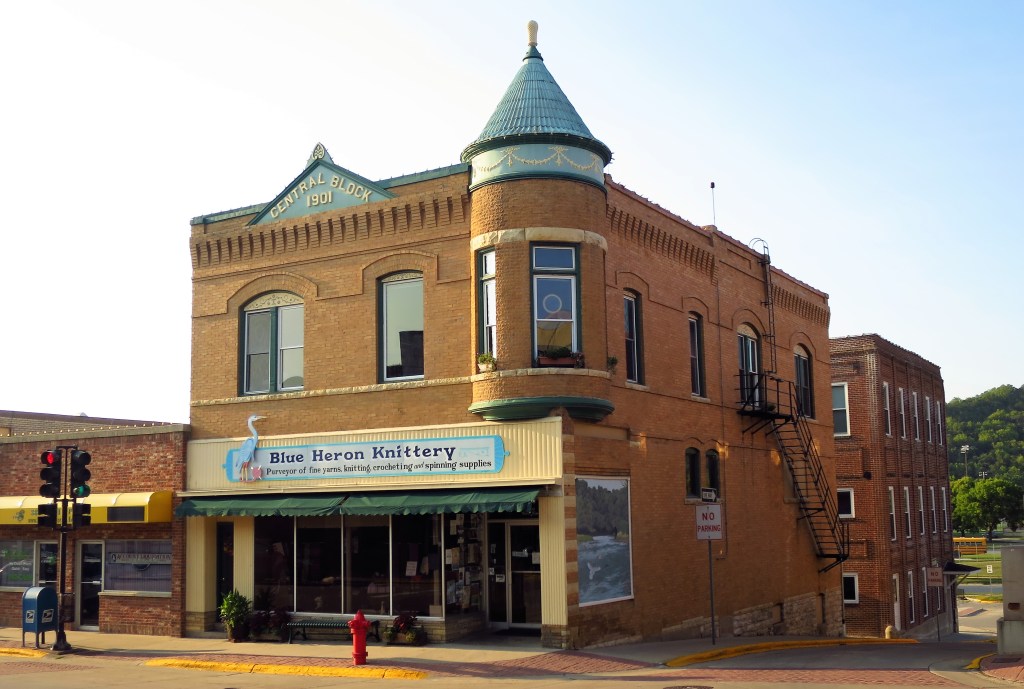
Here are some more photos up and down Water Street. Some of the buildings and detail are just magnificent:

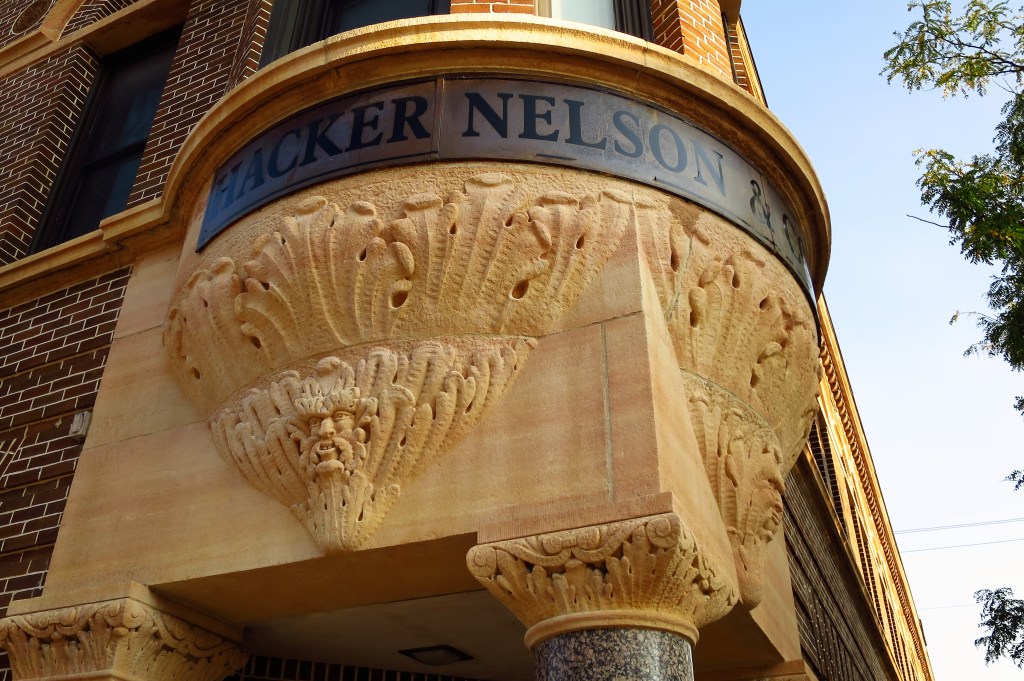
Detail on corner of building shown above
Water Street view with cliffs in the distance.
Water Street with Hotel Winneshiek (on the left)

The classic Hotel Winneshiek offers a fine dining restaurant on the ground floor and rooms for about $100 (when I last checked). I didn’t stay there because I already had reservations elsewhere, but it looks like a great place so I’m including a link to the Hotel Winneshiek & Opera House.

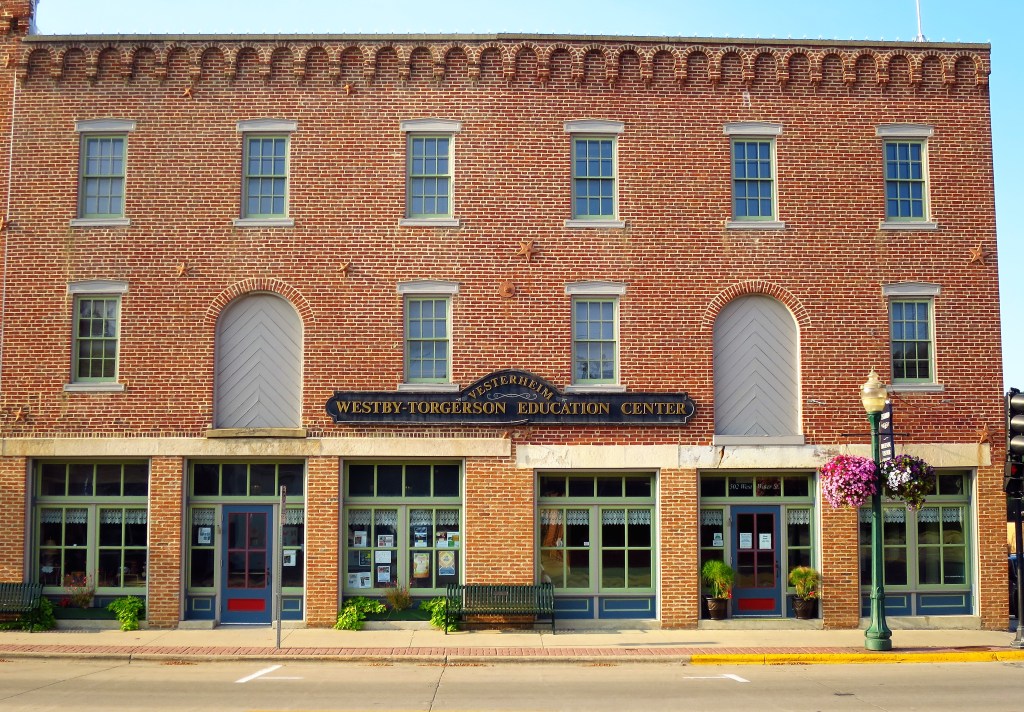
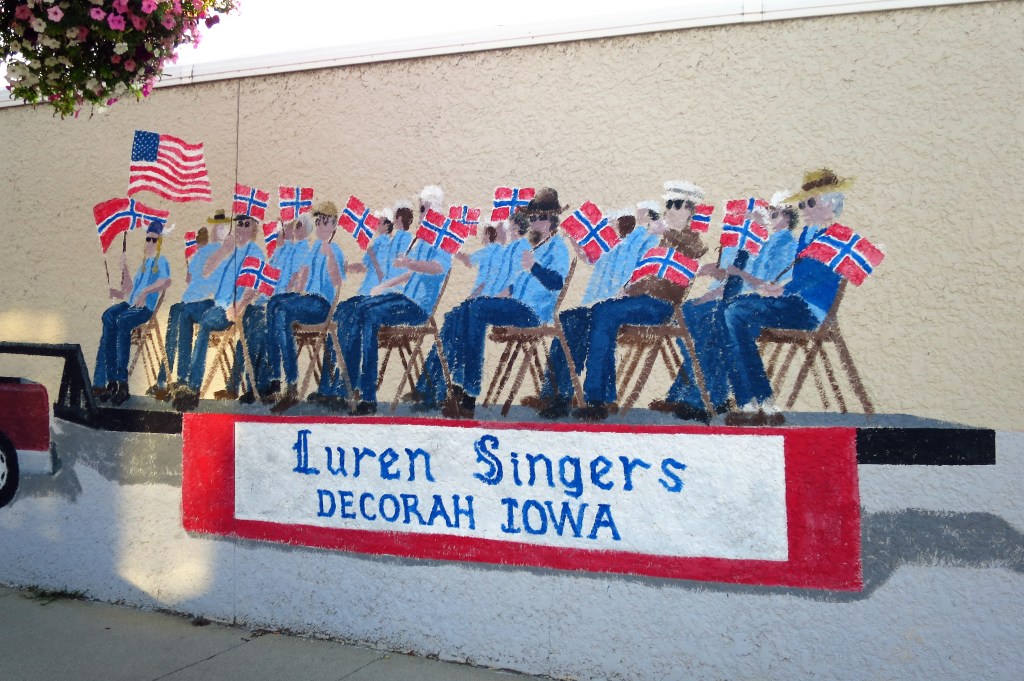
Several reminders of Decorah’s Norwegian roots appear around town:

Westerheim Norwegian-American Museum
Decorah wall mural featuring Norwegian singers
Home on West Broadway with both Norwegian and American flags
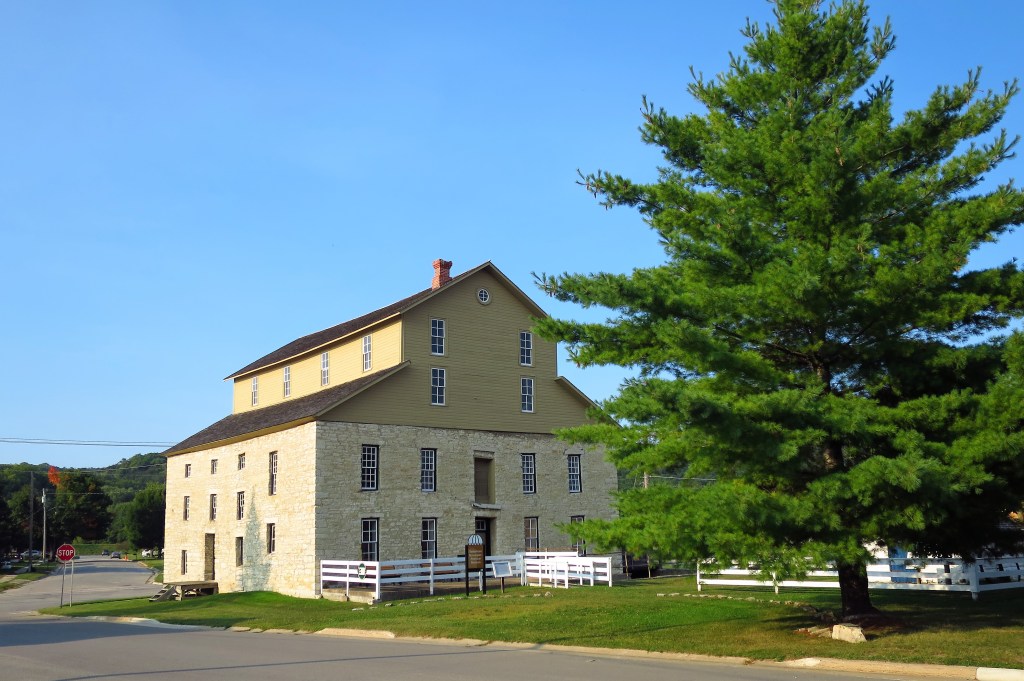
Old Painter-Bernatz Mill, listed on the National Register of Historic Places

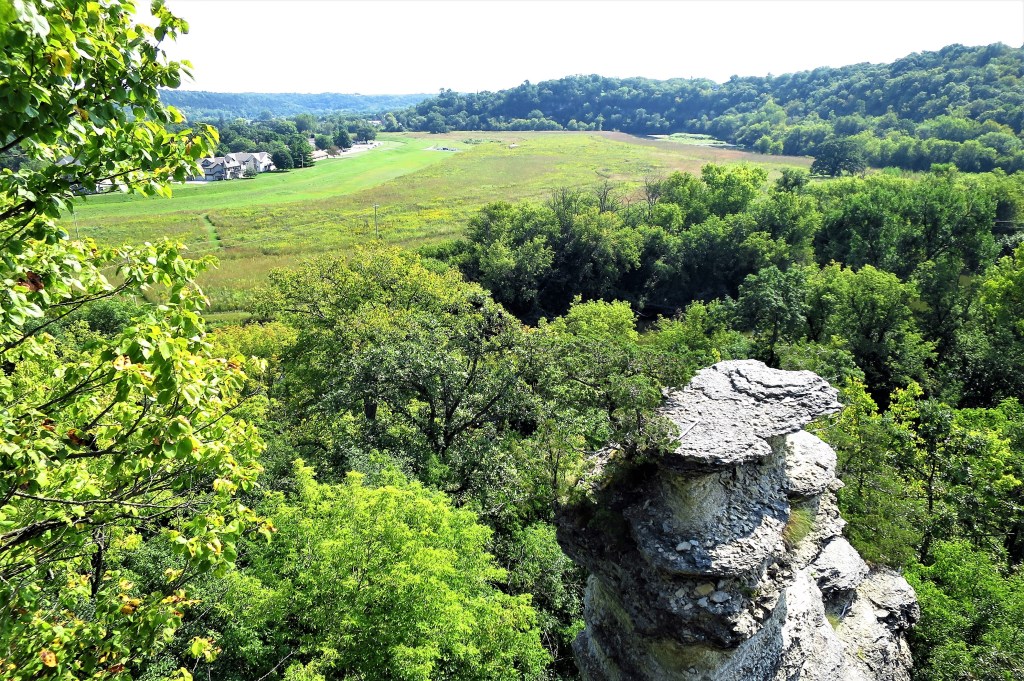
Decorah lies in the valley of the Upper Iowa River in the “driftless” region of northeastern Iowa, meaning that the landscape was never leveled by glaciers during the Ice Ages. As a result, the area landscape features old limestone cliffs and ravines forming natural caves and viewpoints. One of these is known as Pulpit Rock, which I visited the next morning and climbed for the view:

Pulpit Rock, Decorah, Iowa
View from Pulpit Rock

I really couldn’t get enough of this town. I overheard others walking by me saying it was the “cutest town they’d ever seen.” It’s my new favorite Iowa town and deserves a place on your bucket list.

A link to the town’s Wikipedia page is here. Visitor’s info is here.

All photos taken by the author between August 29-30, 2017.


A list of all photo posts from the American County Seats series in TimManBlog can be found here.

I’m trying to travel to all of America’s county courthouses, and each month a post about my visit to the most interesting county seats. It’s only a hobby — but donations are greatly appreciated to help defer my costs.
Thanks,
Tim

One-Time
Monthly
Yearly

Make a one-time donation

Make a monthly donation

Make a yearly donation

Choose an amount

¤5.00
¤15.00
¤100.00
¤5.00
¤15.00
¤100.00
¤5.00
¤15.00
¤100.00

Or enter a custom amount

¤

Your contribution is appreciated.

Your contribution is appreciated.

Your contribution is appreciated.

DonateDonate monthlyDonate yearly
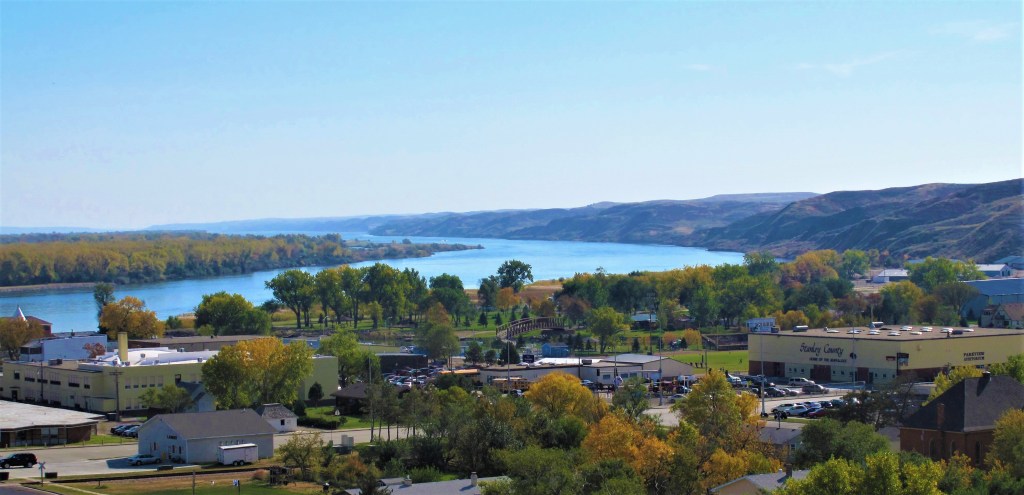
Dixon, Illinois: Three Presidents

July 26, 2019

America has thousands of small towns, the vast majority of which are seemingly unknown to the general public. A few, however, are made famous by their association with some famous person such as a President.  Plains, Georgia and Kennebunkport, Maine are two examples that come to mind.

Dixon, Illinois can claim three such Presidential associations.  So Dixon should be three times famous, right?

The first Presidential association is with Abraham Lincoln.  In 1832, the 23-year-old future president arrived at a key ferrying point on the Rock River in northern Illinois as a volunteer for the Blackhawk War.  The ferrying point was Dixon. As sculpted below, he wears combat boots and carries a sword. Lincoln is elected Captain of volunteers by his peers.

Statue of Abraham Lincoln in Presidents Park. Dixon, Illinois

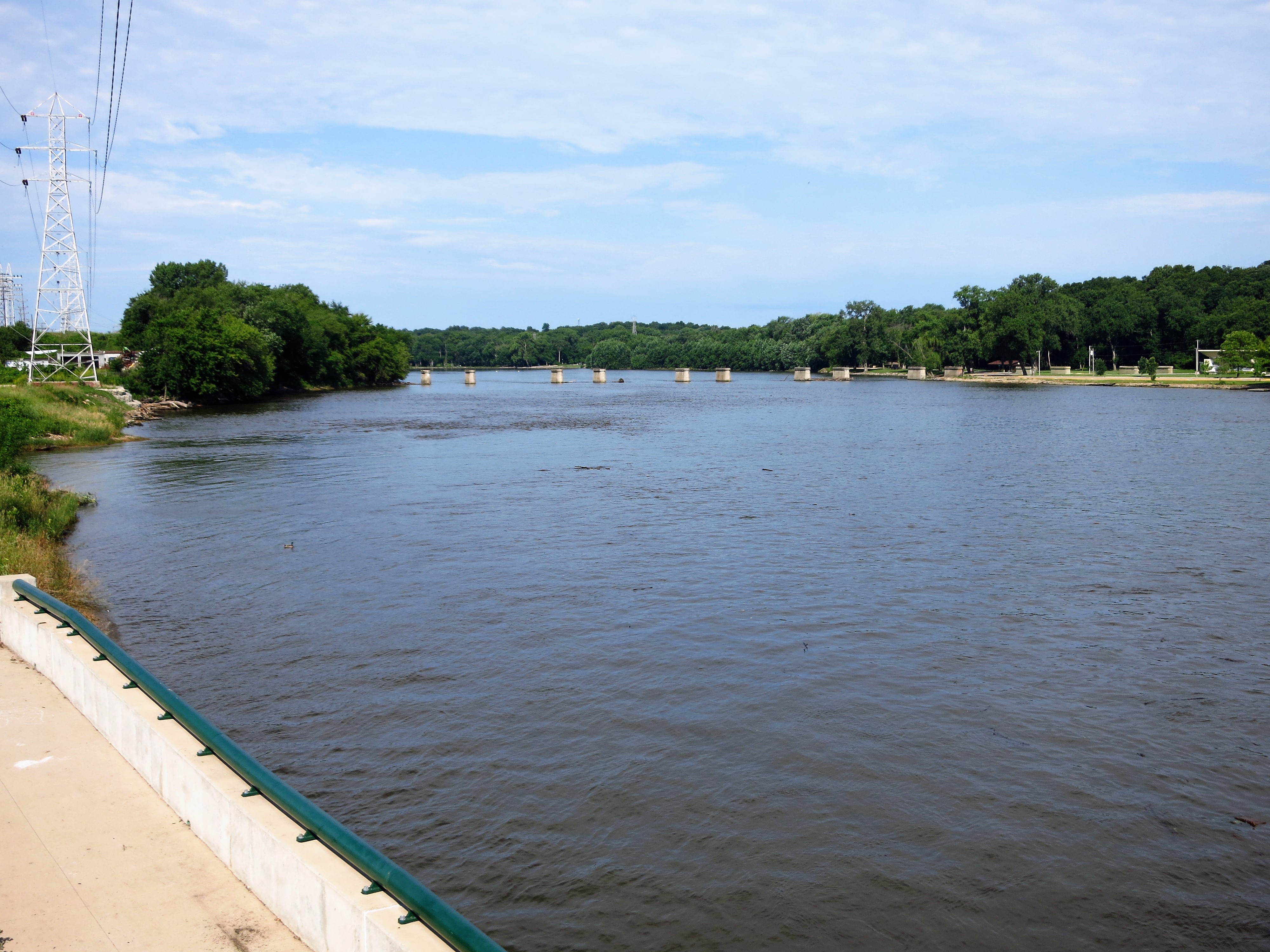
Today the river is dammed at the old ferrying point. Lincoln and his fellow volunteers camped on the far bank.

The Rock River at Dixon, Illinois

Knowledge of history gives us a gift, allowing us to put ourselves in someone else’s shoes at a pivotal place and time. At Dixon, the 23-year old Lincoln was a penniless laborer with no fame or family to recommend him. Yet his peers elected him Captain. This small event surely built the young man’s confidence. Is Dixon the place where a ragged frontier boy became a man?

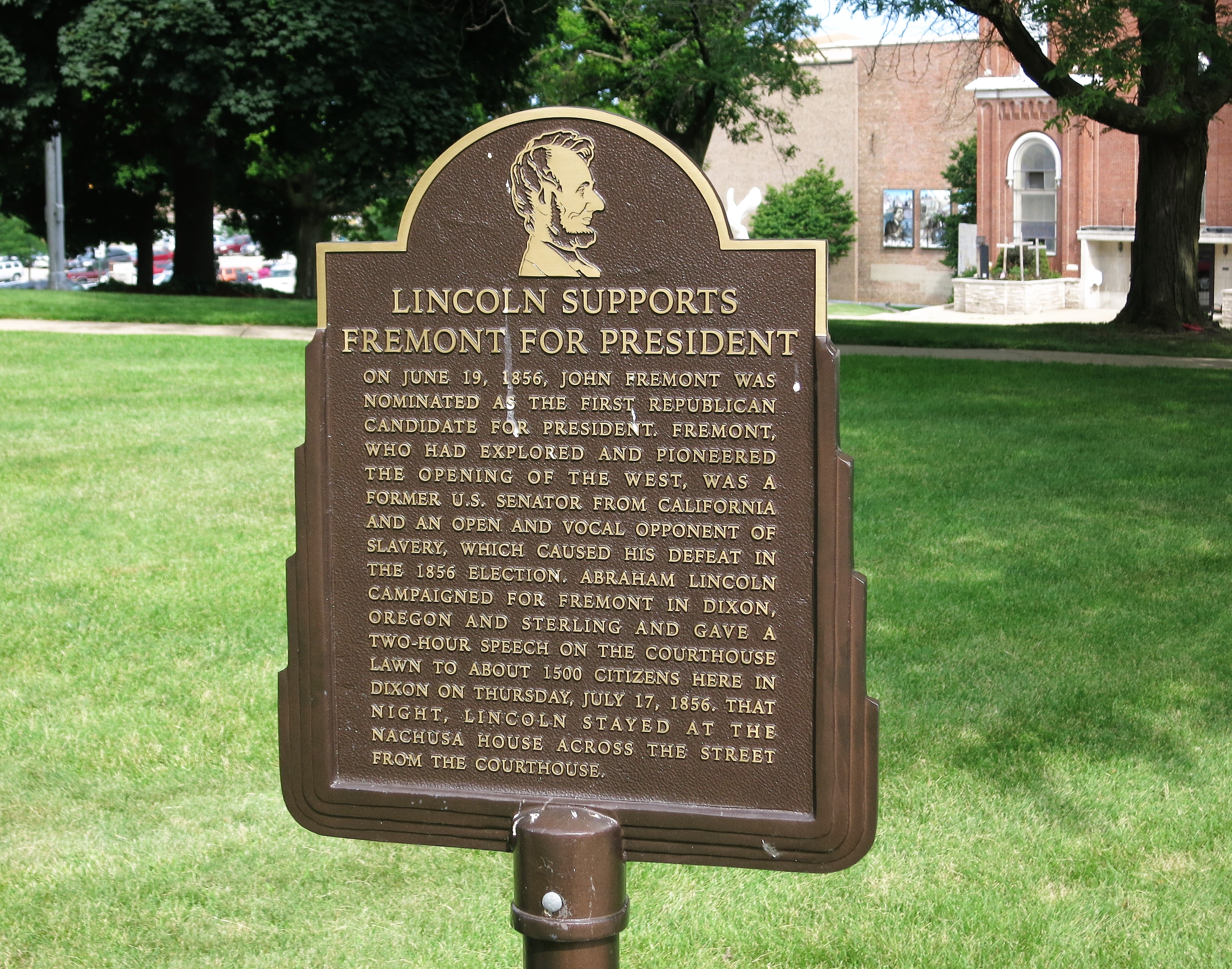
Abraham Lincoln appears again in Dixon in 1856, 24 years after his stint in the Blackhawk War. Now a prominent lawyer and former Congressman, Lincoln makes a proxy speech in favor of the first Republican Presidential candidate, the explorer John C. Fremont.

Historical sign commemorating Lincoln’s campaign speech of 1856 in Dixon, Illinois

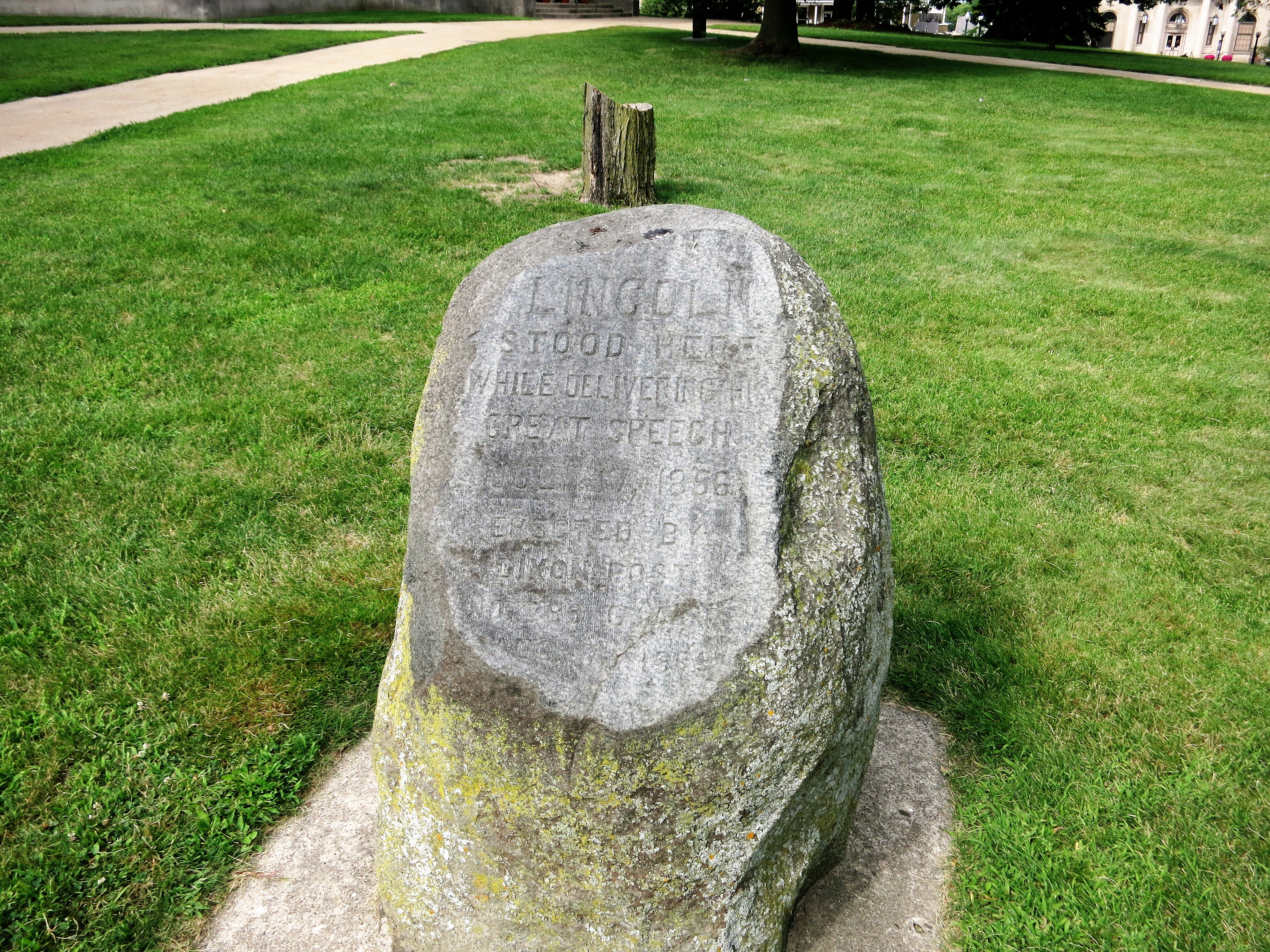
The speech was made on the old county courthouse lawn and is well-marked today.

Memorial to Abraham Lincoln in Dixon, Illinois

Of course, Fremont didn’t become President in 1856. Four years later in 1860 Lincoln ran for the Presidency but didn’t give a campaign speech in Dixon — in that era Presidential candidates did not actively campaign as they do today, preferring to leave speech-making to their supporters and proxies.

Dixon’s next presidential association (the second of three) comes in 1919. Automobiles are gaining popularity and auto roads are rapidly being built across the country.

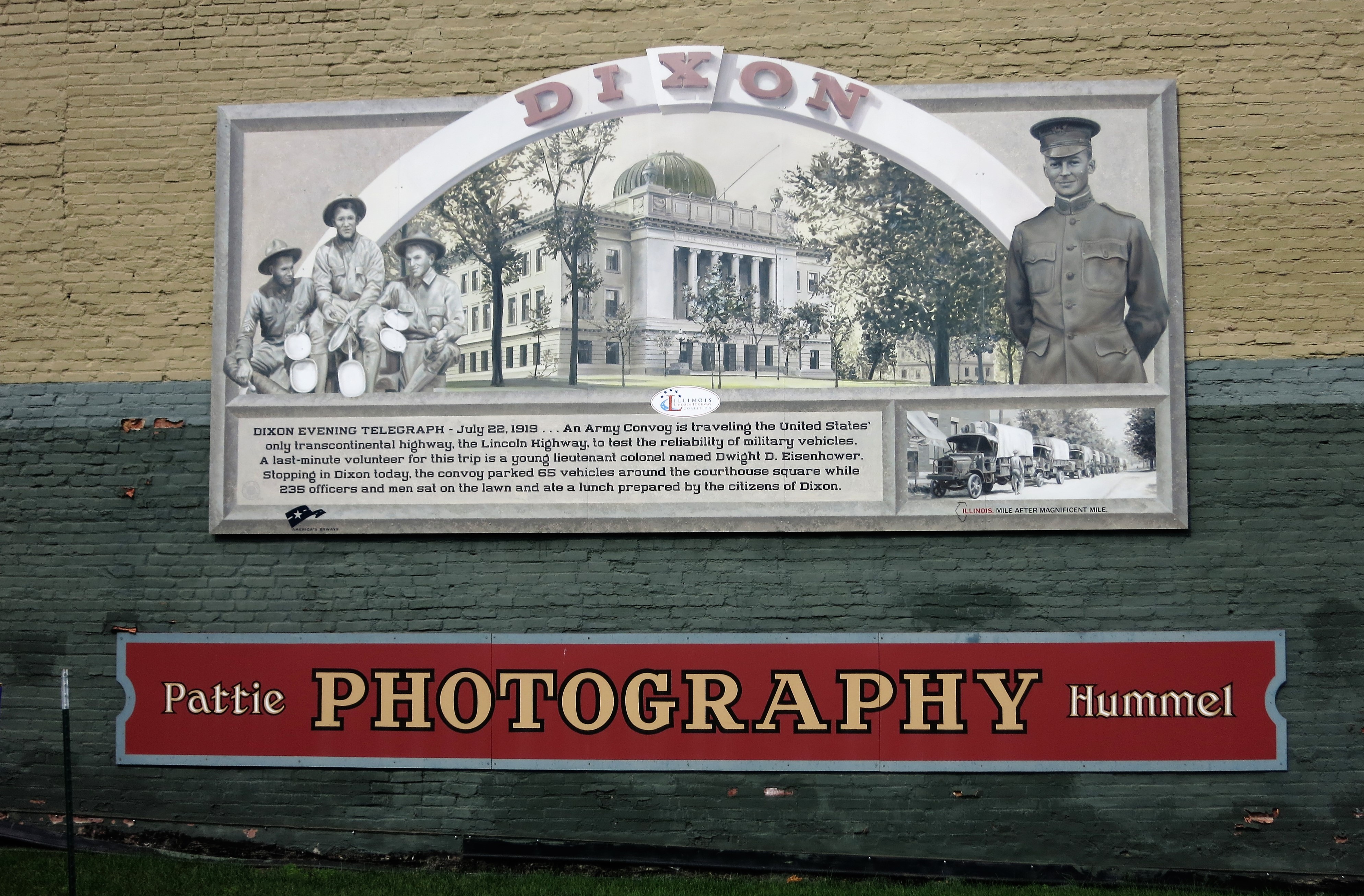
From the text of the mural below:

“July 22, 1919…an Army convoy is traveling the United States’ only transcontinental highway, the Lincoln Highway, to test the reliability of military vehicles. A last-minute volunteer for the trip is a young lieutenant colonel Dwight D. Eisenhower. Stopping in Dixon today, the convoy parked 65 vehicles around the courthouse square while 235 officers and men sat on the lawn and ate a lunch prepared by the citizens of Dixon.”

Street mural explaining the 1919 transcontinental army convoy along the Lincoln Highway
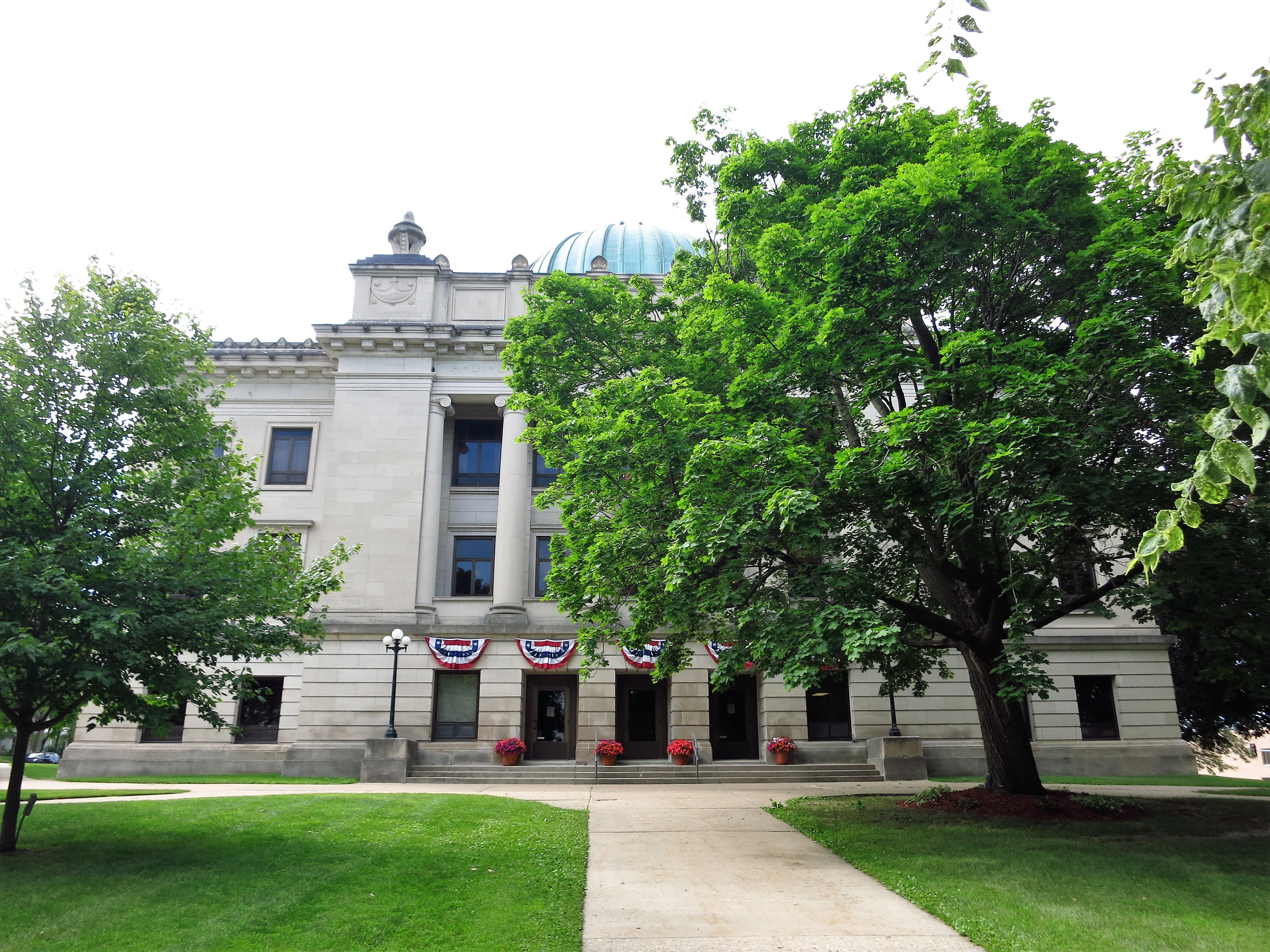
(Former) Lee County Courthouse and lawn. Site of famous speeches and lunches

The army convoy soldiered through muddy or missing roadways and flimsy new bridges. The effort became something of a nightmare for the young Eisenhower. His experience in 1919 stayed with him, however, such that “Ike” proposed the Interstate Highway System after becoming President in 1953. A historical sign provides further details:

Lincoln Highway Army convoy of 1919

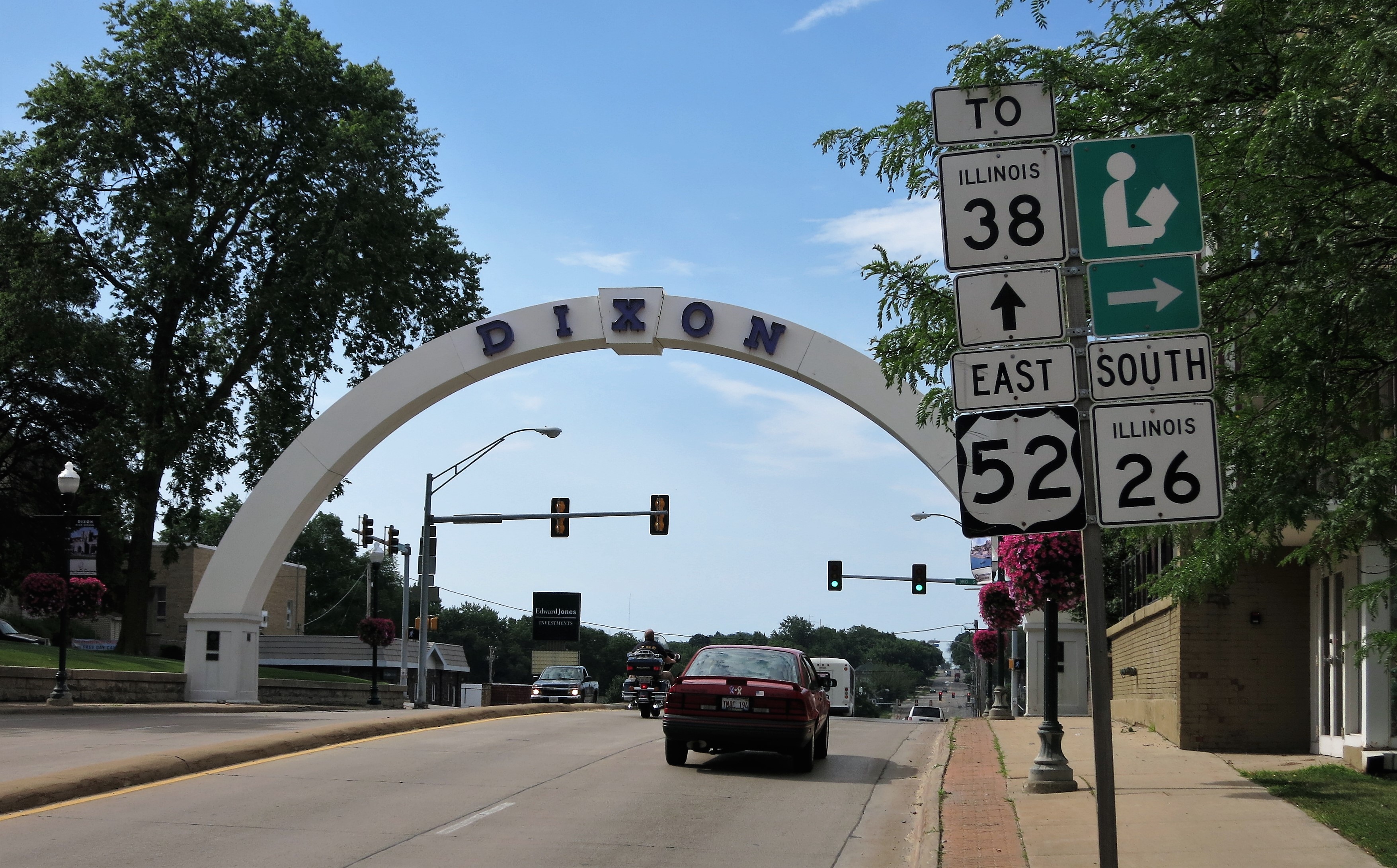
Eisenhower’s convoy passed under an archway built to celebrate triumphant troops returning home from World War I. The arch was meant to be temporary, but it was so well-received by the townspeople that it remains on Dixon’s main street (Galena Street — the old Lincoln Highway) to this day.

Dixon Arch

The third of Dixon’s presidential associations is its most famous. In 1911 future president Ronald Reagan was born in Tampico, Illinois. In 1919 (the same year as Eisenhower’s army convoy) the Reagan family moved to Dixon. His boyhood home is a state historic site:

Ronald Reagan boyhood home. Dixon, Illinois
A typical street in downtown Dixon, a few blocks from the Reagan boyhood home

Reagan worked as a lifeguard on the town beach in his boyhood. Reagan was credited with saving several lives.

Rock River

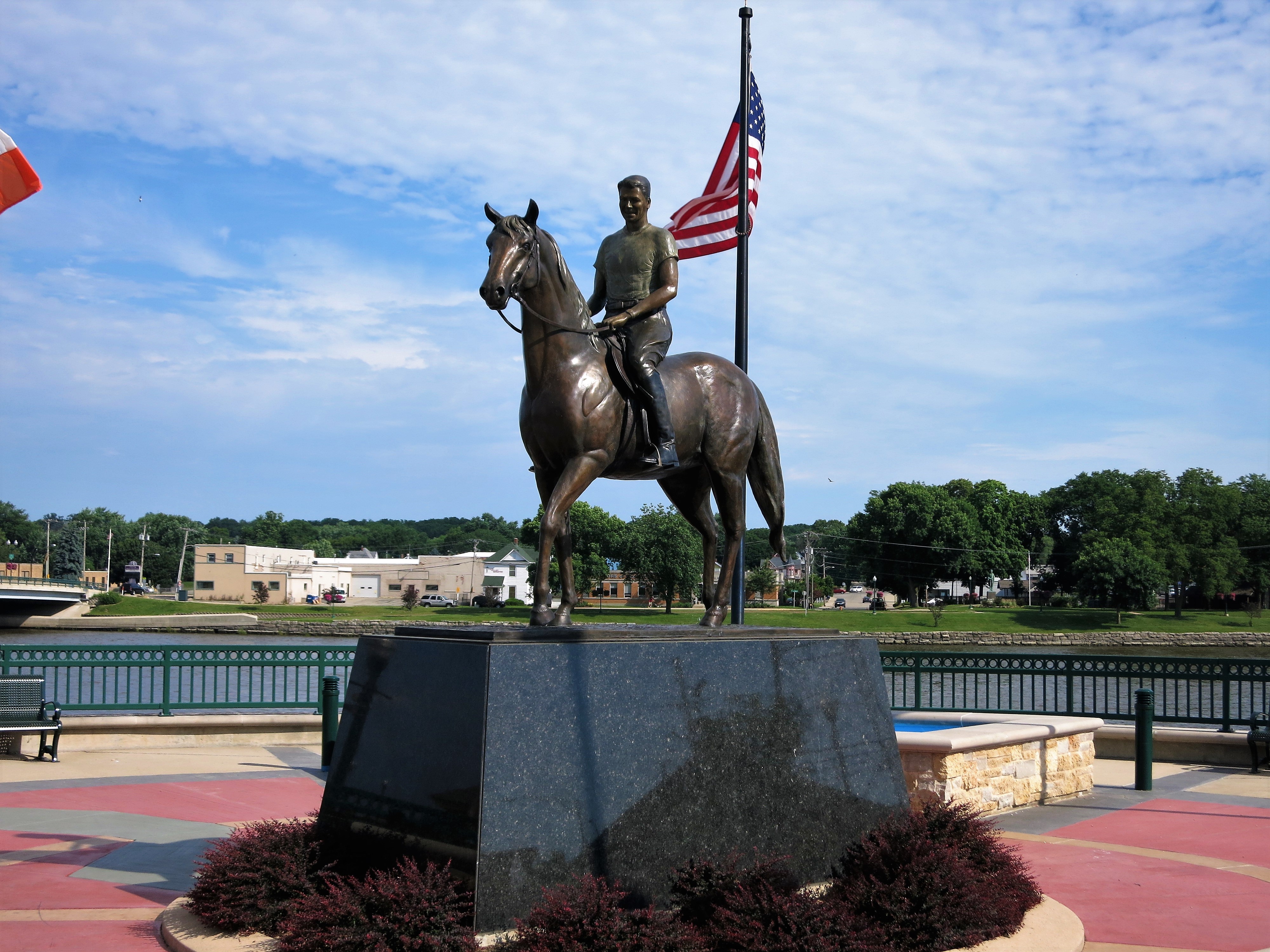
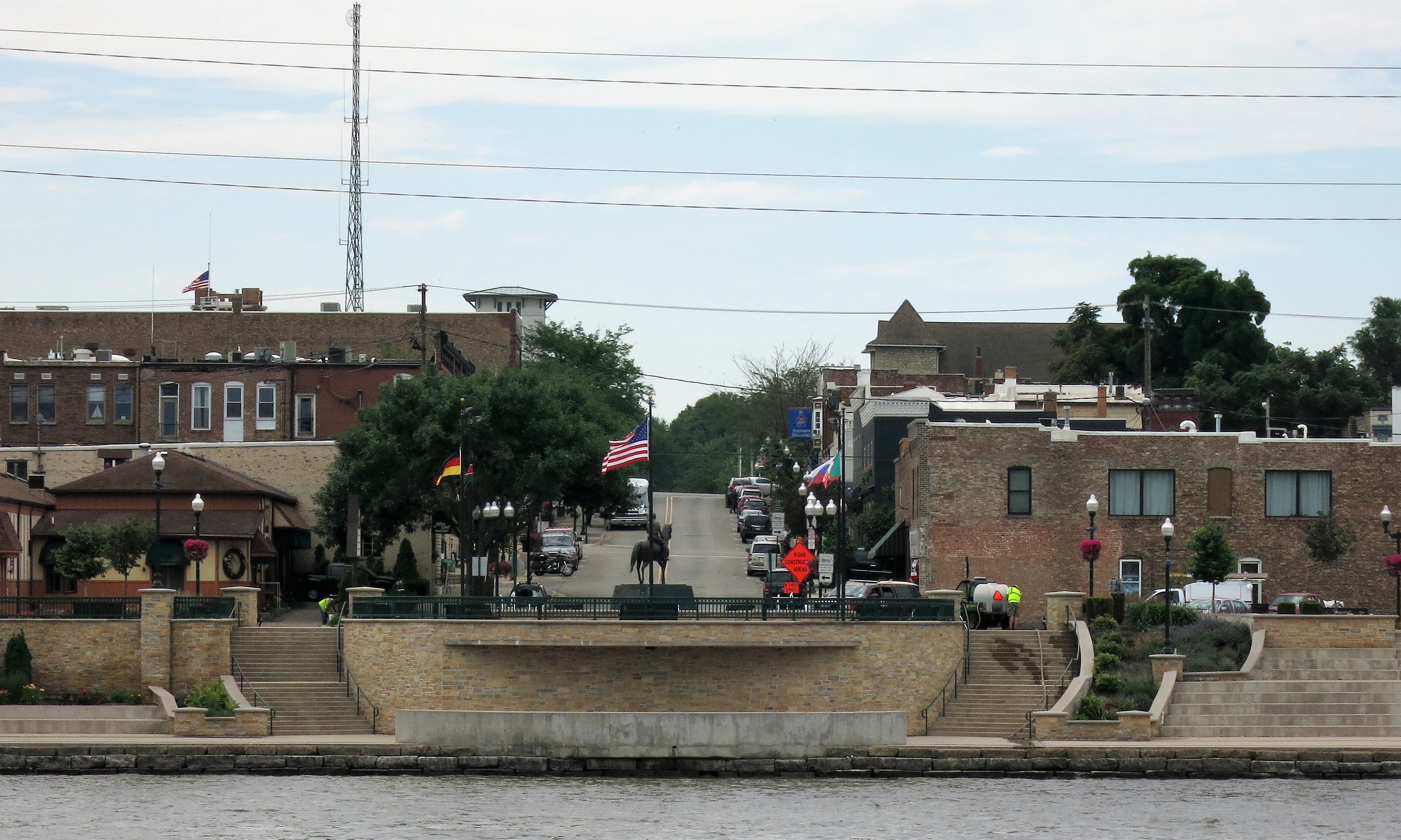
A statue of the 40th President stands at Heritage Crossing in Riverfront Park in downtown Dixon. While I was taking this photo a local man came up to me and provided a few interesting facts:  On the statue, the boots, saddle, and reins Reagan is wearing are real.  They were his during his life. The statue was made from a photo of Reagan riding a horse during a parade in Dixon in 1950 when he was still known as a movie star and not a political figure.

Statue of President Ronald Reagan. Riverfront Park in Dixon, Illinois

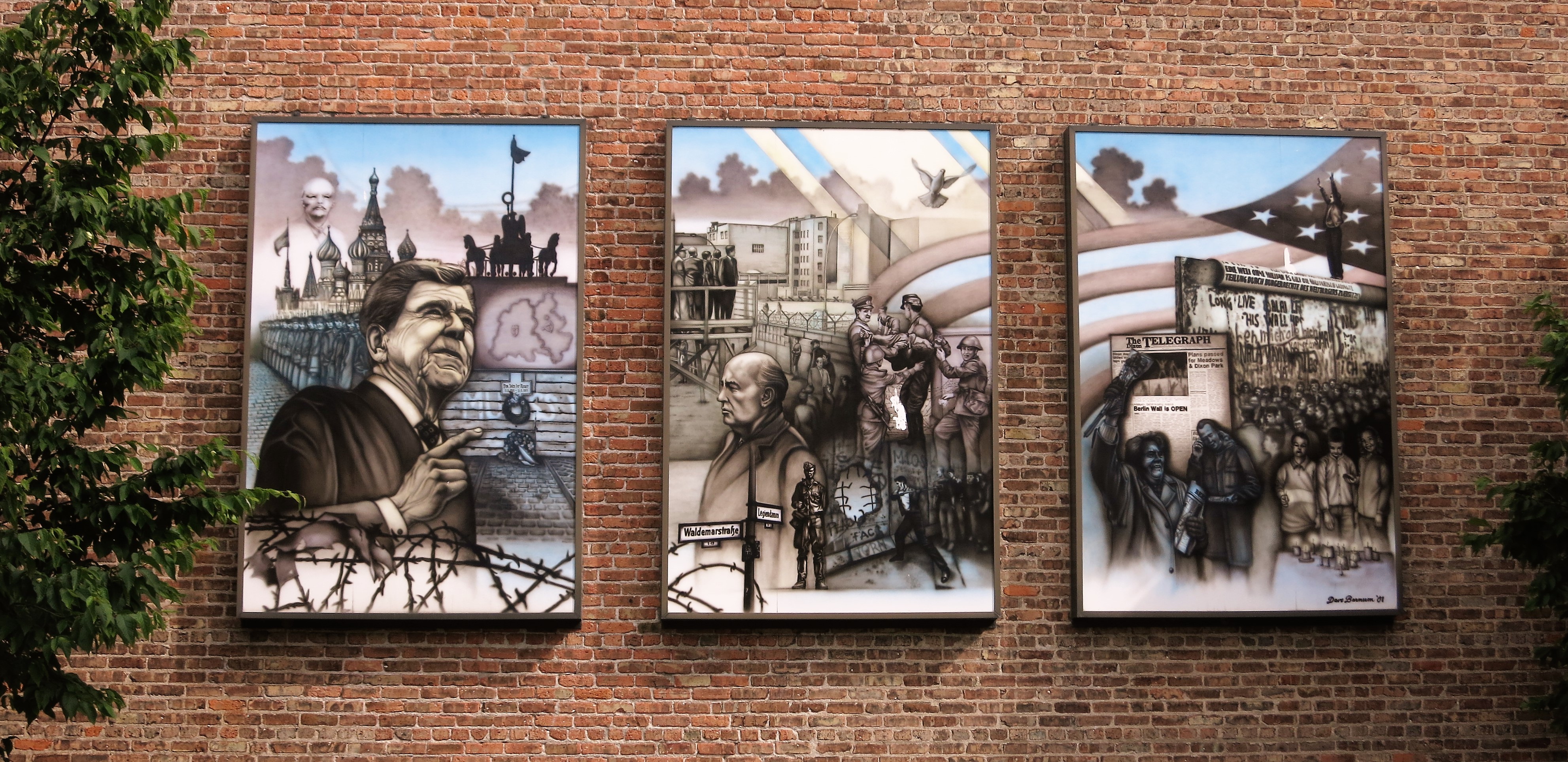
There are a few other memories of Reagan scattered throughout Dixon, including remembrances of his days as President:

The Wings of Peace and Freedom
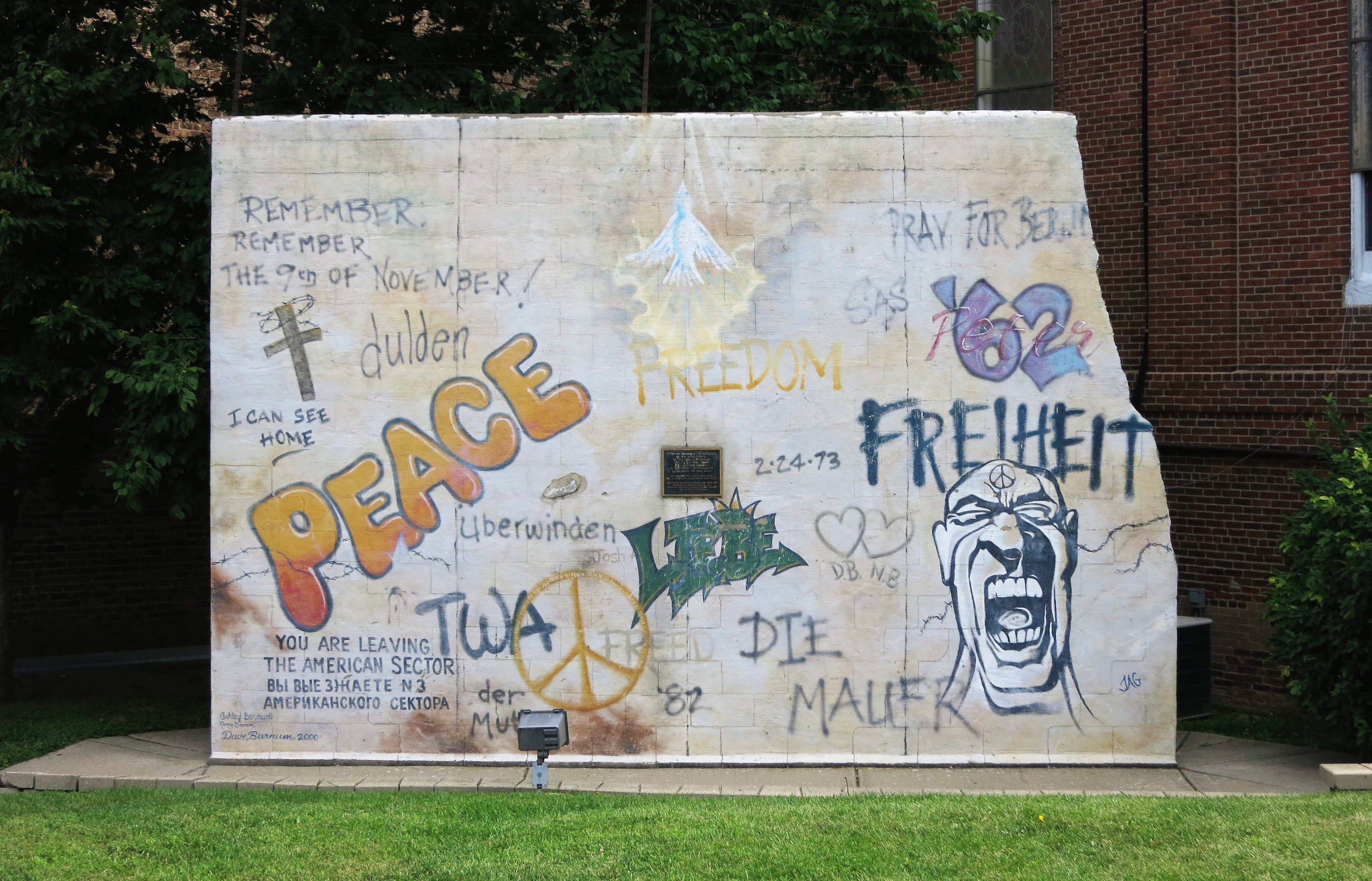
Piece of the Berlin Wall
President Reagan’s face on a Dixon lamp post

Here are few other photos from downtown Dixon, Illinois:

Galena Street, Dixon, Illinois
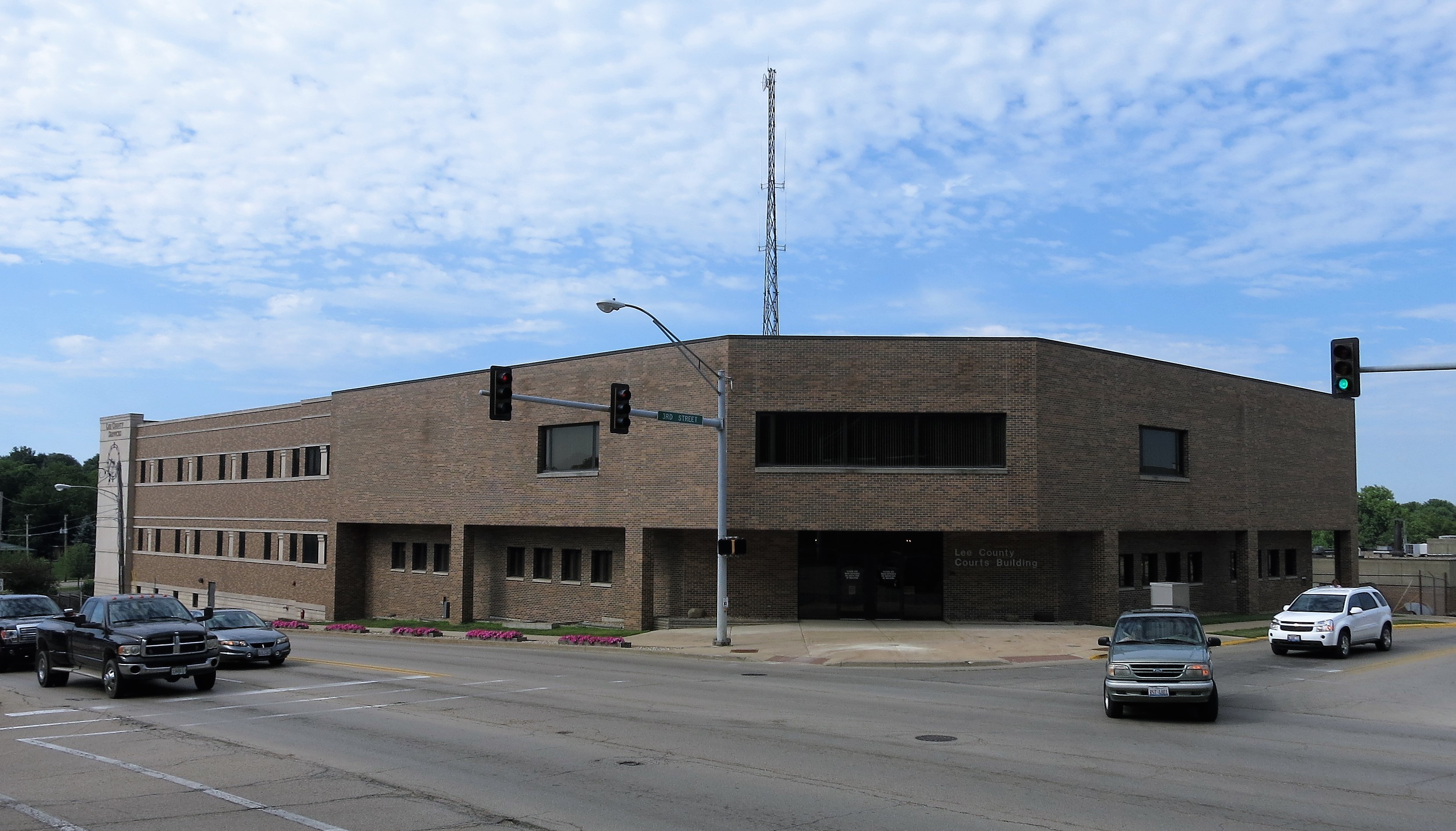
(Current) Lee County Courthouse
Heritage Crossing and Reagan’s statue, taken from across the Rock River at Presidents’ Park

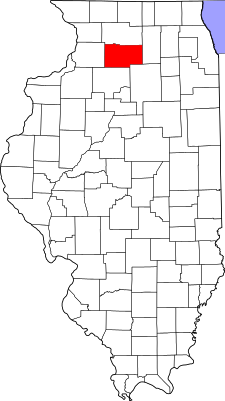
Lee County in the state of Illinois

All photos were taken by the author except for the Ronald Reagan boyhood home. The author’s photos were taken on July 11, 2014.

A list of all photo posts from the American County Seats series in TimManBlog can be found here.

I’m trying to travel to all of America’s county courthouses, and each month a post about my visit to the most interesting county seats. It’s only a hobby — but donations are greatly appreciated to help defer my costs.
Thanks,
Tim

One-Time
Monthly
Yearly

Make a one-time donation

Make a monthly donation

Make a yearly donation

Choose an amount

¤5.00
¤15.00
¤100.00
¤5.00
¤15.00
¤100.00
¤5.00
¤15.00
¤100.00

Or enter a custom amount

¤

Your contribution is appreciated.

Your contribution is appreciated.

Your contribution is appreciated.

DonateDonate monthlyDonate yearly

Enterprise, the Jewel of Eastern Oregon

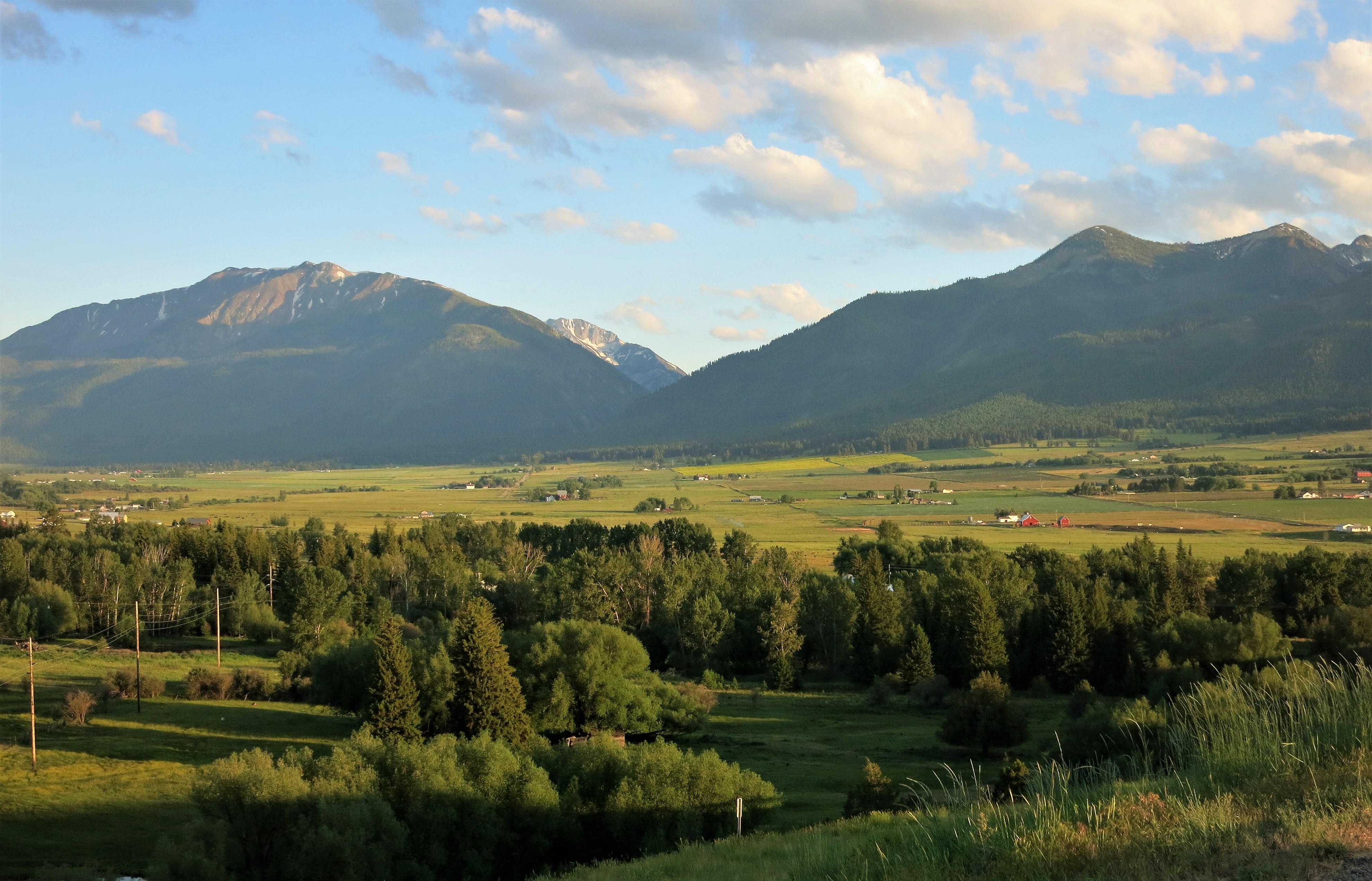
The Wallowa Mountains above Enterprise, Oregon

June 30, 2019

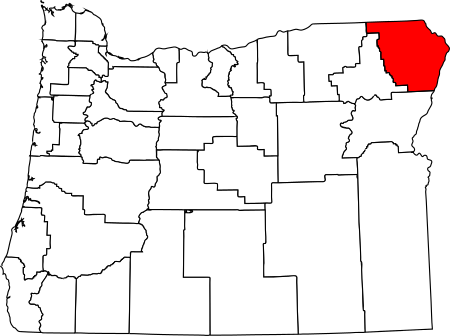
Wallowa County occupies the far northeastern corner of the state of Oregon. It’s far from Portland and the State Capitol in Salem, far from the Pacific Ocean beaches, and far from California. Unlike most of eastern Oregon’s desert stretches, Wallowa County boasts snowed-capped peaks and lush green valleys. 

Enterprise, the county seat of Wallowa County, lies in a beautiful alpine valley.  When you go there, expect to see many pickup trucks with two black labs in the back.  Standard. Expect also to see a few horses get loose just outside town and run down the road with their owners running after them in vain, causing the closest thing to a traffic jam in this rural place. Again, standard.

Welcome to Enterprise, named after the idea of “enterprise.” After a look around town, we’ll end up at the lake. That’s how life usually works around here.

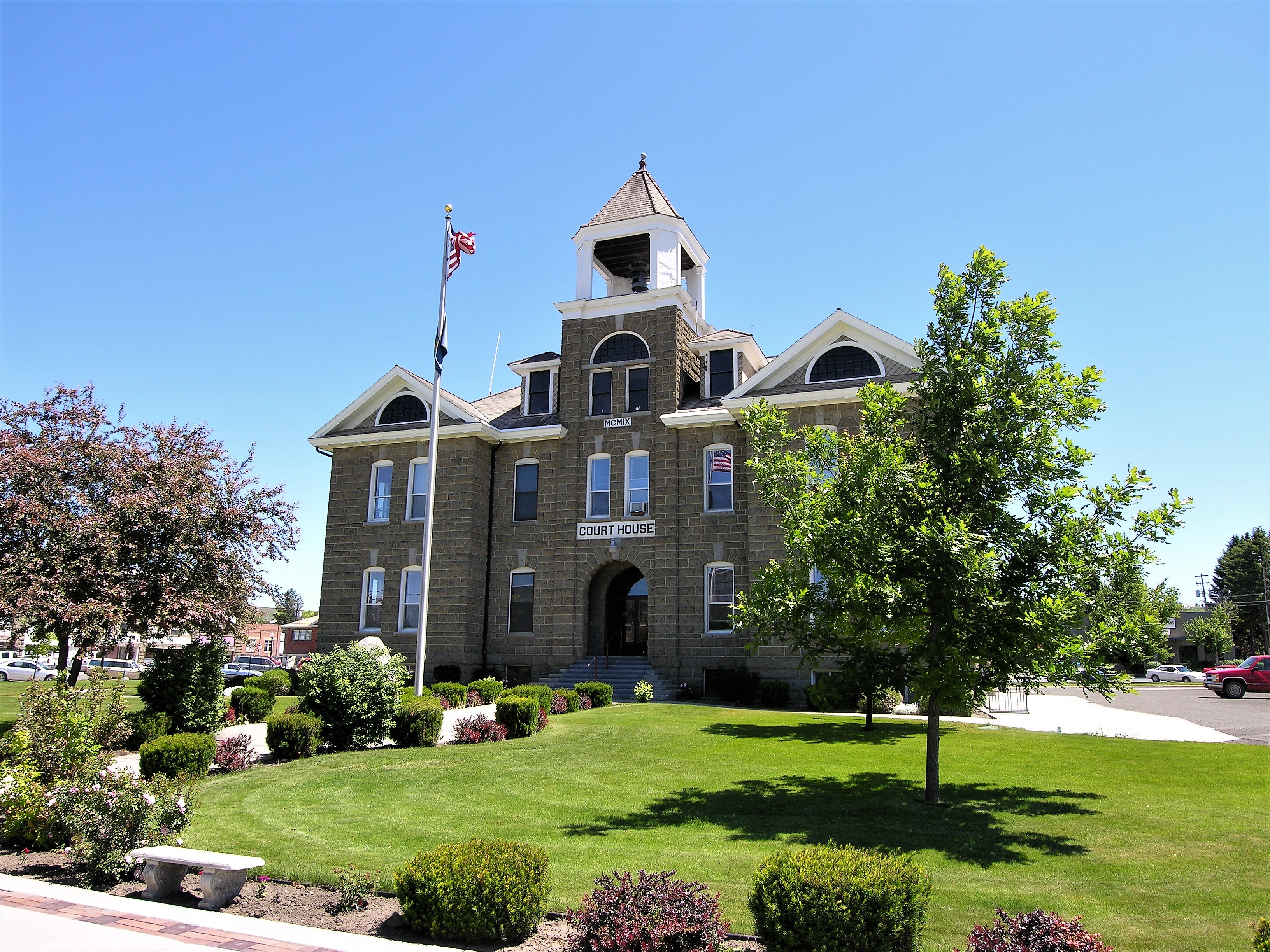
Wallowa County Courthouse — front entrance

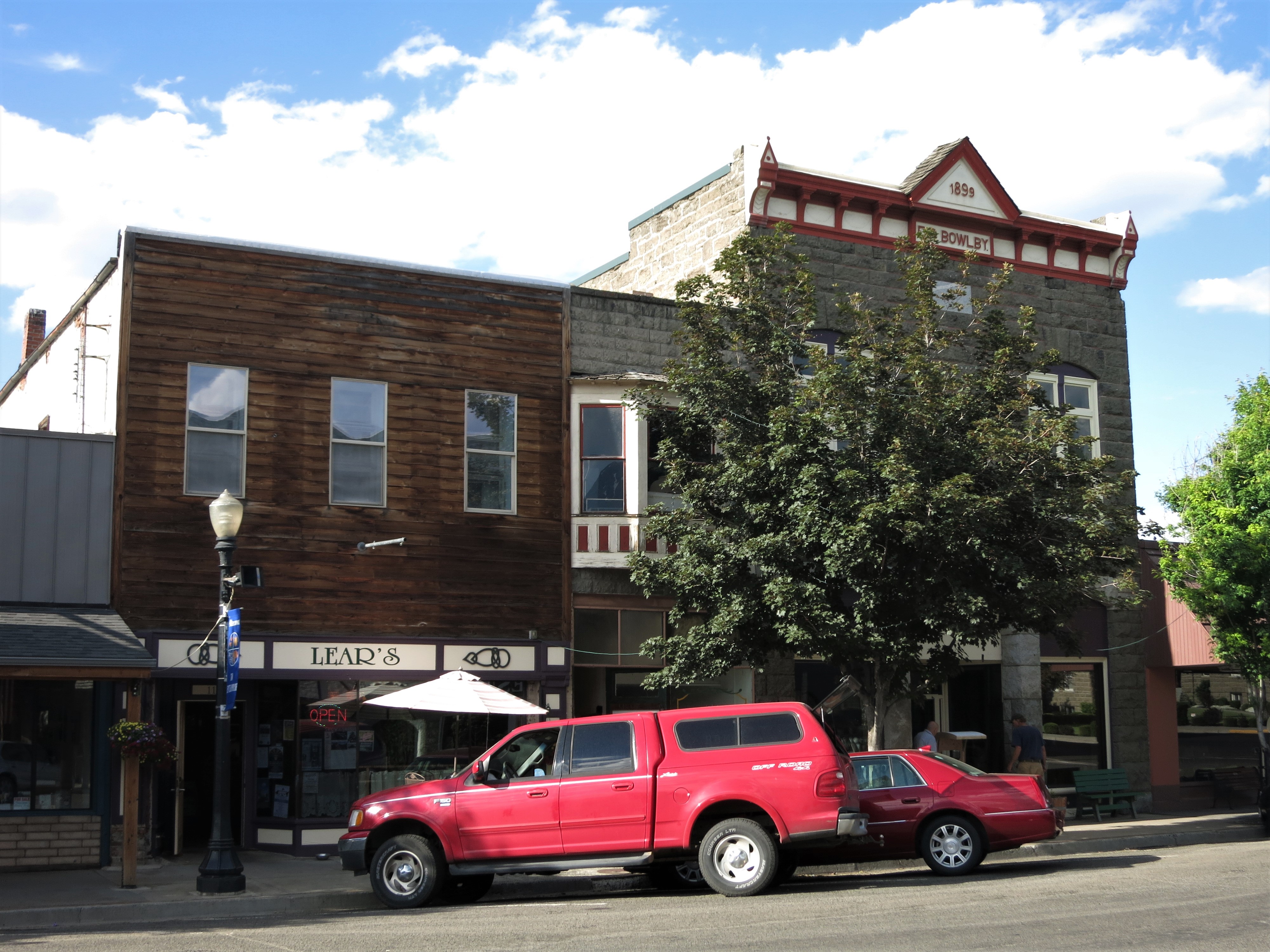
The courthouse and many other buildings in town are constructed of a locally-quarried gray stone block known as Bowlby Stone, named for a local landowner.  The porous stone could be cut by masons while it was still damp from the quarry, but after a time it dried as hard as concrete.  (This last bit I read on a historical sign, and this is the first time I’ve heard of quarried rock being called “damp”.)

Wallowa County Courthouse — Enterprise, Oregon

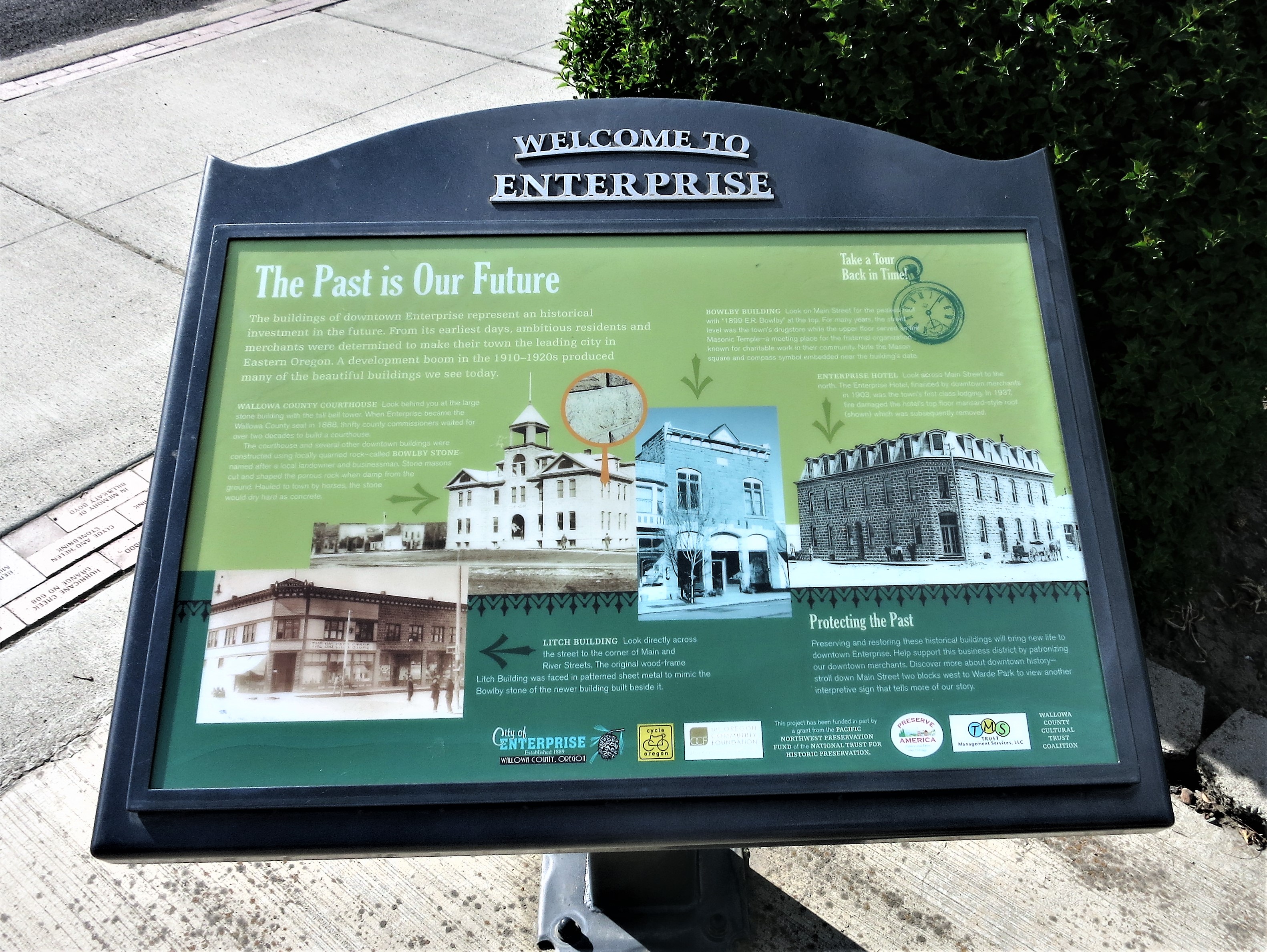
Here’s Enterprise’s slogan: “The Past is our Future.” I doubt that will be so, as will be seen later.

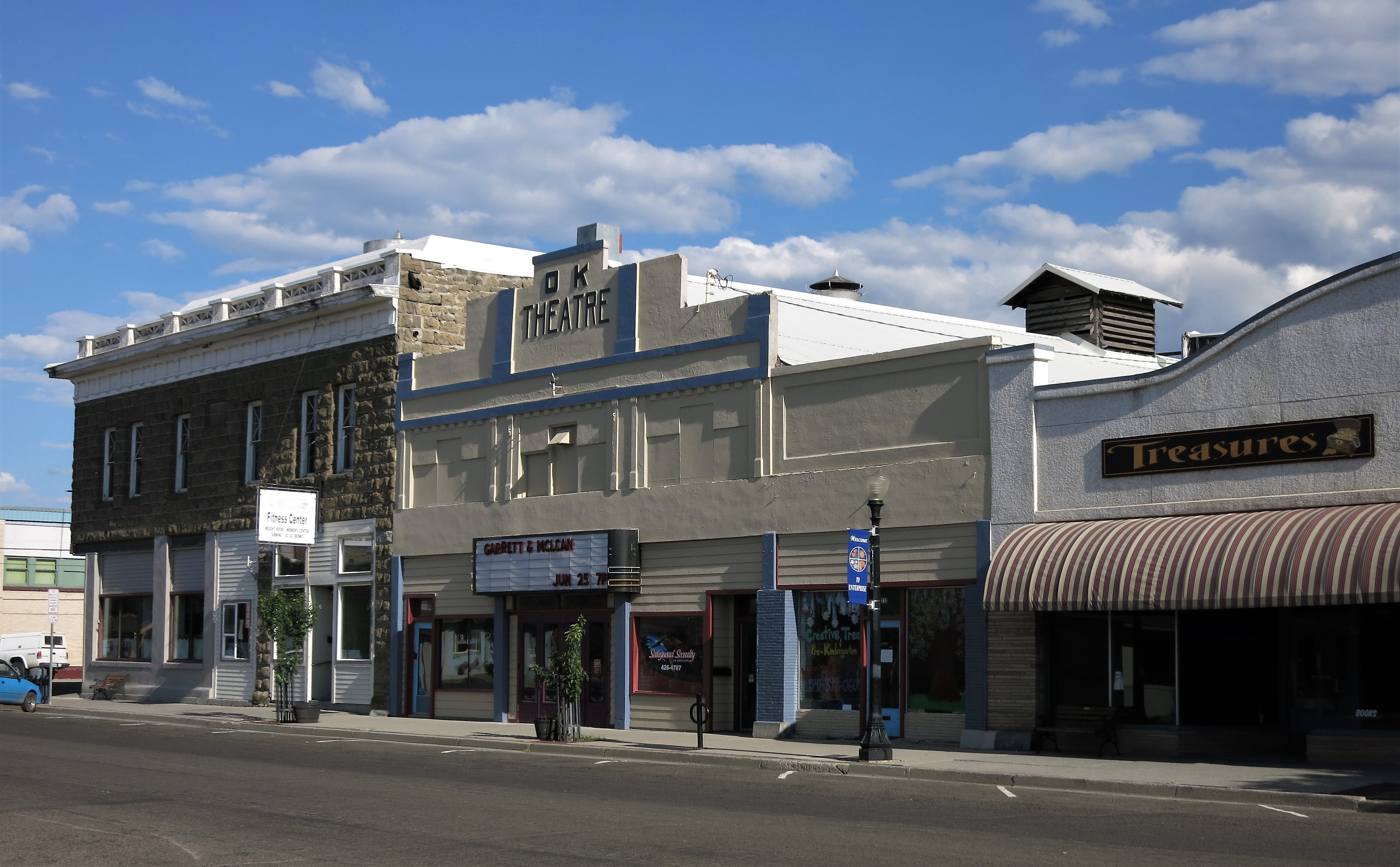
Main Street. Enterprise, Oregon. A Bowlby stone building on the right. A nice local watering hole on the left.
The OK Theatre. Enterprise, Oregon

Enterprise has a population of 1,940; the county has a total population of 7,008. But that may change.  Its fantastic location in a deep Alpine valley beckons travelers, tourists, and second-home seekers.  In short, folks with disposable cash. That’s what I saw when I last visited a few years ago.

Neighborhood home with white picket fence. Enterprise, Oregon
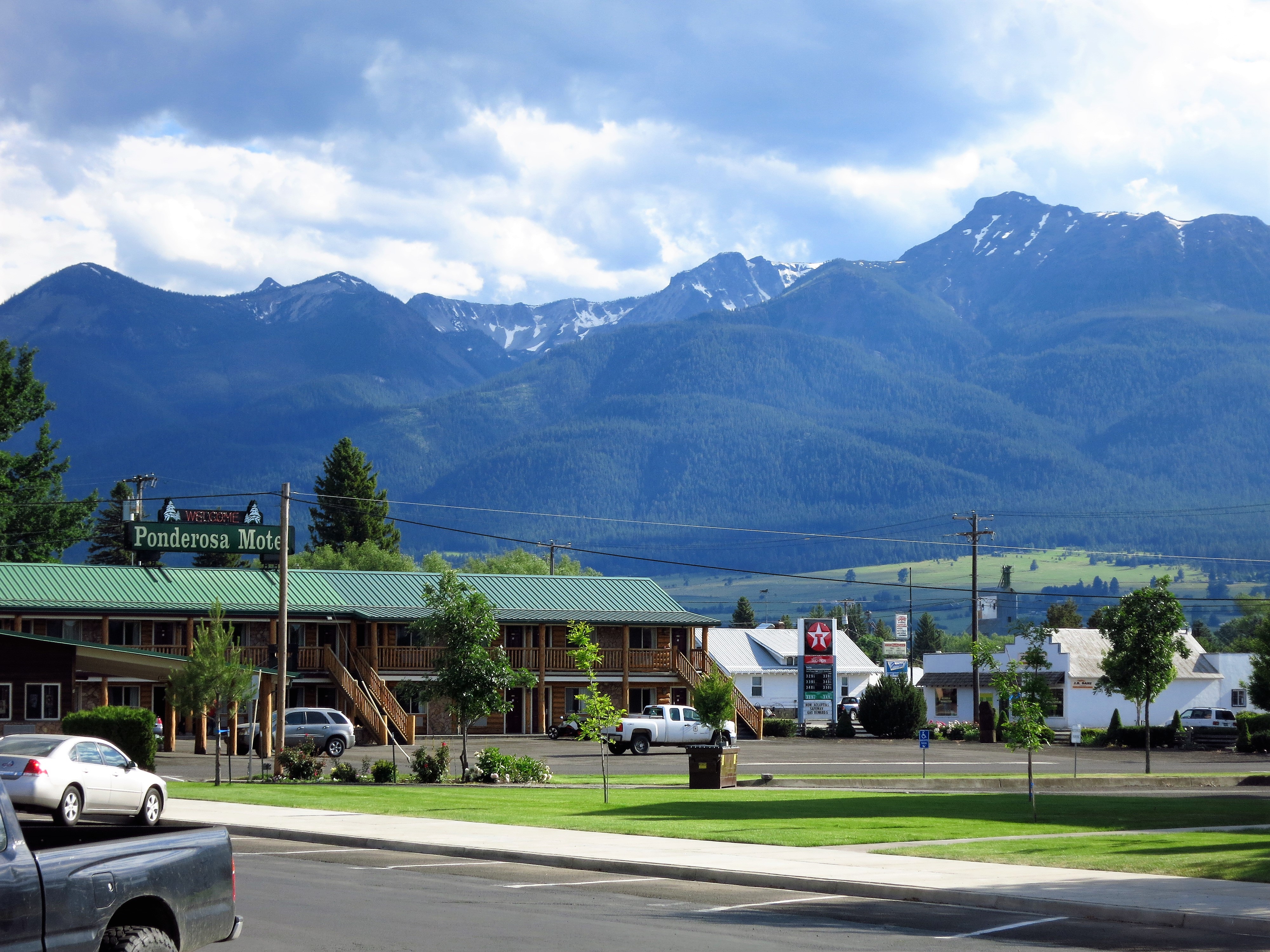
The Ponderosa Motel. Fine lodging just across the street from the courthouse. The Wallowa Mountains are the backdrop. Enterprise, Oregon.

Only western Oregon makes the national news — in Portland, Antifa just beat a bystanding journalist into a brain bleed (https://humanevents.com/2019/06/29/antifa-brutally-assault-journalist-during-portland-protest/?utm_referrer=https%3A%2F%2Fduckduckgo.com%2F) — but eastern Oregon is the Republican half of the state.

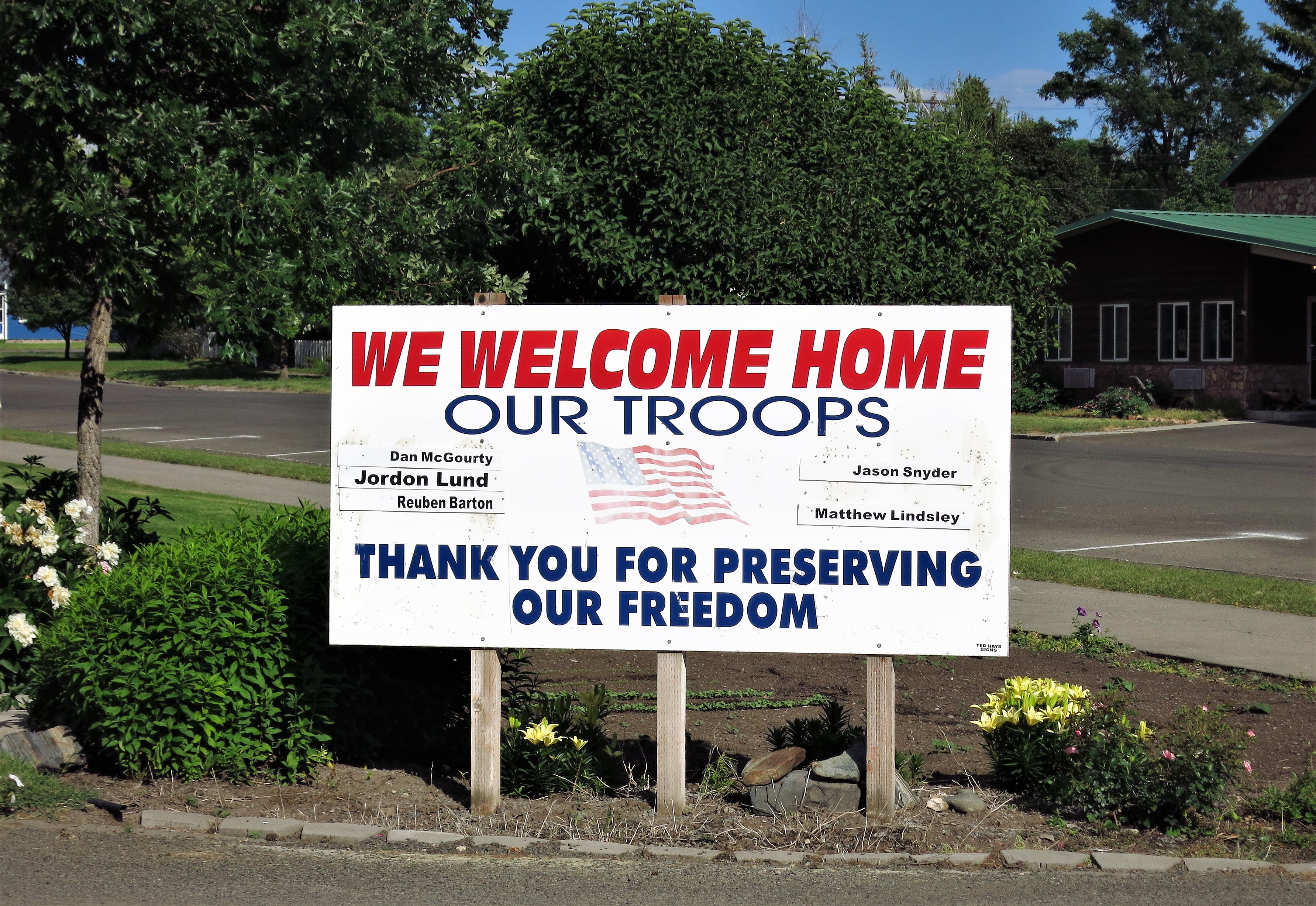
You can see the signs of it everywhere:

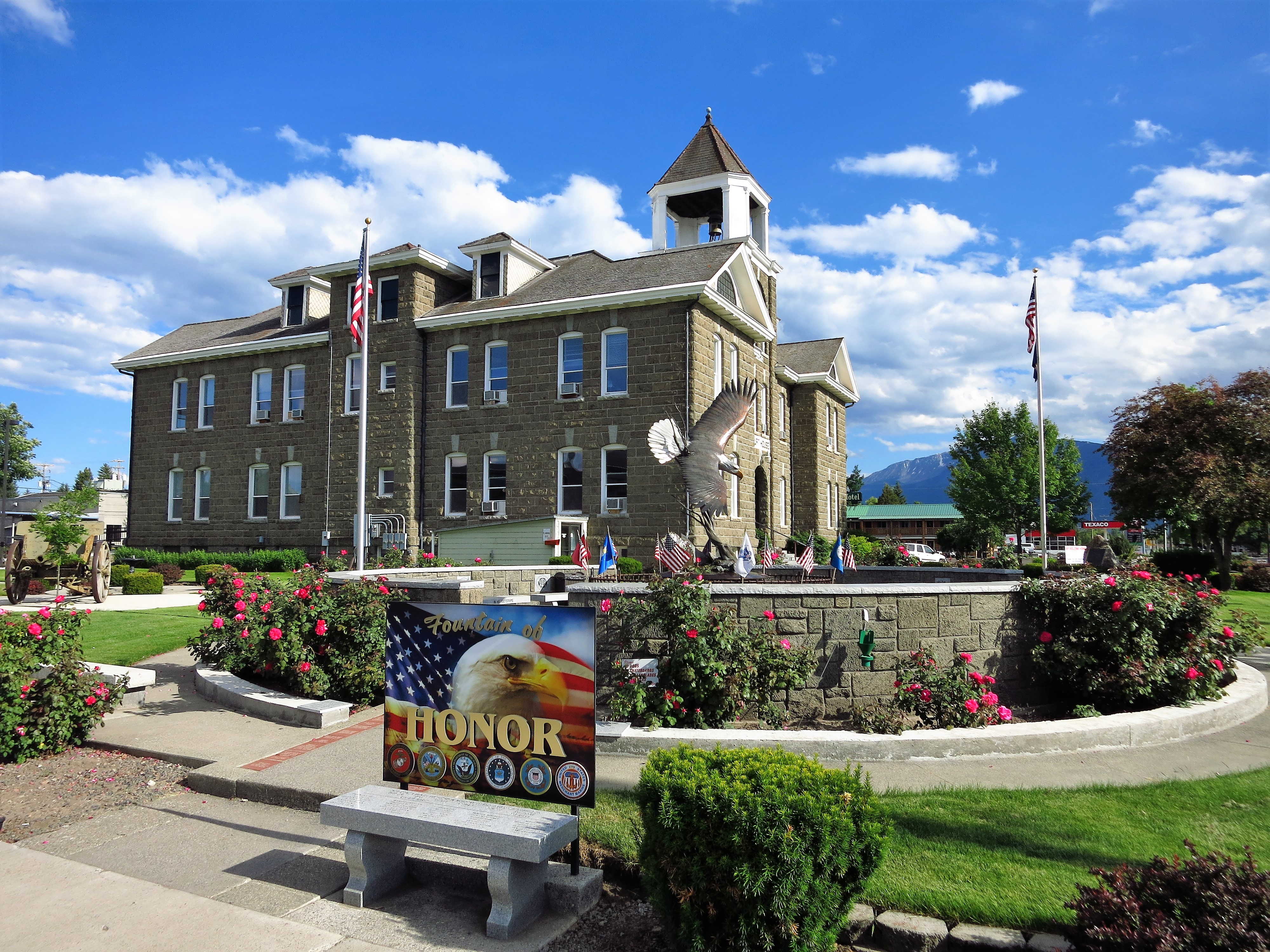
Wallowa County Courthouse’s Fountain of Honor — Enterprise, Oregon

This part of Oregon is becoming a refuge from the fascists taking control in western Oregon. Meanwhile, the spirit of Chief Joseph and the Nez Perce will be here always.

Statue of Chief Joseph of the Nez Perce.

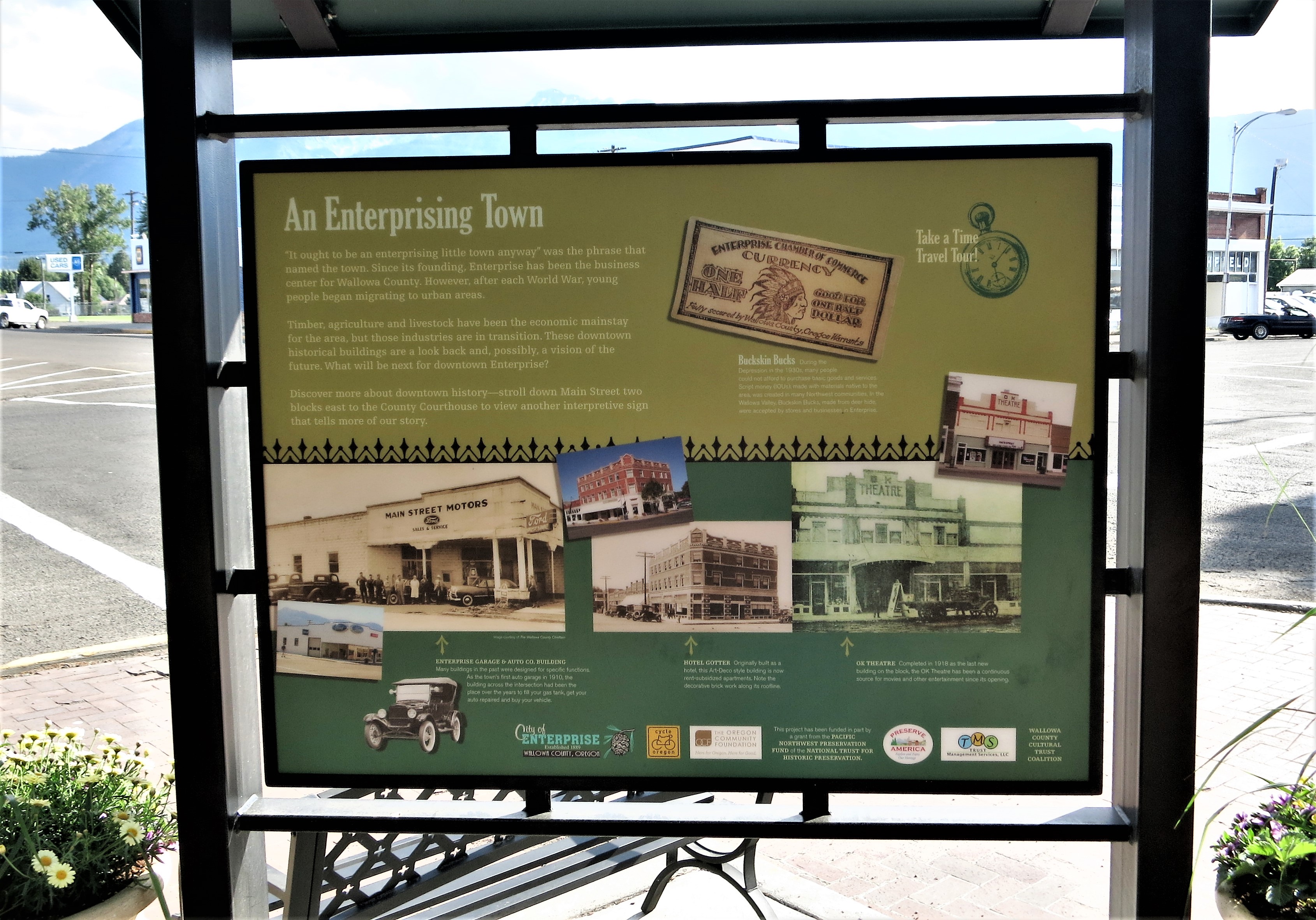
Here’s some more history, for this interested:

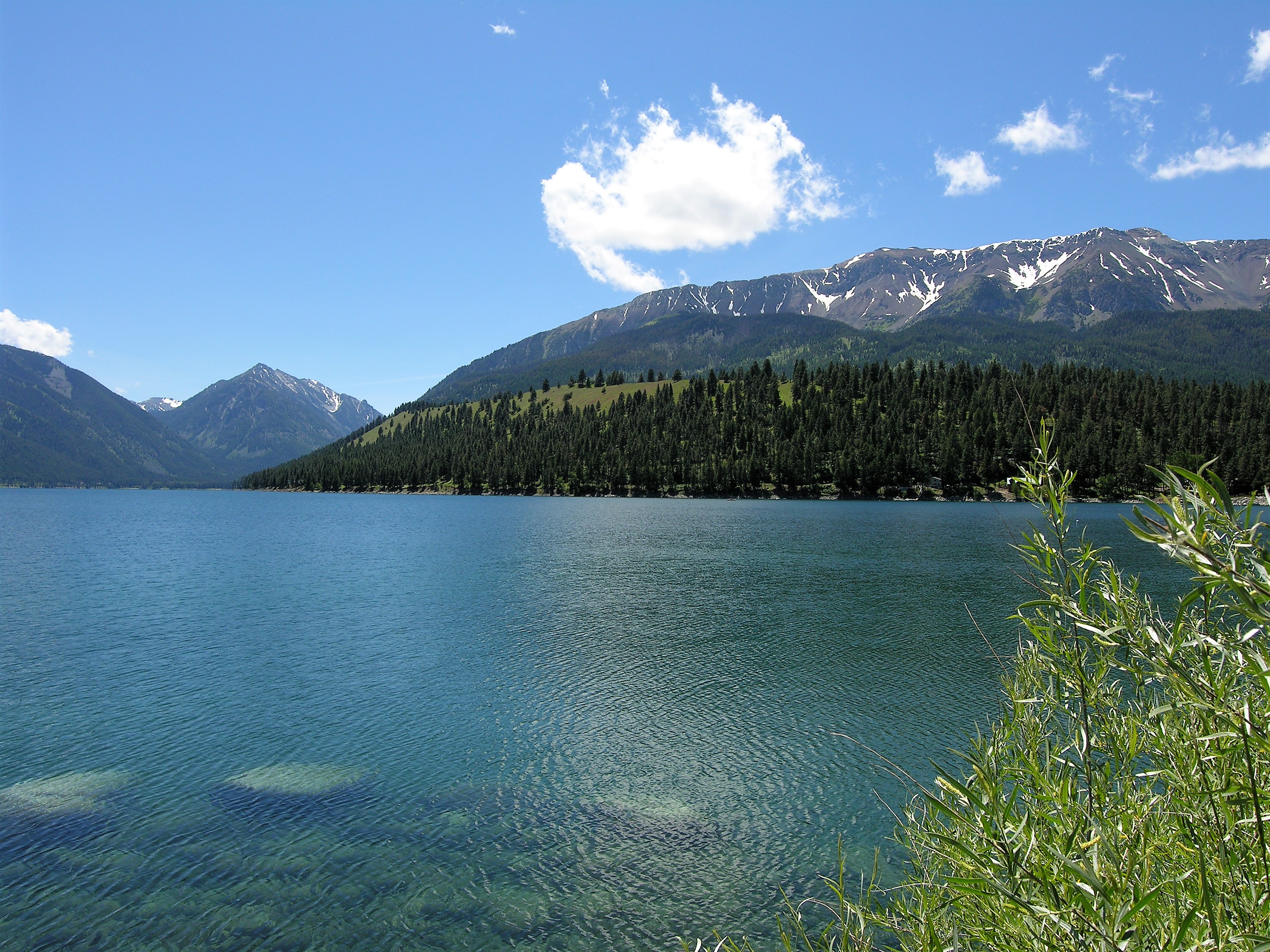
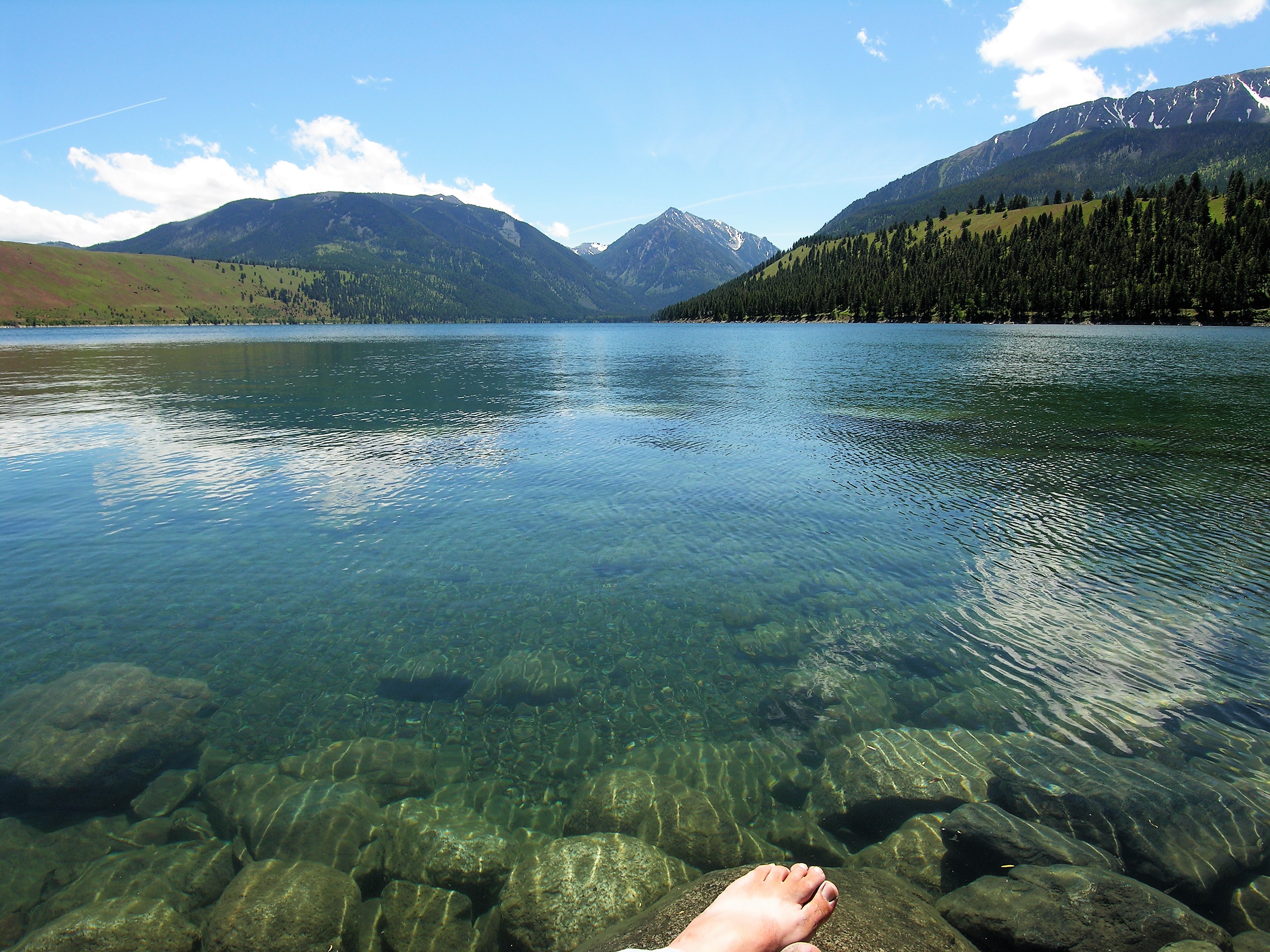
South of town, Wallowa Lake catches the snowmelt from the mountains high above it and feeds the Wallowa River which runs through Enterprise:

Wallowa Lake
Wallowa Lake

Cool summer memories. Toes compliments of yours truly.

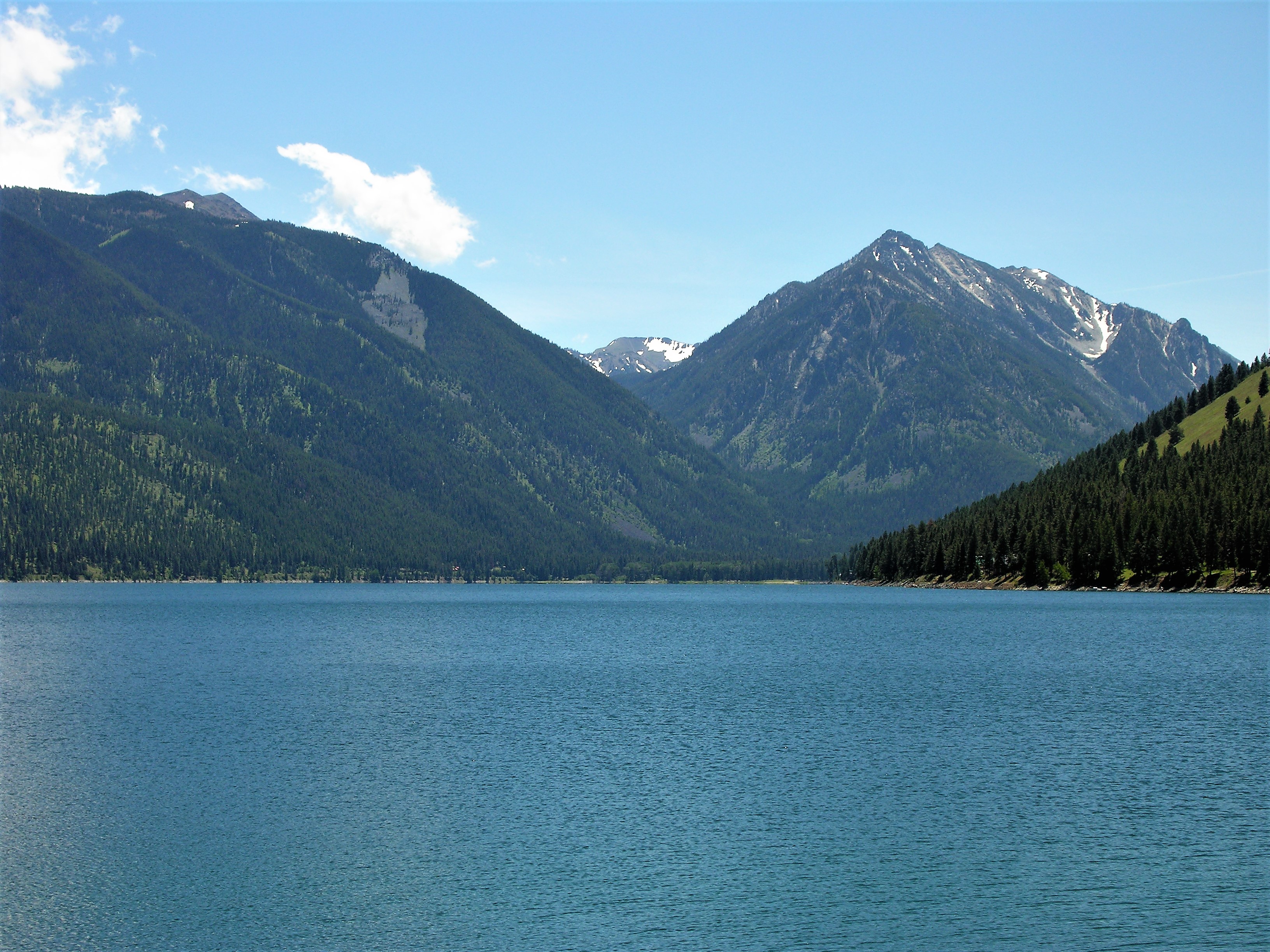
Wallowa Lake

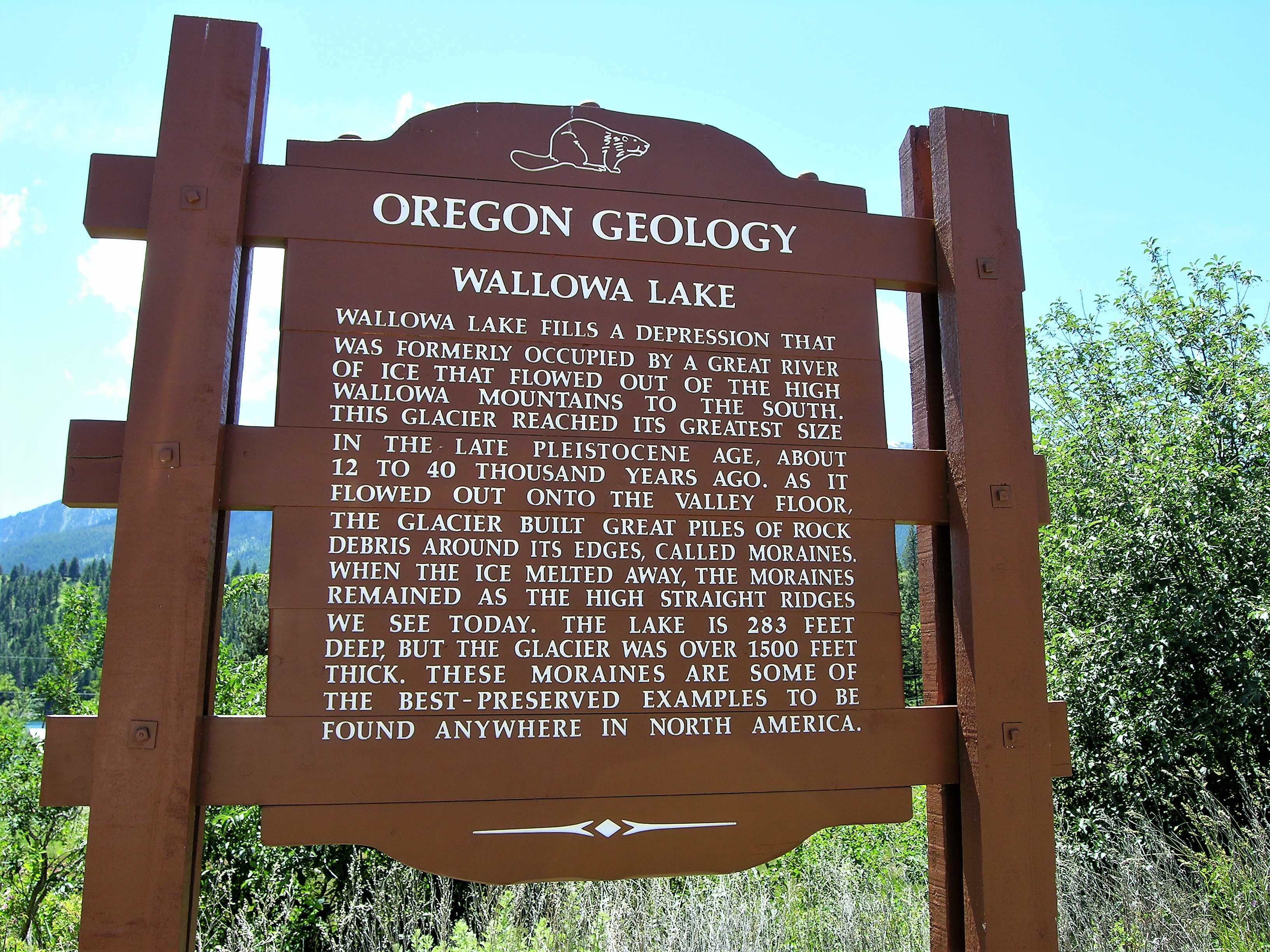
Some scientific information on the lake and surrounding area:

Finally, one last look at the valley, taken just before sunset on a warm June day:

View of the Wallowa Mountains, as seen from my room at the Eagle’s View Inn & Suites, Enterprise, Oregon

All photos were taken by the author. Photos were taken on June 25, 2007, and June 22, 2015.

A list of all photo posts from the American County Seats series in TimManBlog can be found here.

I’m trying to travel to all of America’s county courthouses, and each month a post about my visit to the most interesting county seats. It’s only a hobby — but donations are greatly appreciated to help defer my costs.
Thanks,
Tim

One-Time
Monthly
Yearly

Make a one-time donation

Make a monthly donation

Make a yearly donation

Choose an amount

¤5.00
¤15.00
¤100.00
¤5.00
¤15.00
¤100.00
¤5.00
¤15.00
¤100.00

Or enter a custom amount

¤

Your contribution is appreciated.

Your contribution is appreciated.

Your contribution is appreciated.

DonateDonate monthlyDonate yearly
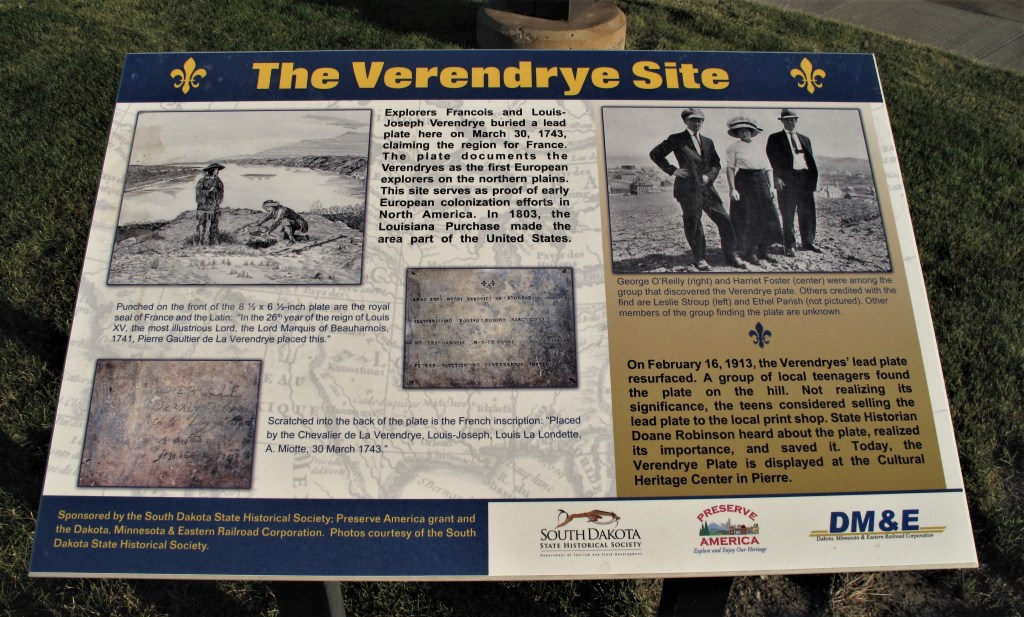
The town of Sylva in the hills of Western Carolina

May 19, 2019

By far, the best birthday present I’ve ever had was a week-long trip to western North Carolina in May. The skies were blue, the mountains were green, and the sun was warm (and golden yellow).

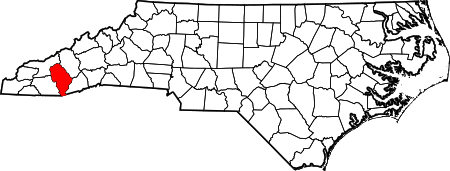
We’ll start in the town of Sylva (population 2,000 or so), the county seat of Jackson County, North Carolina, named for President Andrew Jackson.

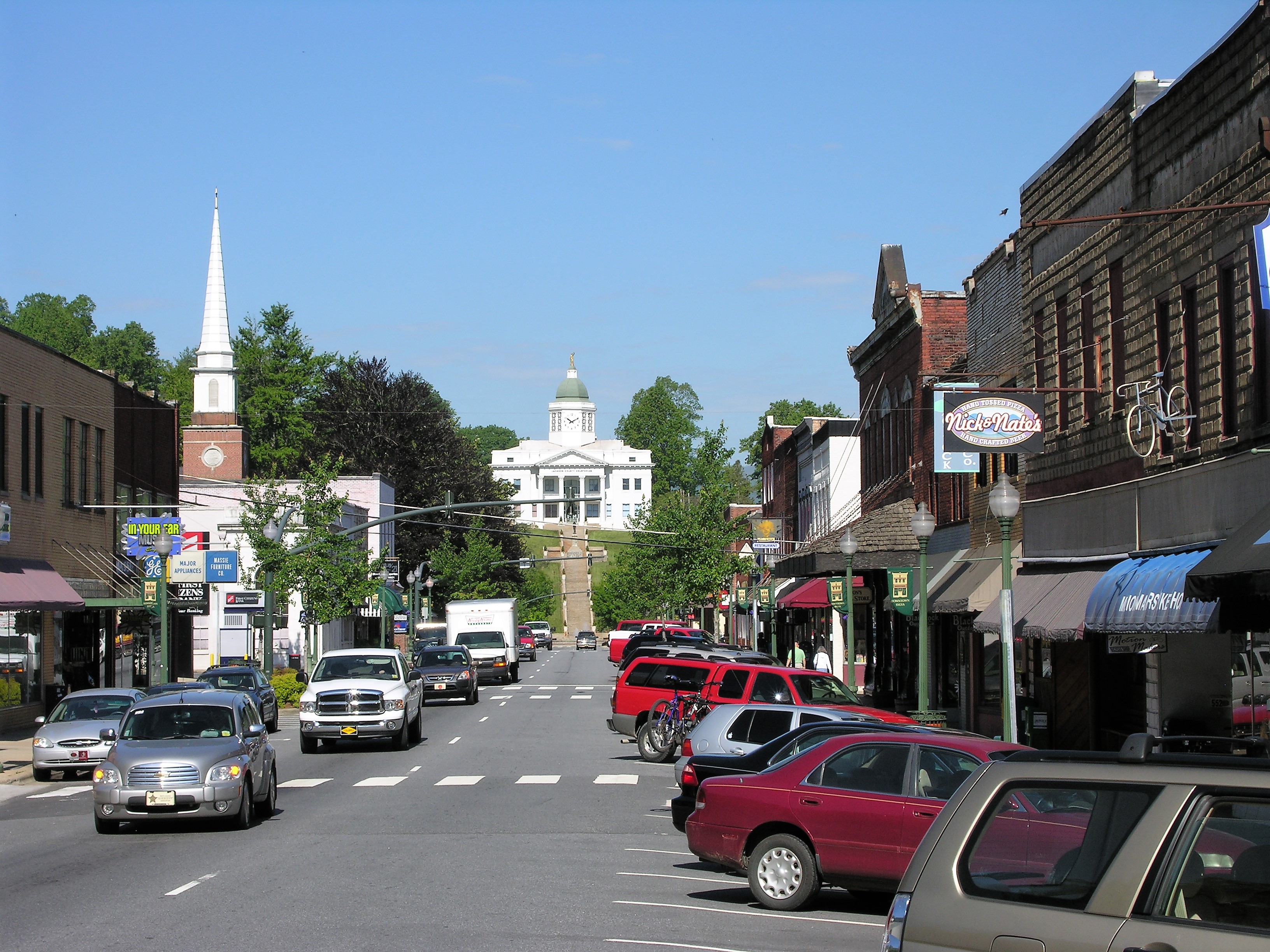
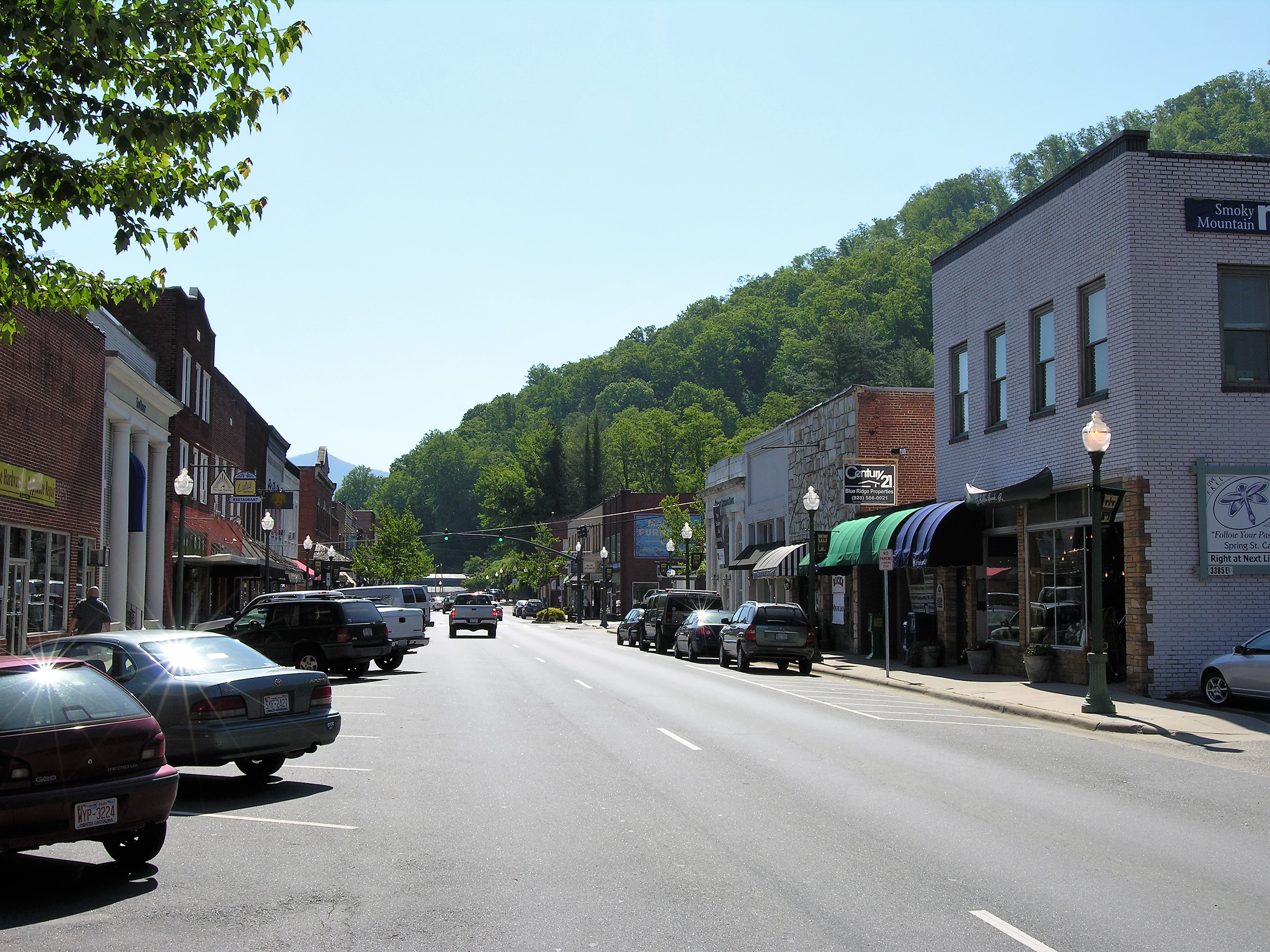
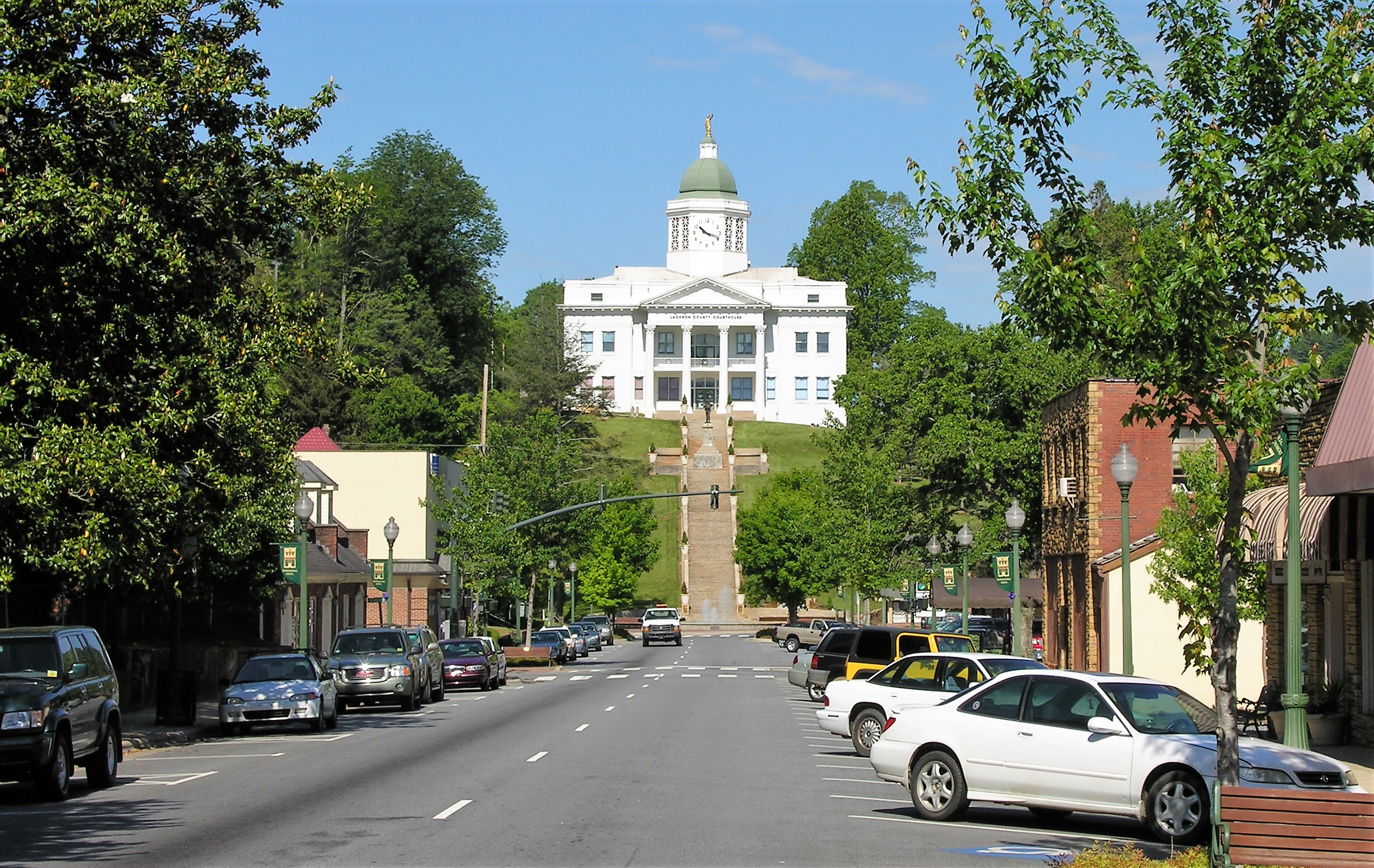
Nestled in a deep Appalachian valley, Sylva has two parallel main streets, an upper one and a lower one. The upper main street, actually called Main Street, holds several shops, cafes, and galleries. The lower main street, called Mill Street, seems like its storefronts are actually the back doors of the stores on the upper main street.

West Main Street, Sylva, North Carolina as it looked in May, 2008. Shops and galleries, coffee houses and microbreweries.
West Main Street looking east. The hill on the right is quite steep.

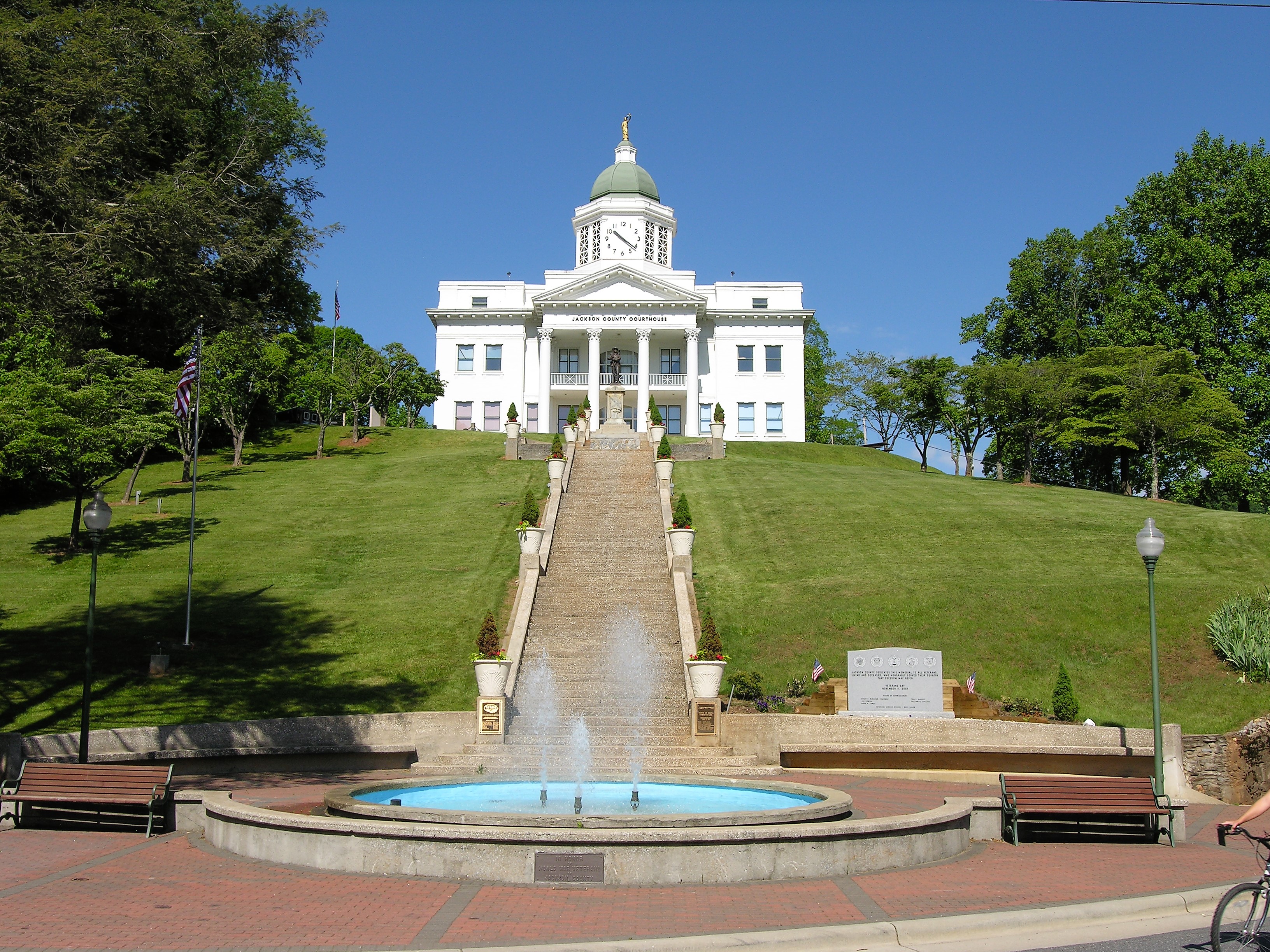
The old Jackson County Courthouse rises above the west end of Main Street, high up on a hill, towering over the town below.

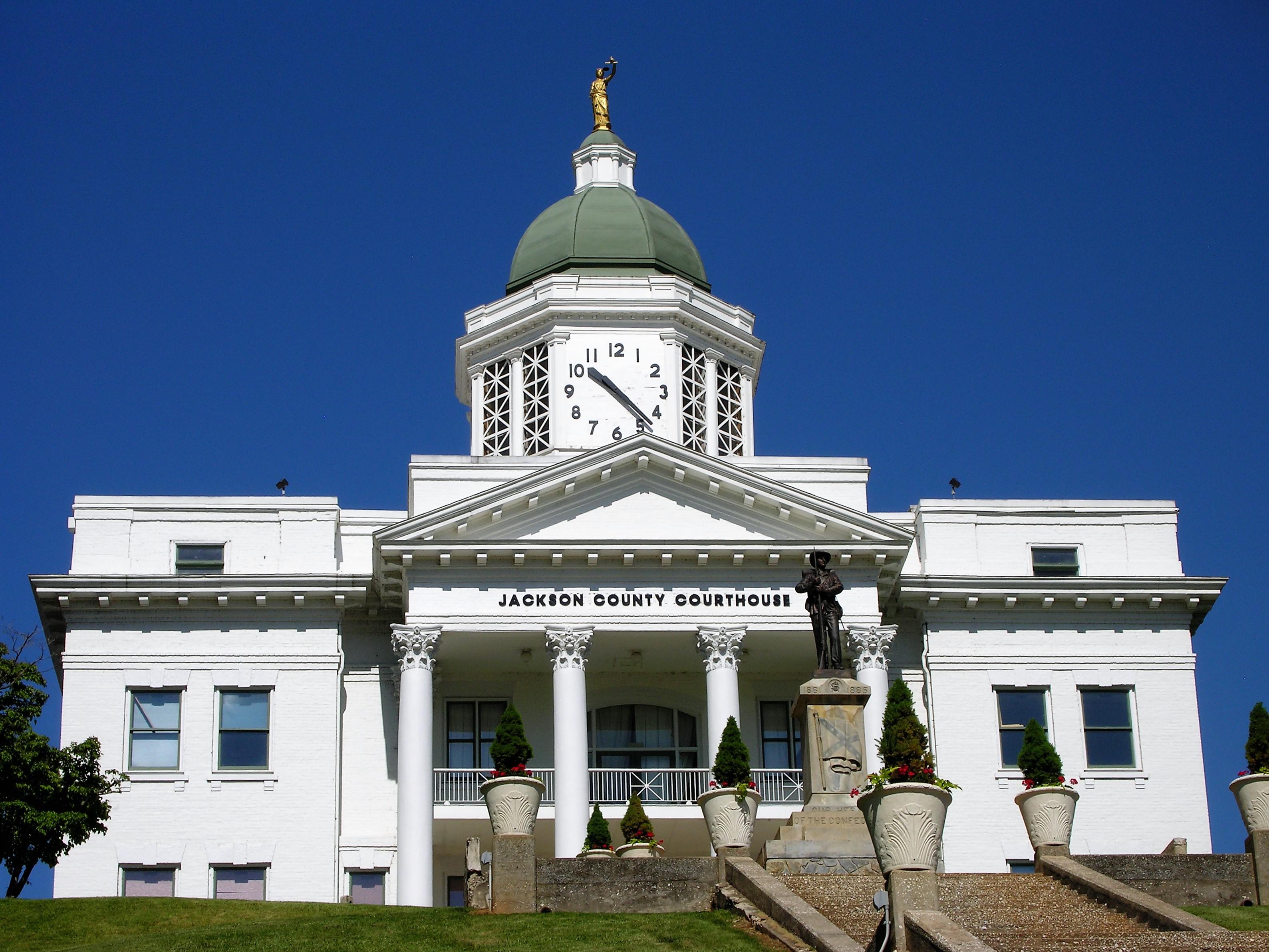
Former Jackson County Courthouse, now the county public library
Jackson County Veterans Memorial lies at the base of the steps below the former courthouse

A statue of a Confederate soldier stands watch at the summit of some thirty or forty concrete steps rising above Main Street. In all my travels this is one of the best locations for a courthouse I’ve ever seen.

Former Jackson County Courthouse. Confederate statue at the front, golden statue of Lady Justice stands atop the cupola.

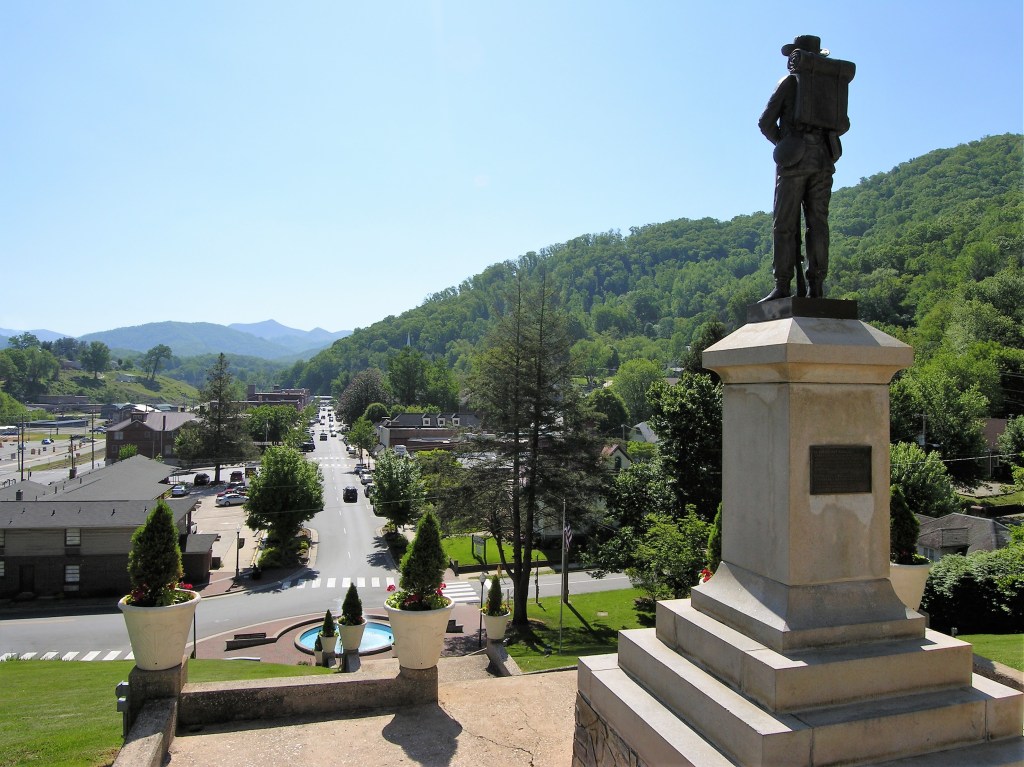
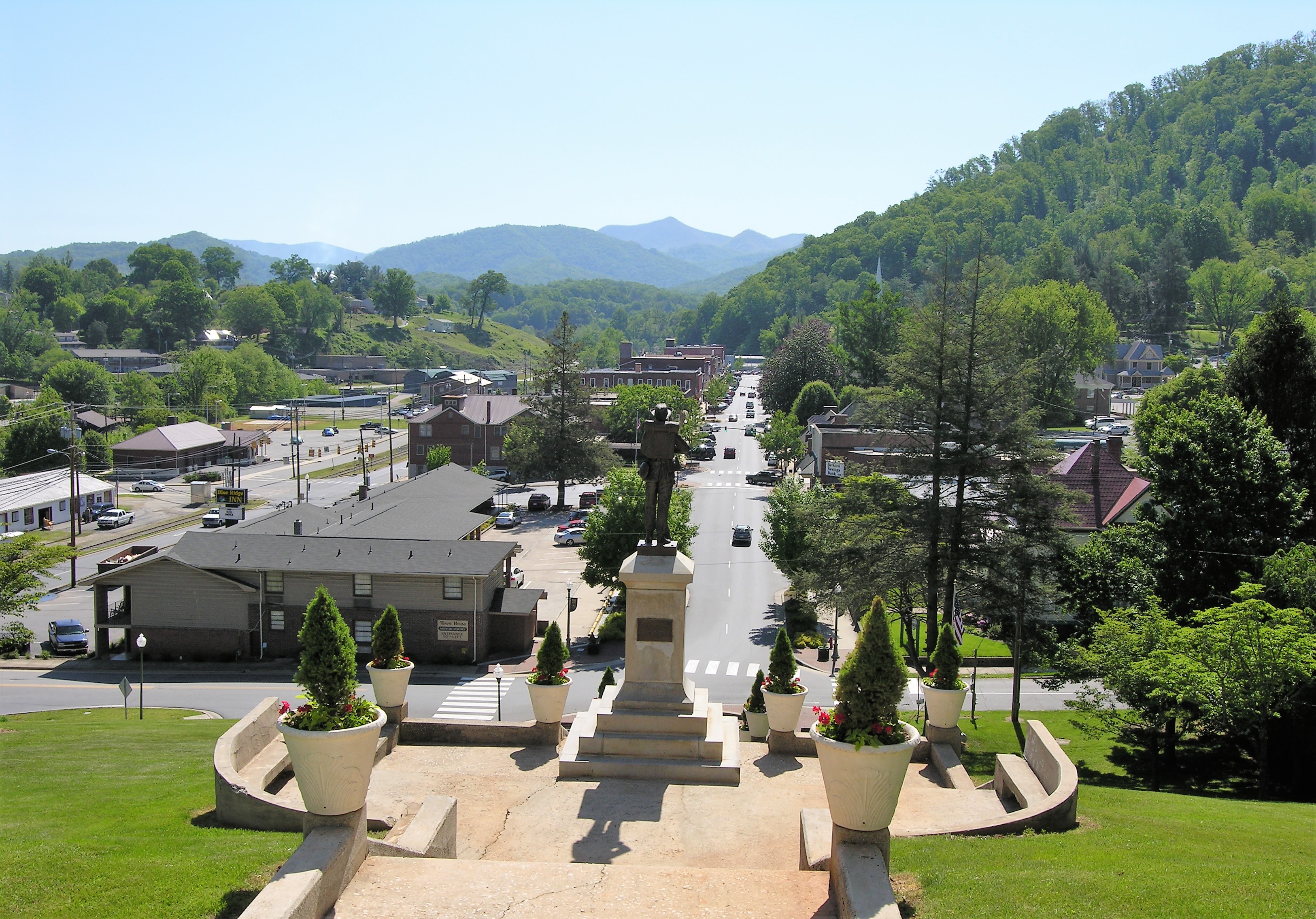
As you might imagine, the view from the top of the steps is spectacular.

The town of Sylva, North Carolina

Just makes you want to sit for a spell, doesn’t it?

Sylva Main Street from the old county courthouse. Confederate soldiers’ memorial is the foreground; the county veterans’ memorial is at the base of the steps.

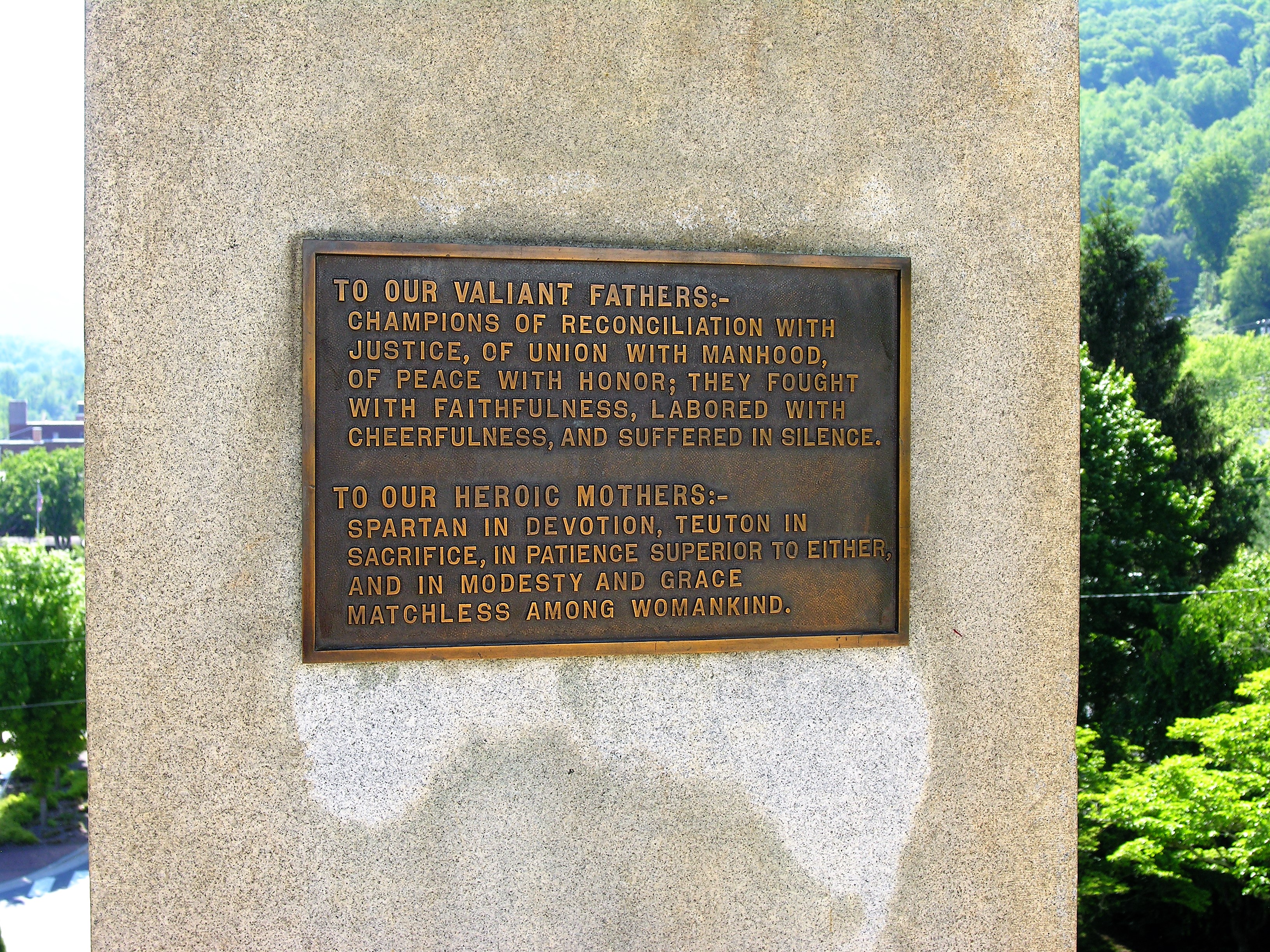
Old Confederate statues generally honor the soldiers who served in that war while being silent of the war’s causes. As a born and bred Pennsylvanian I have no problem with such monuments, they are an important part of our history. If you want to tear them down, I suggest you instead erect your own memorial as you deem appropriate — and leave others’ memories alone.

The inscription on the back of the Confederate soldier’s memorial, Sylva.

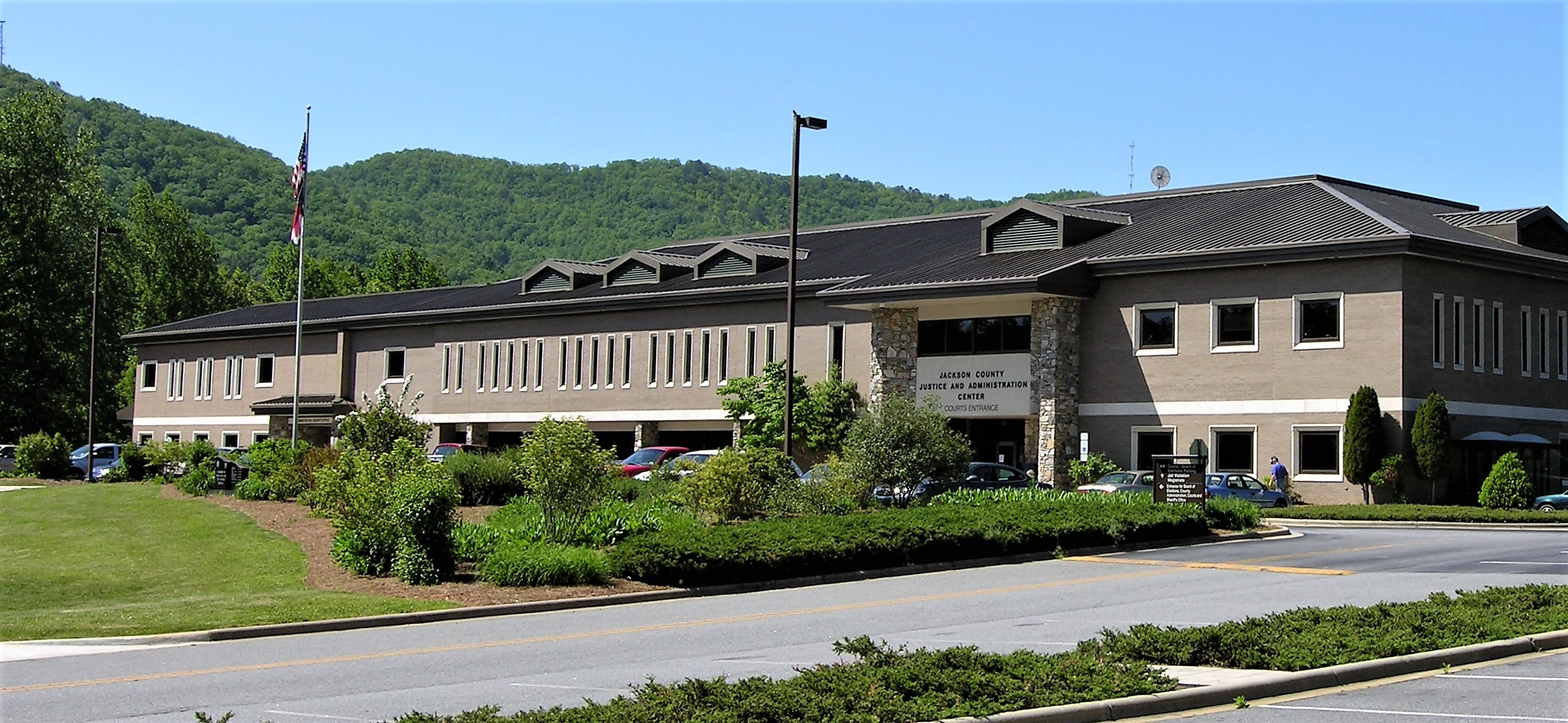
The new county Justice Center and Administration Building is a mile out of town. It must have been cramped in that old courthouse since the new one the county built is a sprawling two-story structure with plenty of parking spaces around it.

Jackson County Justice and Administration Center, Sylva, North Carolina

Western Carolina University is located here in Sylva. I suppose it could be called “Western North Carolina University” but since North Carolina is larger and more populous than South Carolina, the North Carolinians apparently feel free to usurp the singular “Carolina” to use in their names. I copied that style for the title of this post.

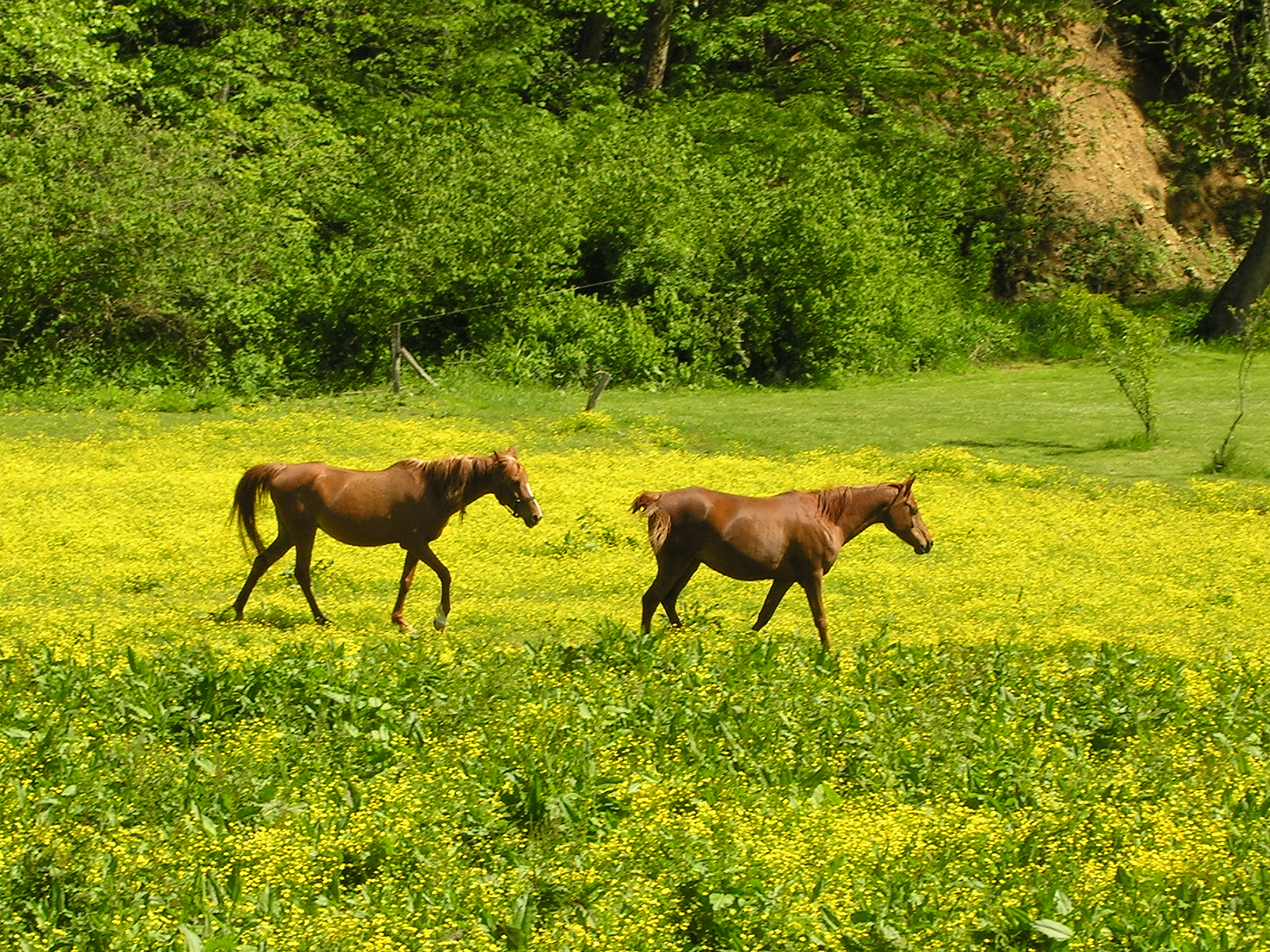
Because that trip was just so memorable, I decided to add a few photos from the western Carolina mountains and countryside.

Horses in pasture near Trust, North Carolina

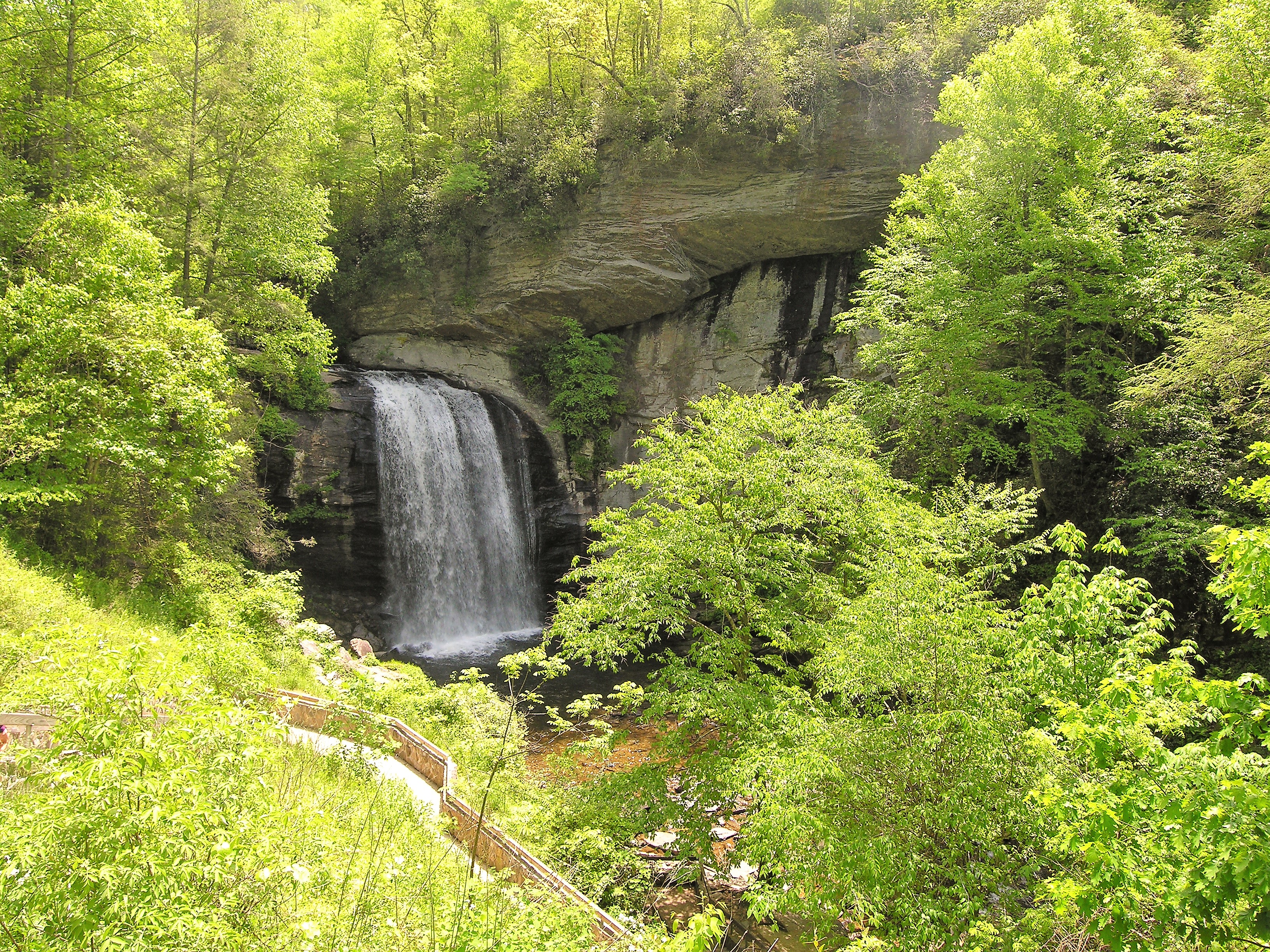
As if Great Smoky Mountains National Park didn’t have enough natural beauty, western Carolina is home to numerous waterfalls outside the park. Looking Glass Falls is one of the most photogenic of these cascades:

Looking Glass Falls, Pisgah National Forest, North Carolina

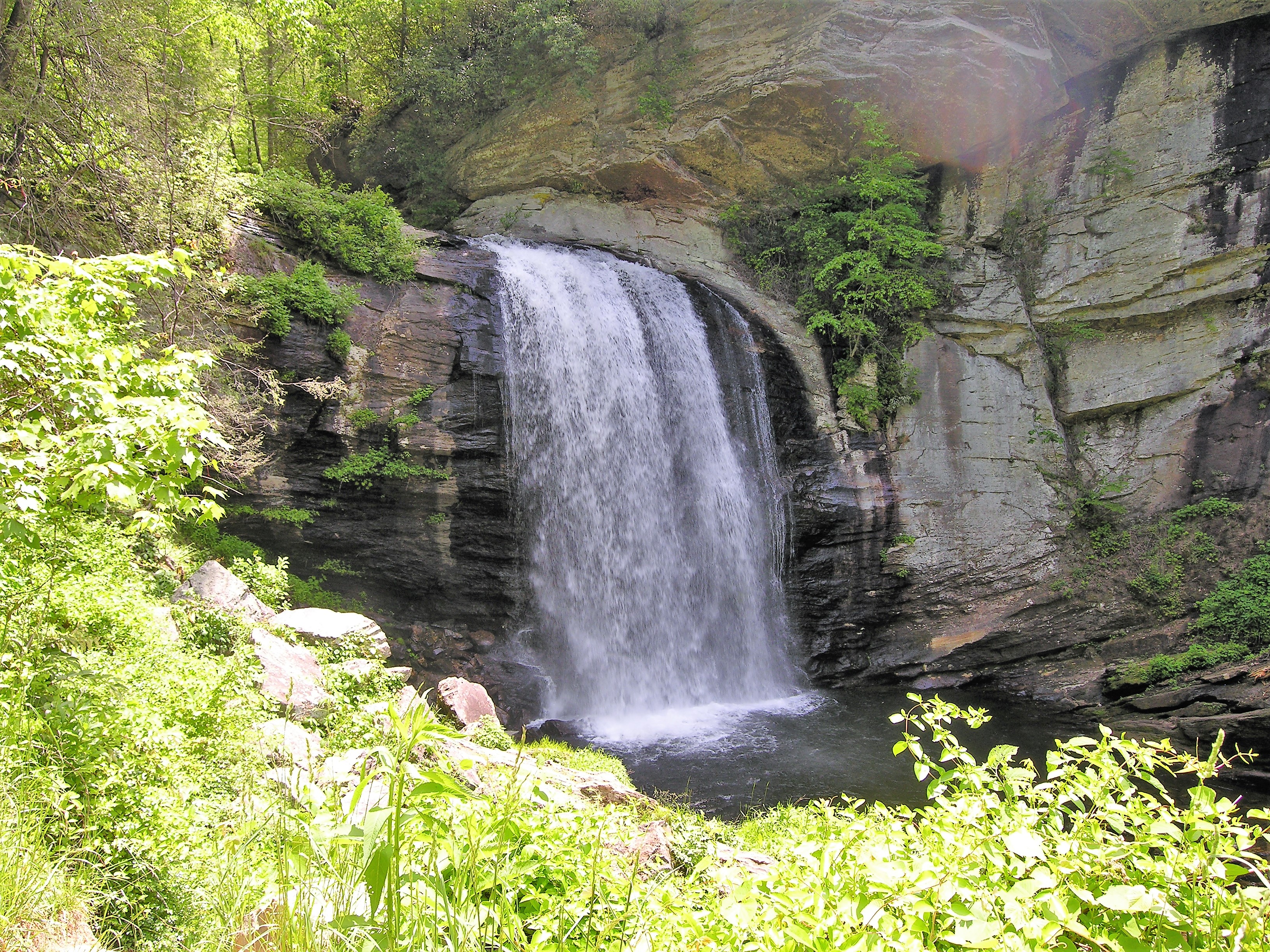
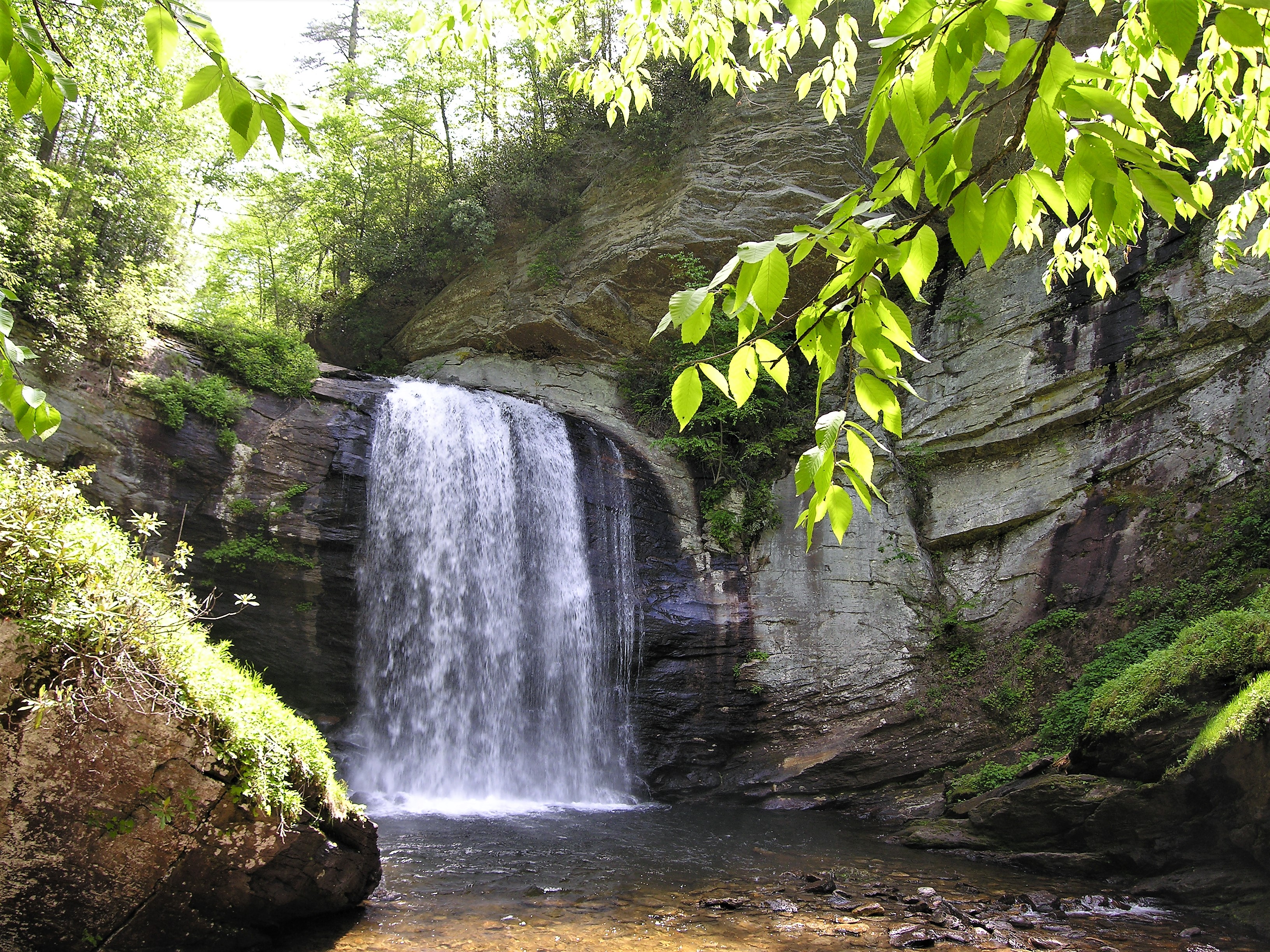
Here are two closeup shots from the base of the falls:

Looking Glass Falls, Pisgah National Forest, North Carolina

A convention of Monarch butterflies congregate near the base of the falls:

Monarch butterflies

All photos were taken by the author. Photos were taken between May 19-23, 2008.

A list of all photo posts from the American County Seats series in TimManBlog can be found here.

I’m trying to travel to all of America’s county courthouses, and each month a post about my visit to the most interesting county seats. It’s only a hobby — but donations are greatly appreciated to help defer my costs.
Thanks,
Tim

One-Time
Monthly
Yearly

Make a one-time donation

Make a monthly donation

Make a yearly donation

Choose an amount

¤5.00
¤15.00
¤100.00
¤5.00
¤15.00
¤100.00
¤5.00
¤15.00
¤100.00

Or enter a custom amount

¤

Your contribution is appreciated.

Your contribution is appreciated.

Your contribution is appreciated.

DonateDonate monthlyDonate yearly
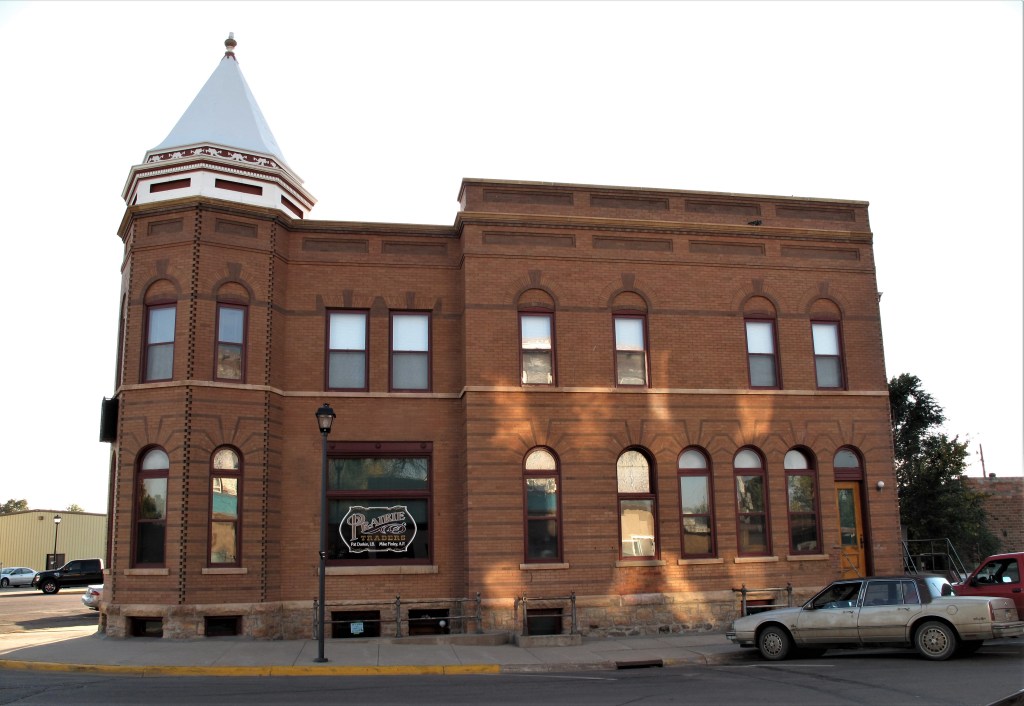
April 19th in Middlesex County, Massachusetts

The Lexington Minuteman

On April 19, 1775, the battles of Lexington and Concord were fought in Middlesex County, Massachusetts, commencing the American Revolution. Each year on Patriot’s Day, the battles are re-enacted in remembrance of the day when the rights of men were asserted against despotic power.

I had long wished to be in Lexington, Massachusetts on April 19th and had my chance to go a few years ago. I stayed the night before in nearby Woburn, awoke at 3:00 am, and arrived in Lexington in the 4:00 am darkness. I wasn’t the first to arrive.

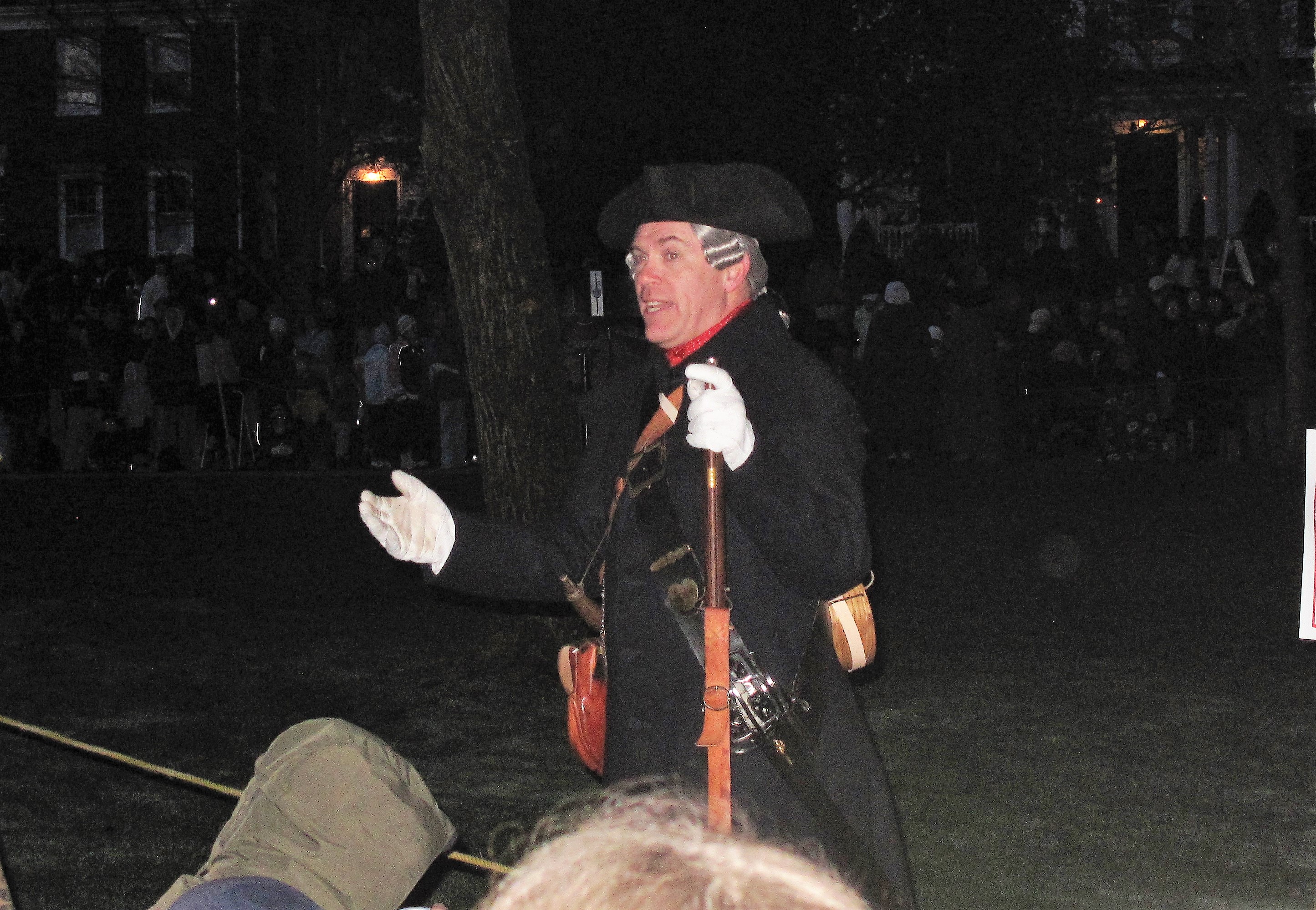
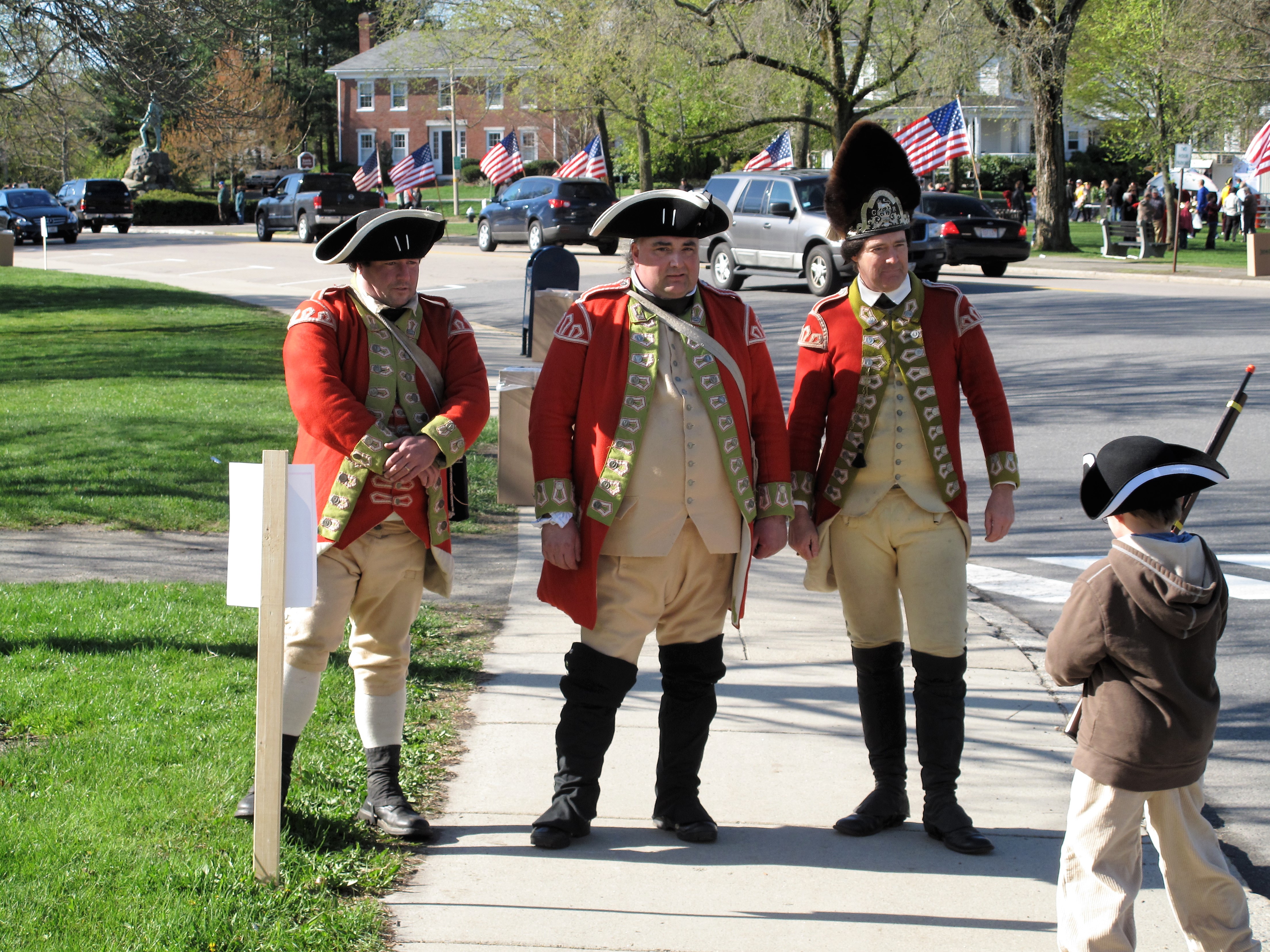
The crowds gathered before dawn on Lexington Green. About half were tourists while the other half were classes of schoolchildren, ready to watch history. Local guides dressed in period costumes explained to the crowds what is about to happen. I watched with keen interest.


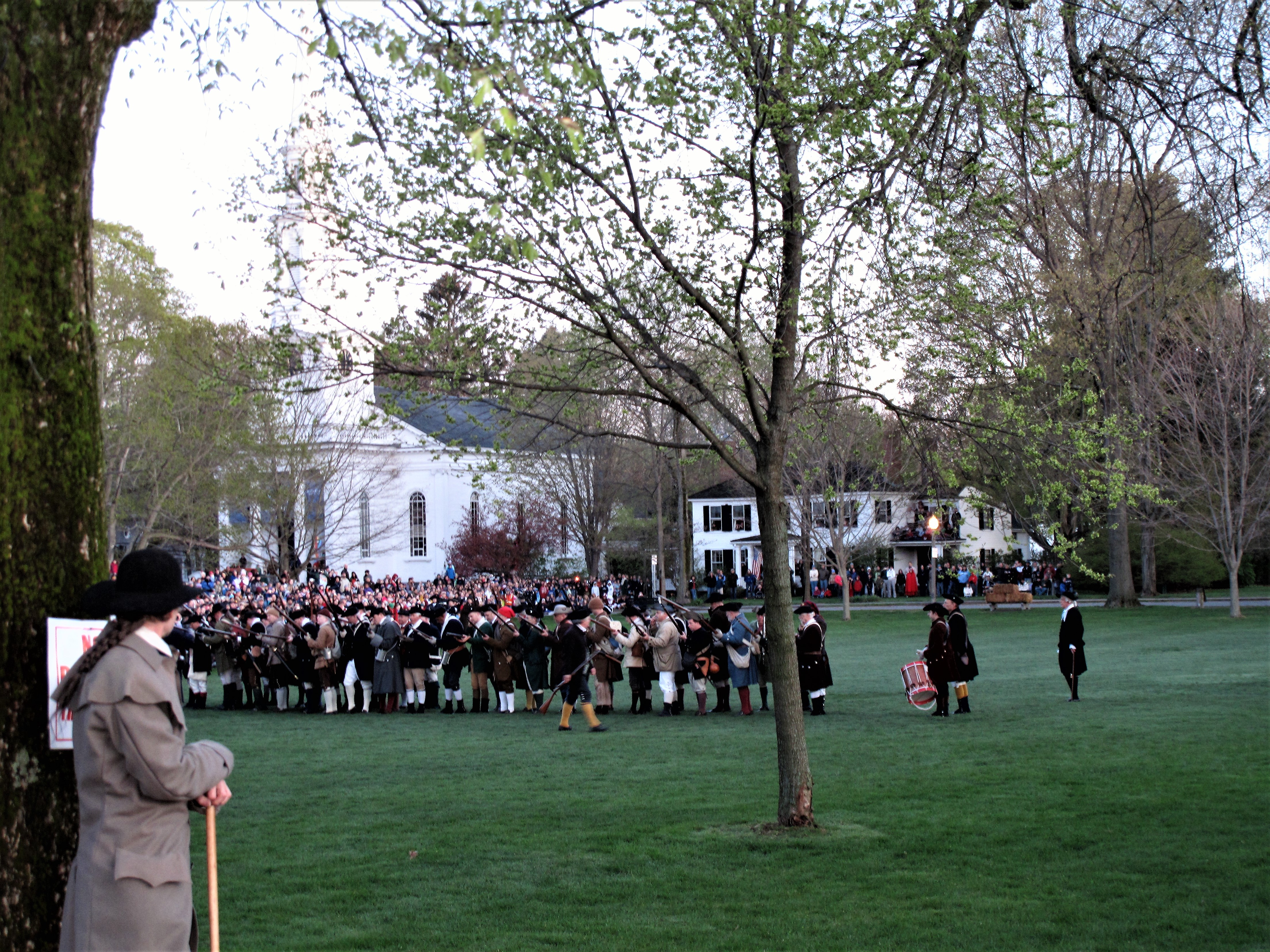
Learning of the impending British advance, Massachusetts Minutemen gather on Lexington Green at dawn. They know they will be outnumbered.

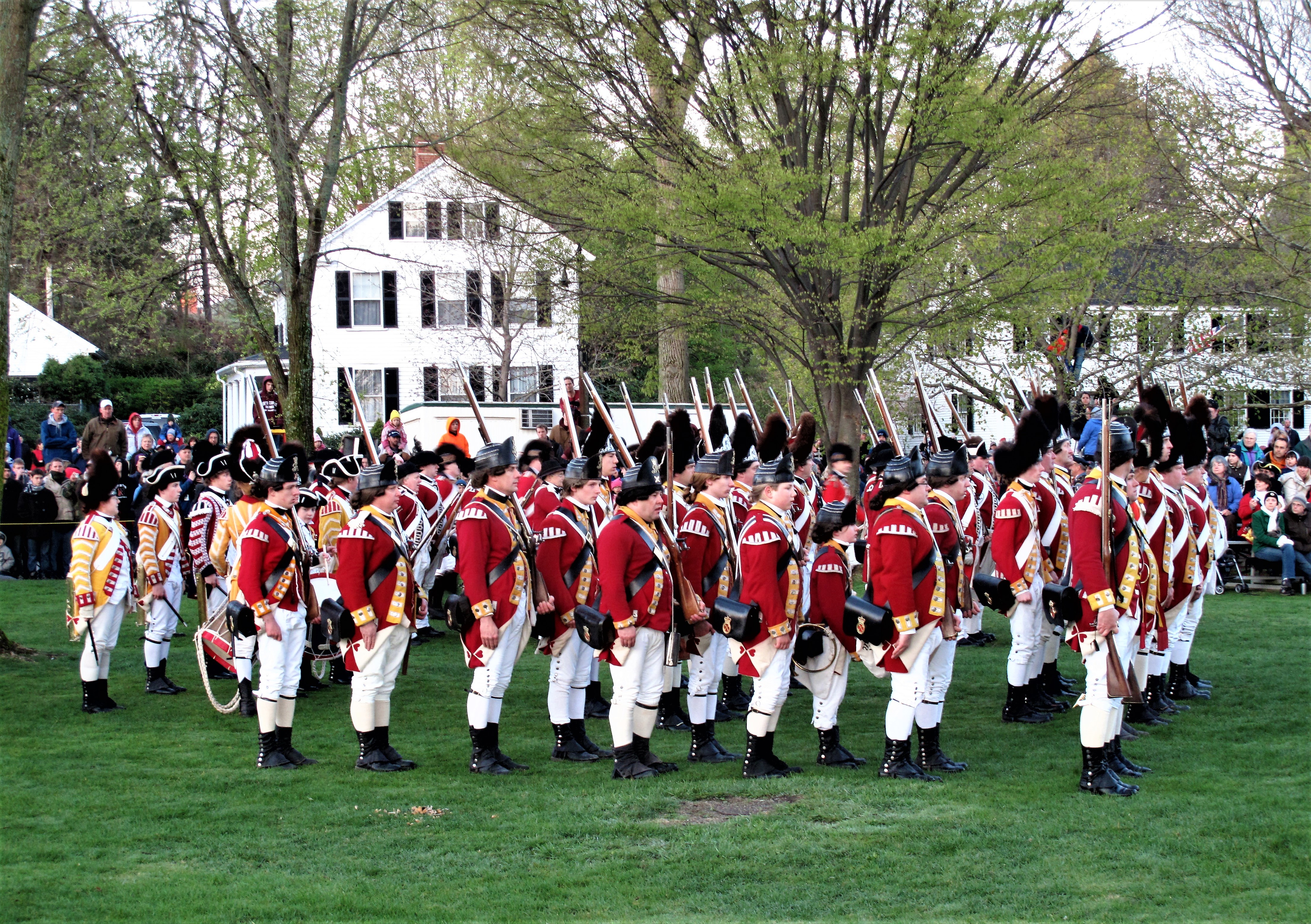
The Redcoats arrive in formation.

The two sides confront each other on Lexington Green. There’s a stand-off.

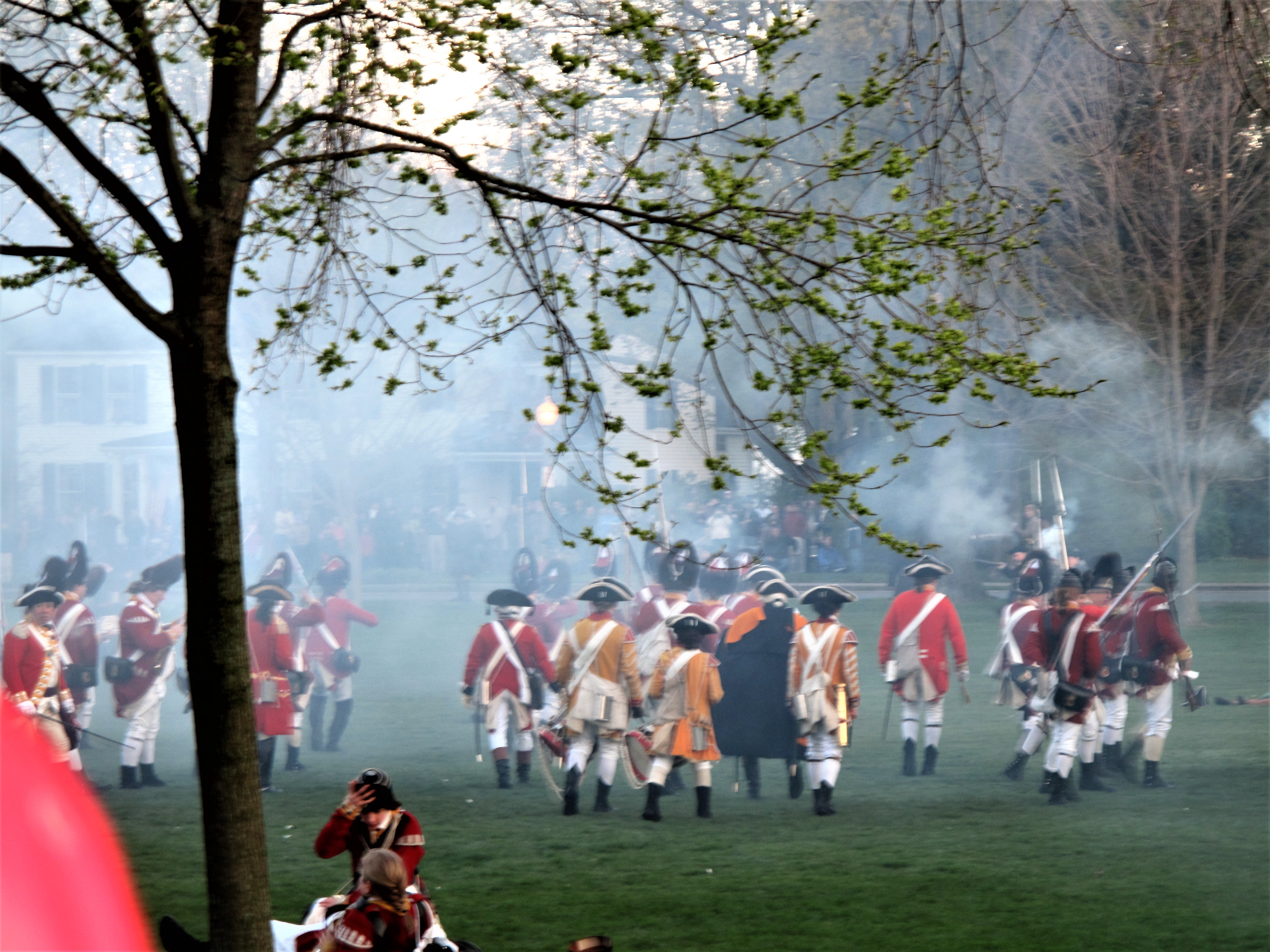
Then shots are fired. The noise and smoke are tremendous.

The result was eight militiamen killed, ten wounded. One British regular was wounded.

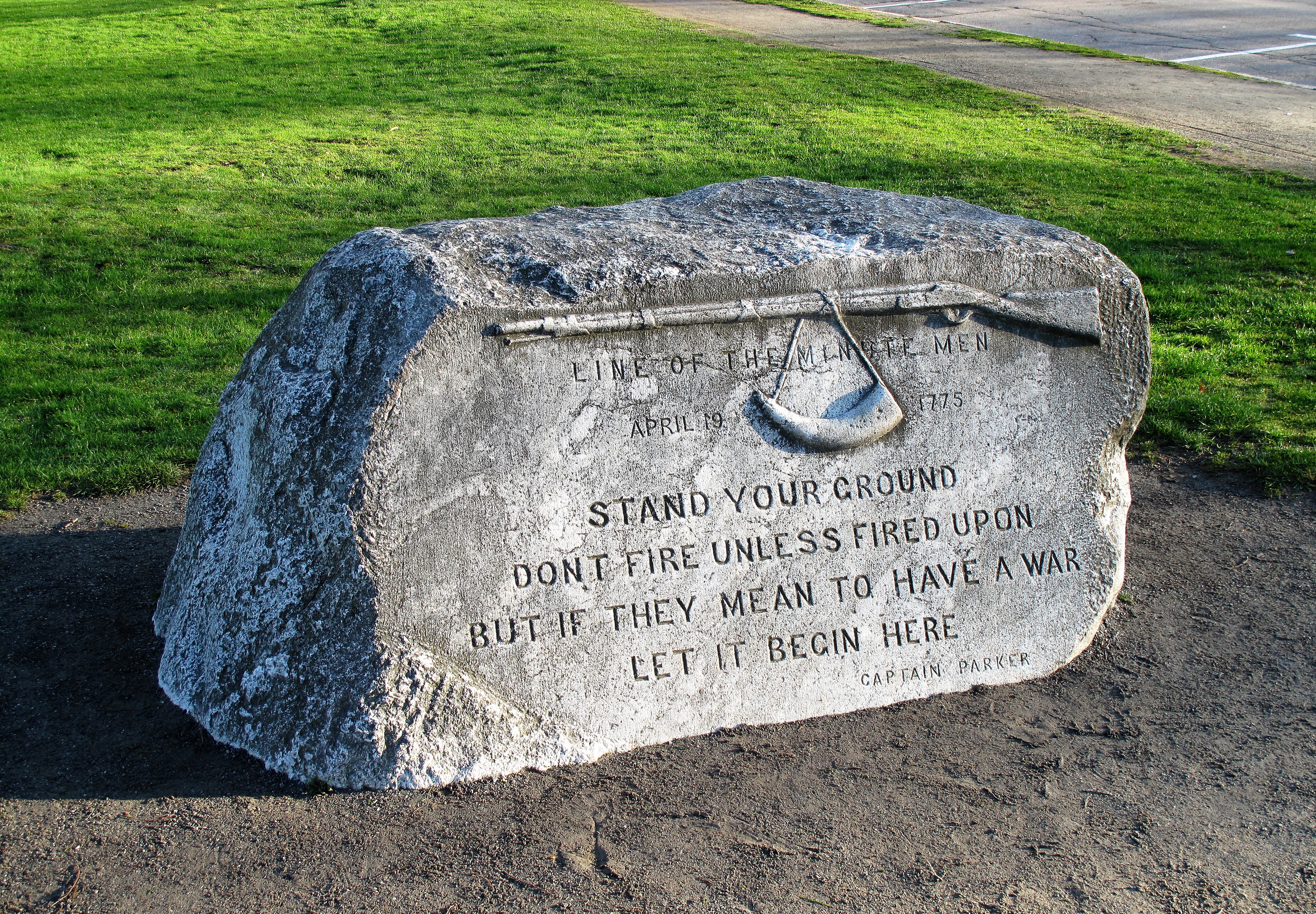
The words attributed to Captain John Parker of Lexington are memorialized in stone:

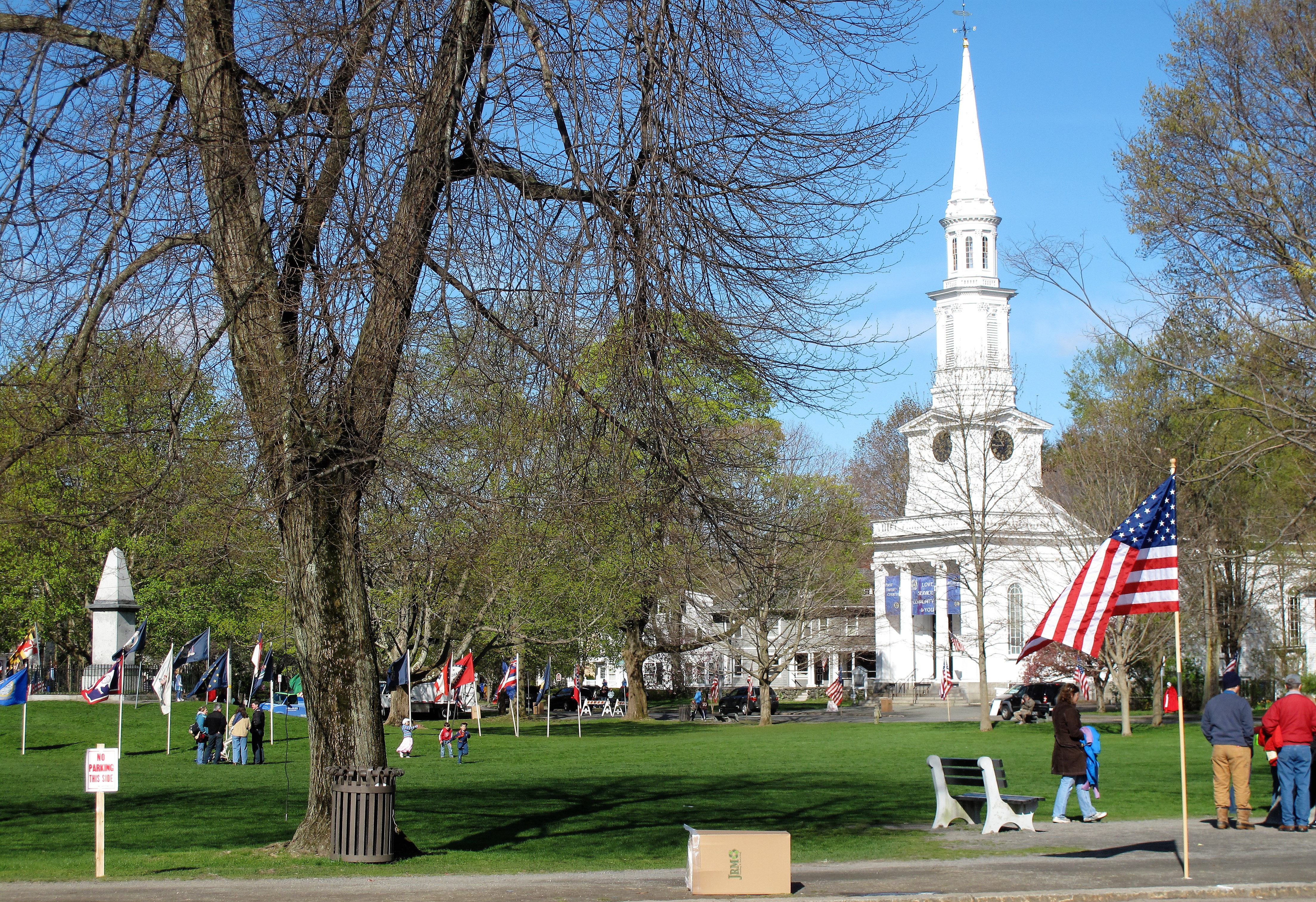
After the re-enactment was over, I had a chance to wander about taking photos. The April weather was cool, but the skies were sunny.

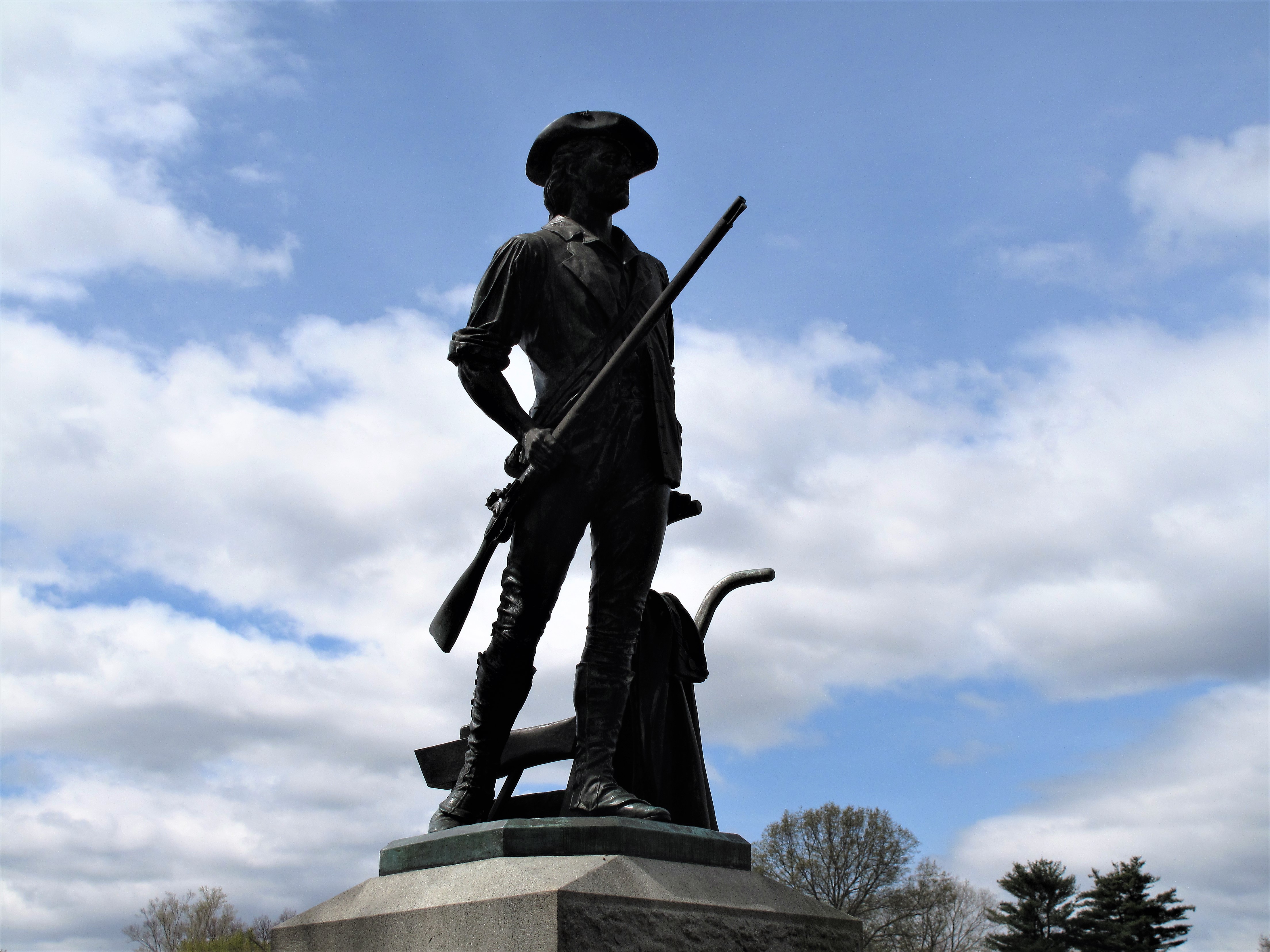
The famous Minuteman statue, Lexington Common. Lexington, Massachusetts
An armed Rebel youth confronts and captures three Redcoat soldiers! What pluck!
Lexington Common

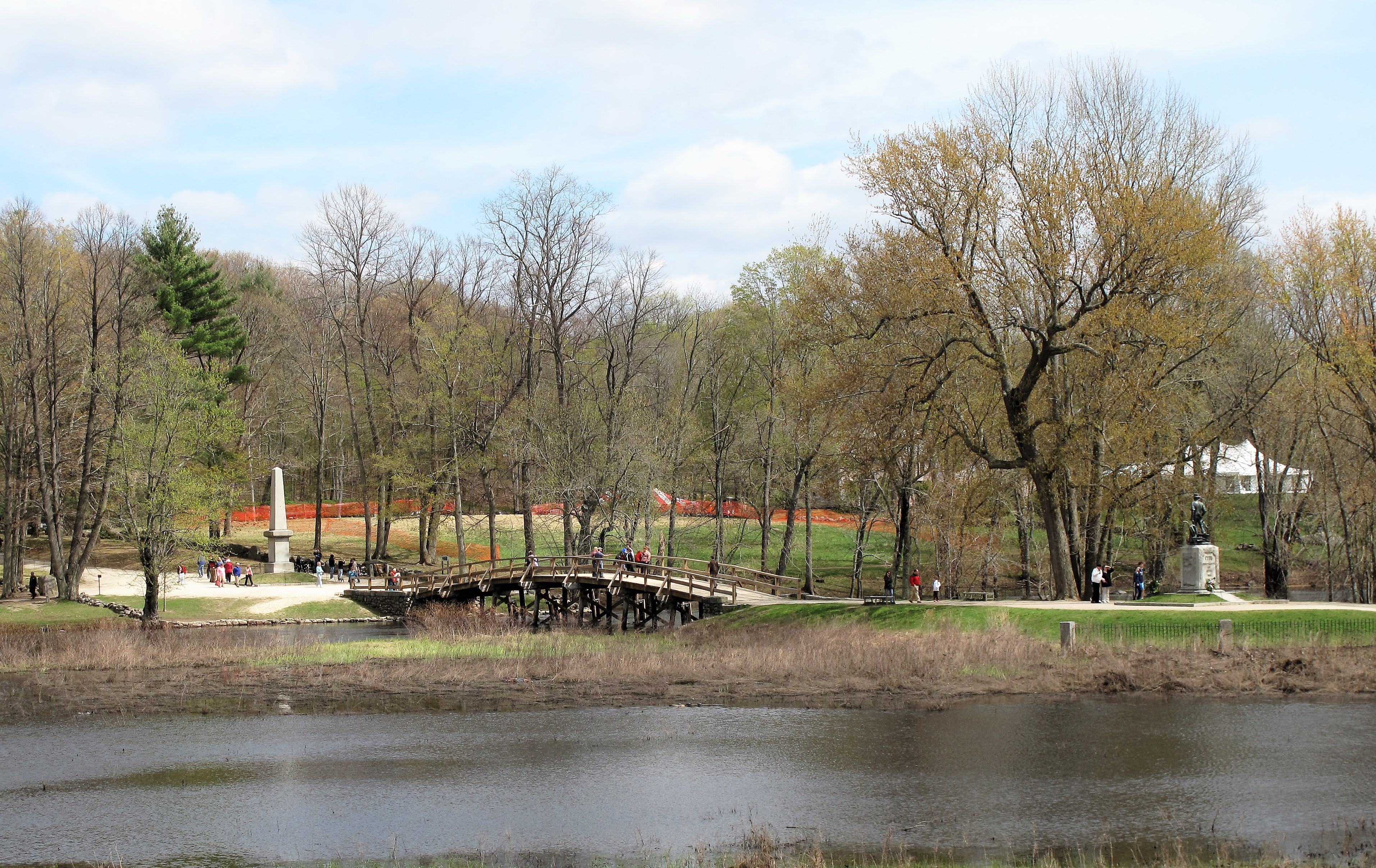
As you know from the history books, the fight then moved on to Concord bridge where 100 British regulars met 400 American militiamen.

Old North Bridge, site of the Battle of Concord. Memorial obelisk is on the left; Minuteman’s statue on the right
Inscription on the obelisk at the Old North Bridge: “Here on the 19th of April 1775 was made the first forcible resistance to British aggression…”
Minute Man statue at Concord, which was erected in 1875 on the centennial of “the shot heard round the world”
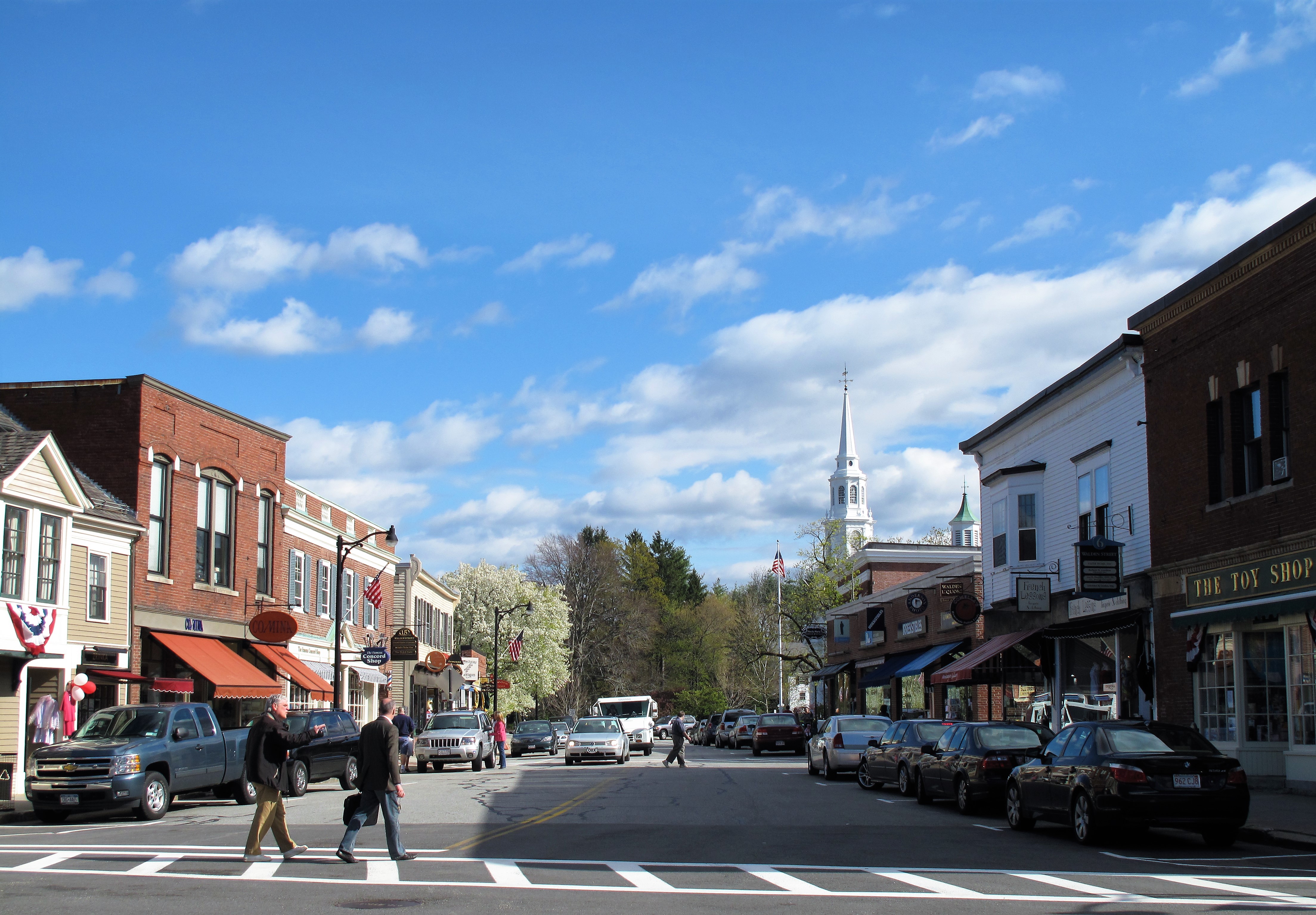
A view down Walden Street. Concord, Massachusetts

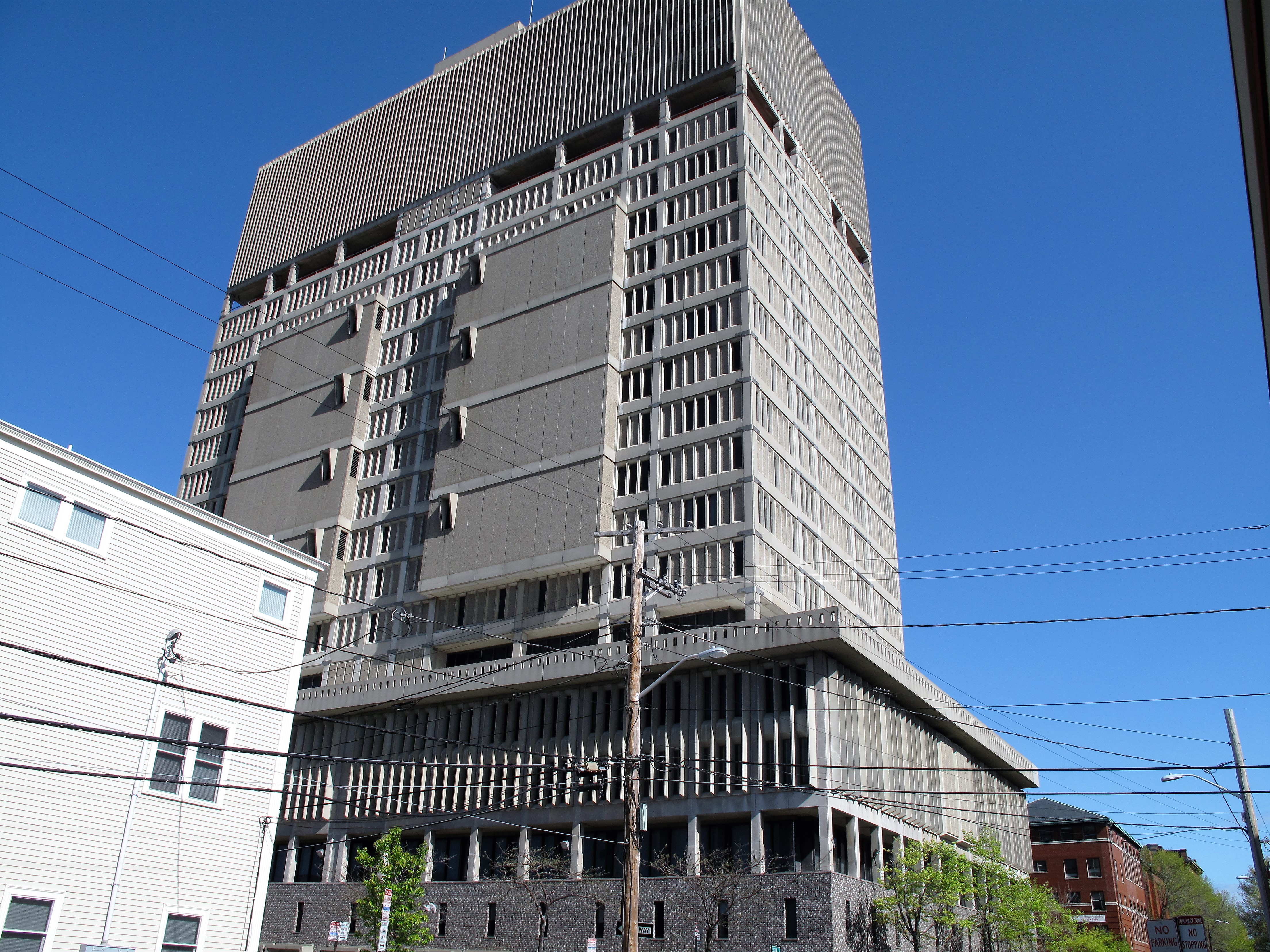
Later on, I drove down to Cambridge, the county seat. The Middlesex County Courthouse looks more like a military stronghold than a court of Justice, towering above residential East Cambridge like Saruman’s Tower from Lord of the Rings.  I believe the jail occupies several of the floors.

The courthouse is in a part of town called East Cambridge, away from the Harvard Square area which was the original Cambridge settlement. The buildings here are townhouses of brick or wood.  The brick ones are remnants of homes for the wealthy; the wood ones are cheaper, yet many have been painted bright colors and remind me of row houses on the Irish seashore.

Middlesex County Courthouse. Cambridge, Massachusetts

  The old red brick courthouse is across the street.

Registry of Deeds and Probate Court. Cambridge, Massachusetts
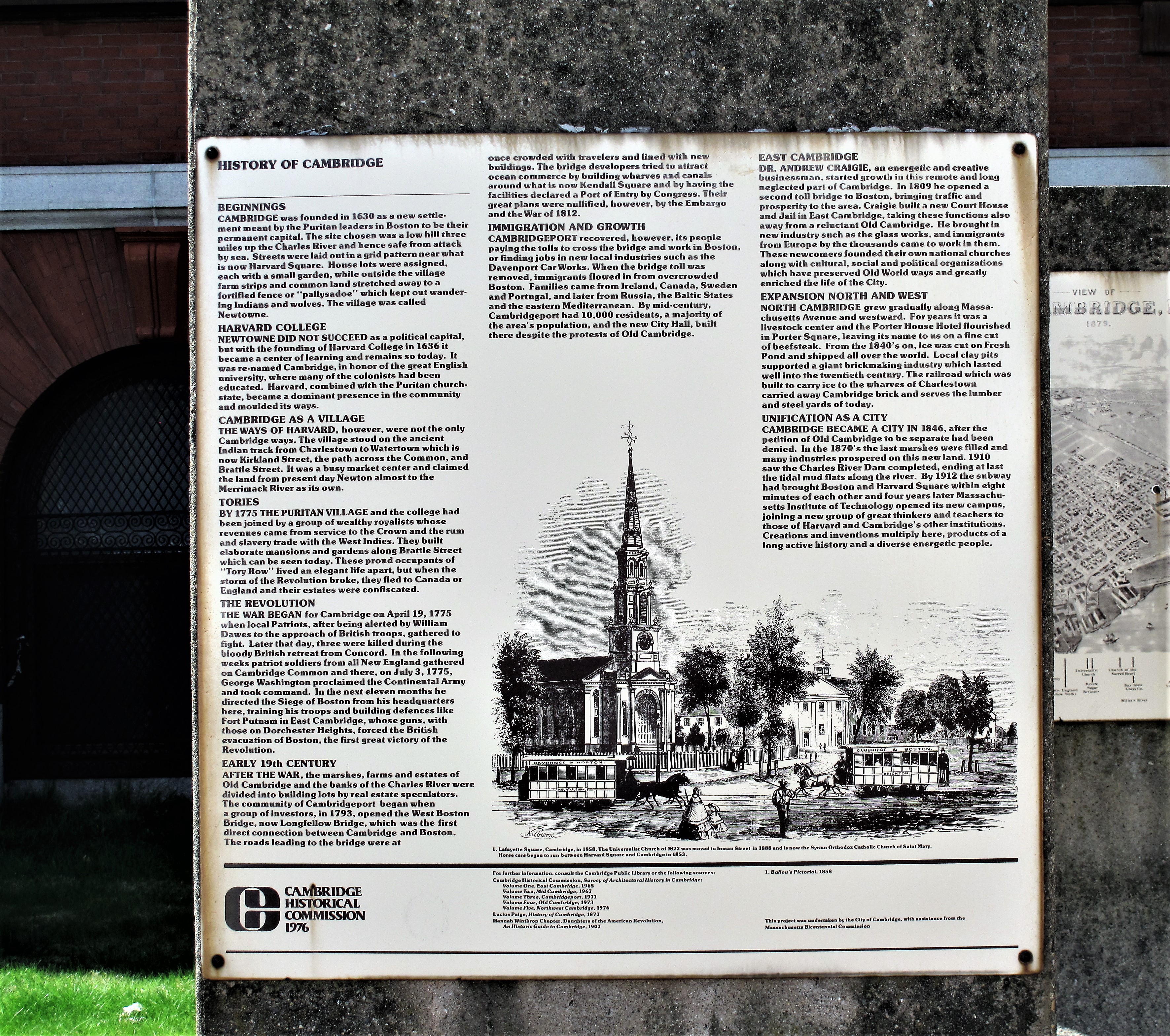
Historical sign: the History of Cambridge
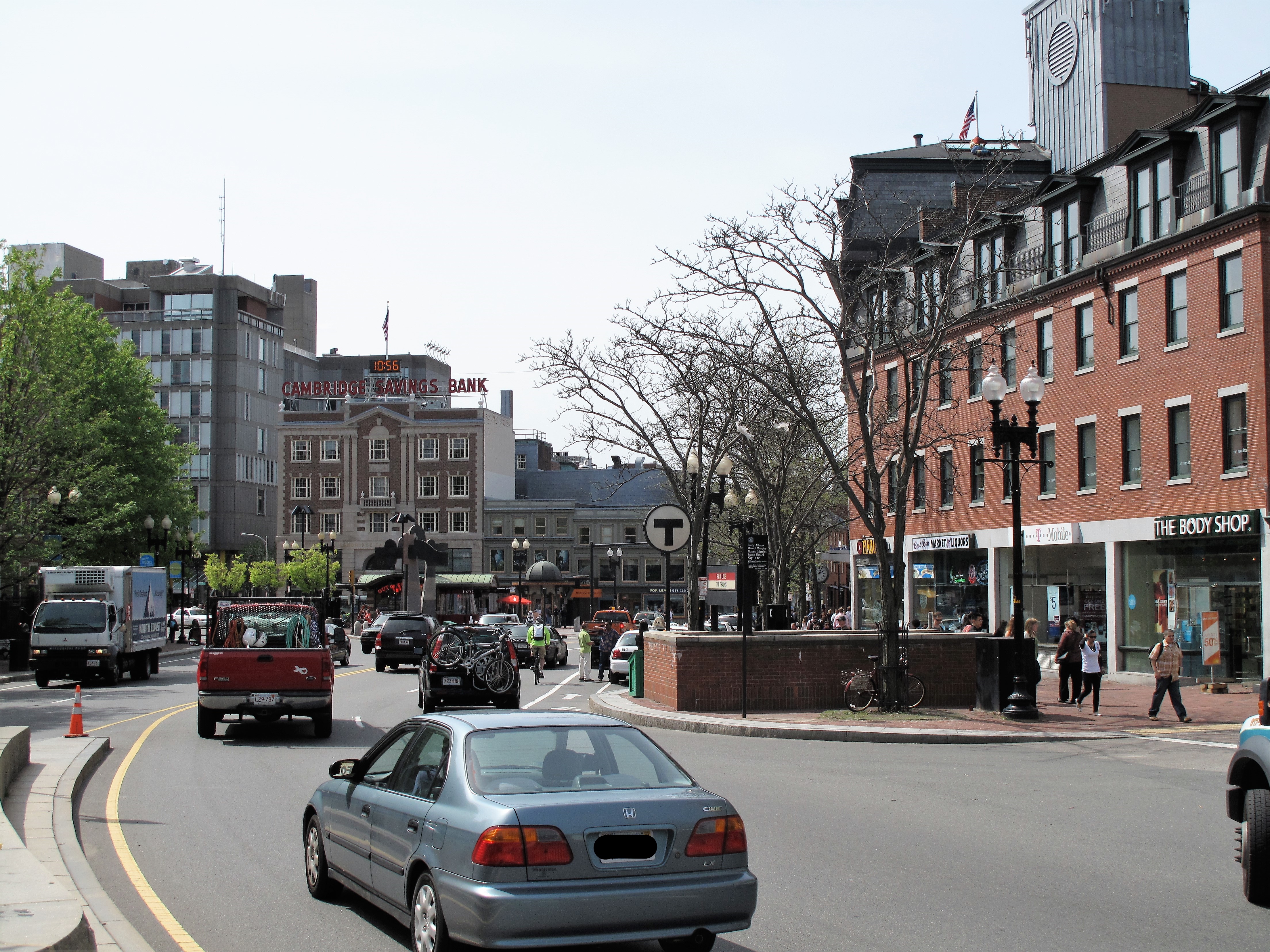
The streets of Cambridge, Massachusetts

From East Cambridge, I drove down Main Street, up Massachusetts Avenue, around Harvard Square, and back down Broadway.  Cambridge is a college town but usually isn’t thought of in the same way as Lawrence, Kansas, or Athens, Georgia.  Yet I was amazed at how much Massachusetts Avenue looks like a college town’s main street.  Shops are in single-story buildings with a few large brick two-story buildings nearby.  Little restaurants and fast-food places predominate.  I saw several Middle Eastern eateries.  However, the pedestrians seemed to be not so much the college crowd as ethnic workers of all types.  So downtown Cambridge seems more of an ethnic neighborhood than a college hang-out.

Residences along the side streets are mostly two-story walkups surrounded by blooming trees.  It’s the middle of spring and all the trees are in bloom right now.  That’s especially nice on a warm, shirt sleeve day, perhaps the best day of spring so far.

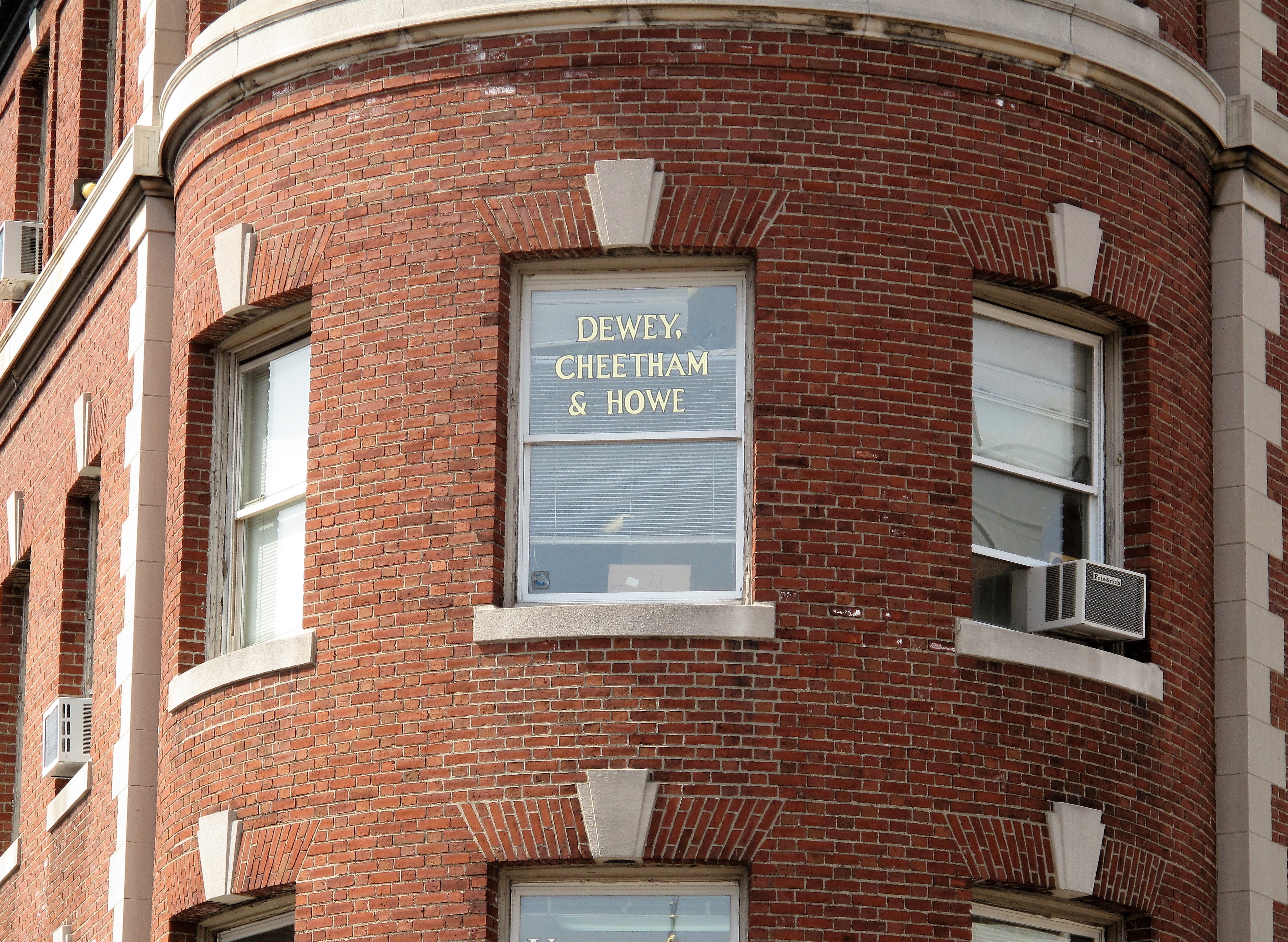
Harvard’s Most Prestigious Law Firm: Dewey, Cheetham & Howe
Hahvard Yahd

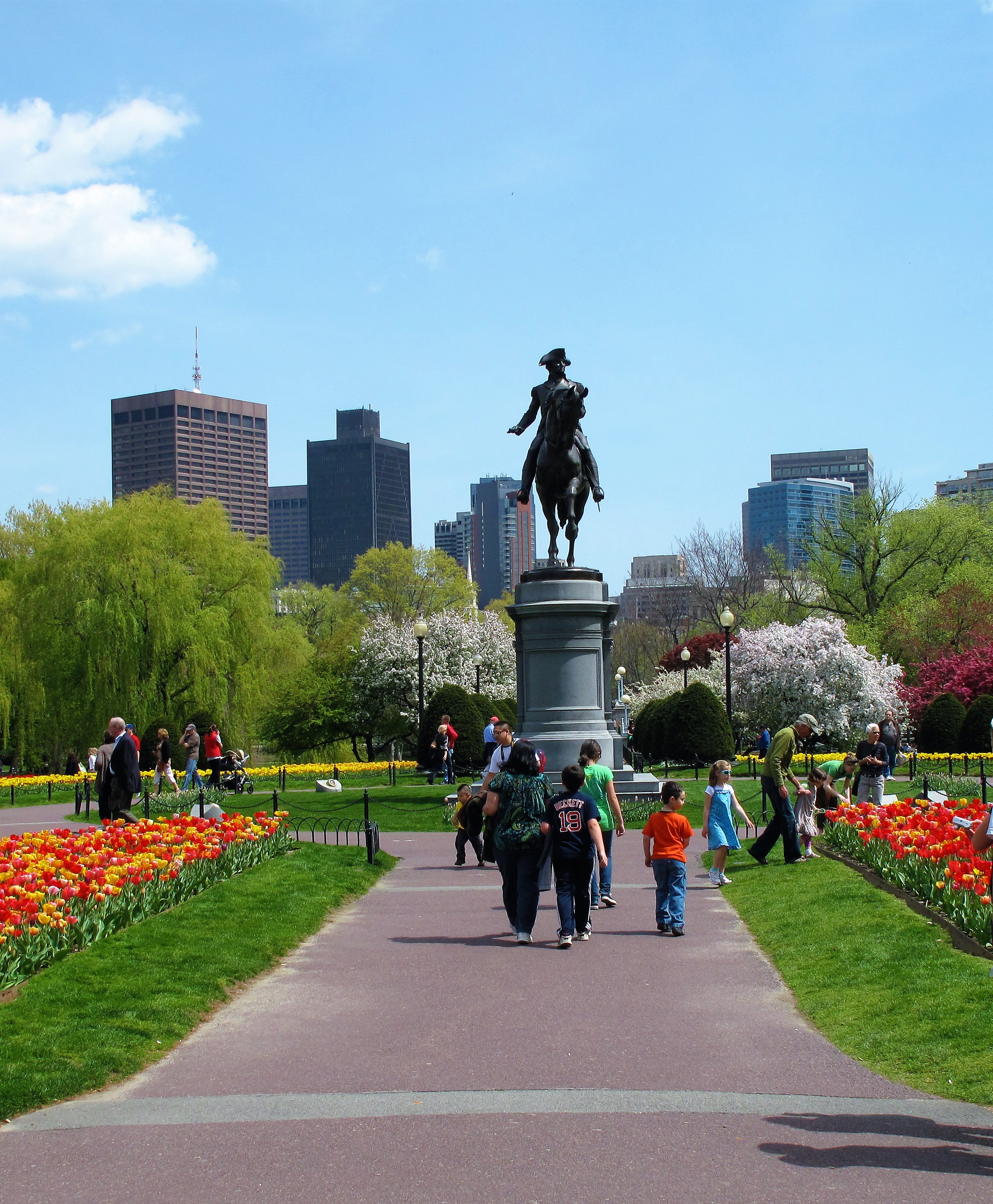
Meanwhile across the Charles River in Suffolk County (Boston) I found this and couldn’t resist adding it here.

Statue of George Washington amid planters of tulips. Boston Common
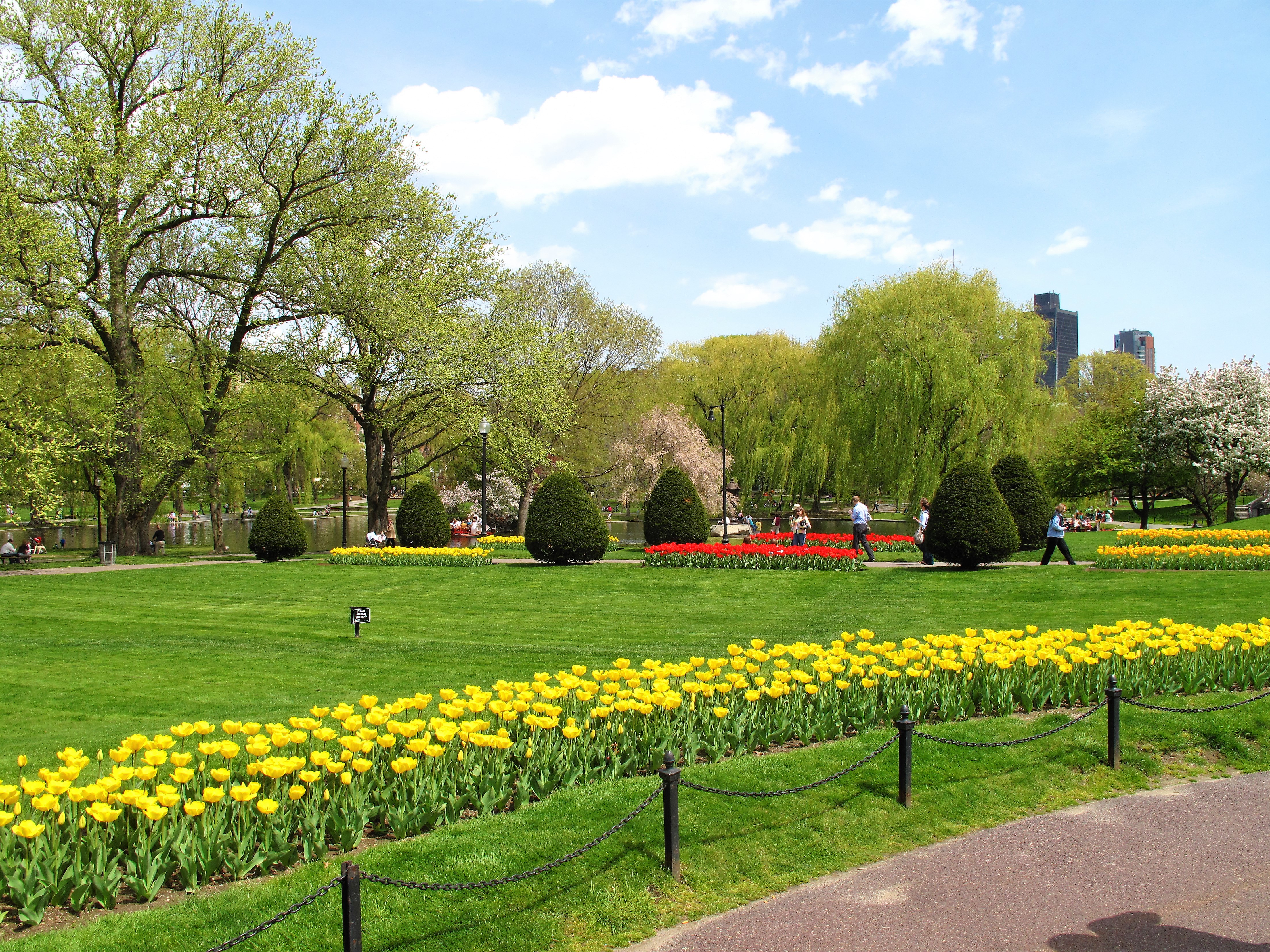
Flower gardens blooming in April. Boston Common
Middlesex County in the state of Massachusetts

All photos were taken by the author. Photos were taken between April 19-21, 2010.


A list of all photo posts from the American County Seats series in TimManBlog can be found here.

I’m trying to travel to all of America’s county courthouses, and each month a post about my visit to the most interesting county seats. It’s only a hobby — but donations are greatly appreciated to help defer my costs.
Thanks,
Tim

One-Time
Monthly
Yearly

Make a one-time donation

Make a monthly donation

Make a yearly donation

Choose an amount

¤5.00
¤15.00
¤100.00
¤5.00
¤15.00
¤100.00
¤5.00
¤15.00
¤100.00

Or enter a custom amount

¤

Your contribution is appreciated.

Your contribution is appreciated.

Your contribution is appreciated.

DonateDonate monthlyDonate yearly
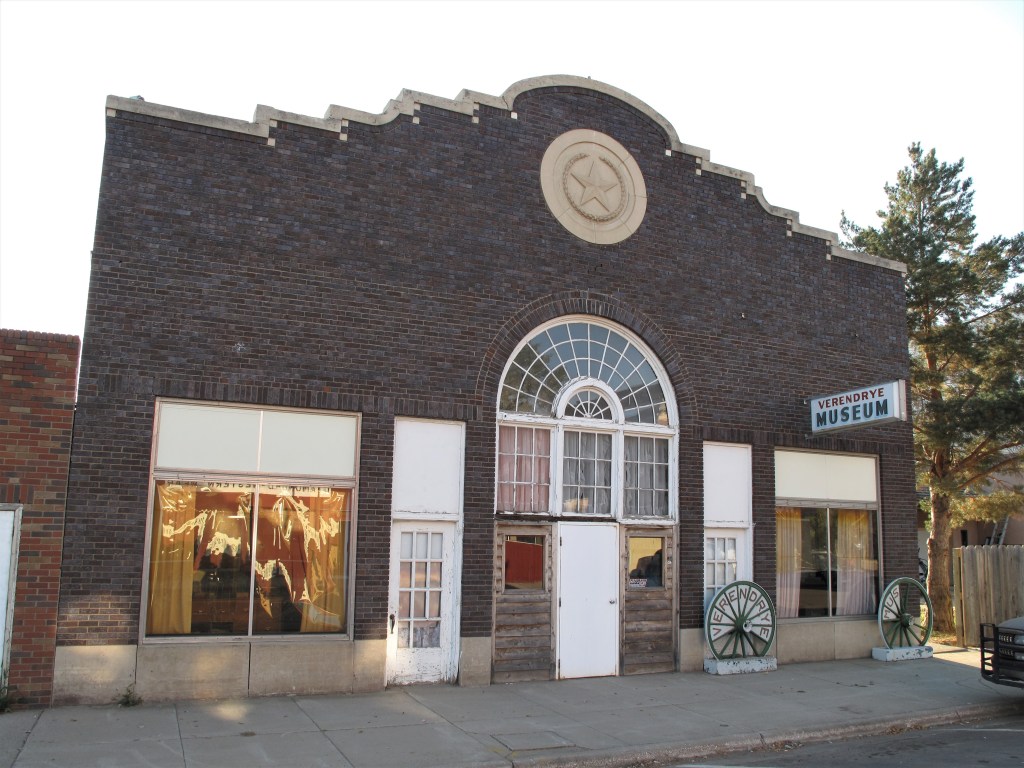
Climbing to Mariposa

March 31, 2019

The Scenic Route to Mariposa

If someone were ever to write the Great California Epic, they might wisely choose Mariposa as the central setting, for Mariposa, near the entrance to the great Yosemite Valley, is the navel of the Golden State. All California life seems to flow from this place like water from a spring.

Mariposa is nestled in the foothills of California’s central Sierra Nevada Mountains, just outside the boundaries of Yosemite National Park.

Mariposa County in the state of California

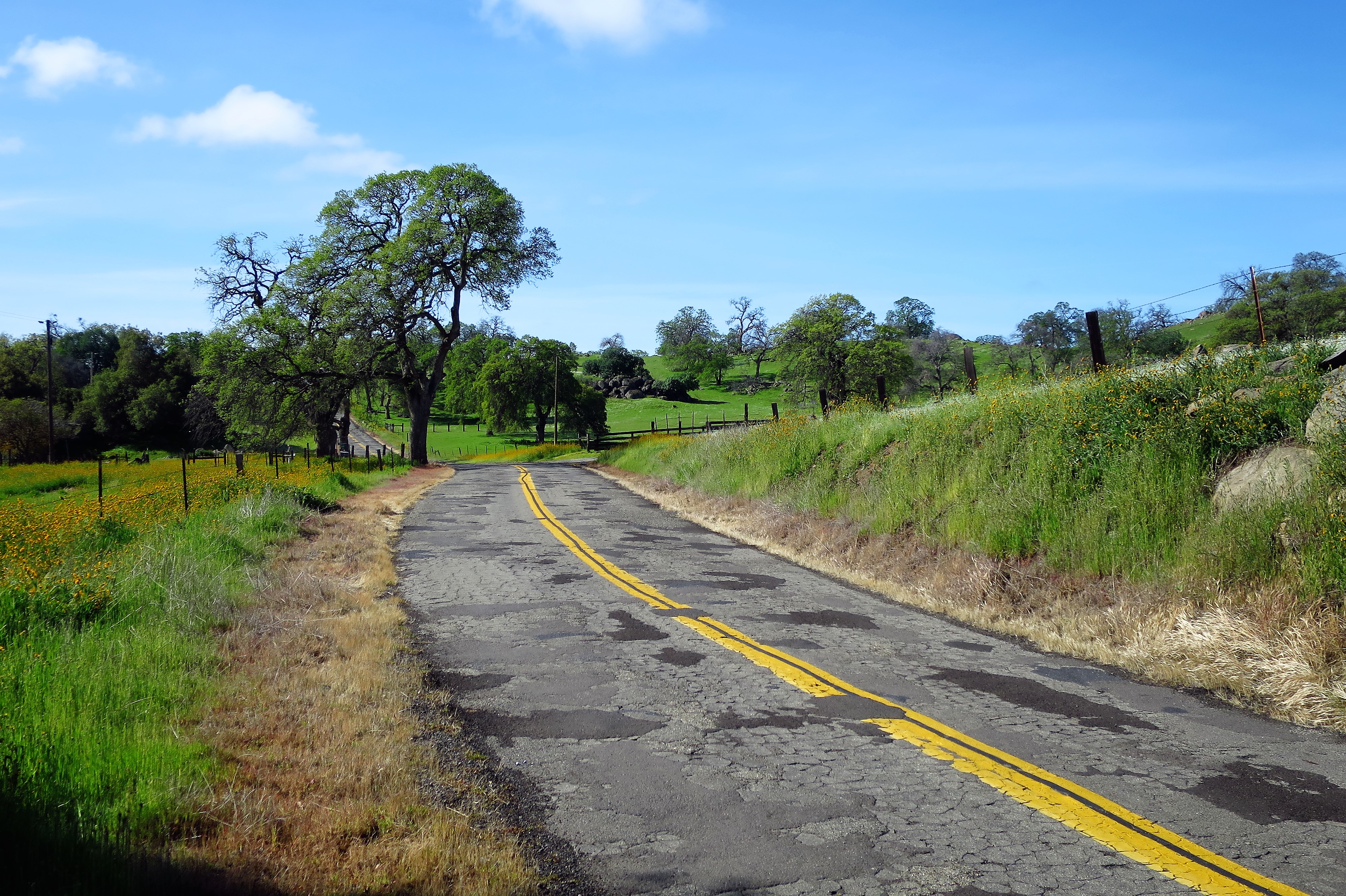
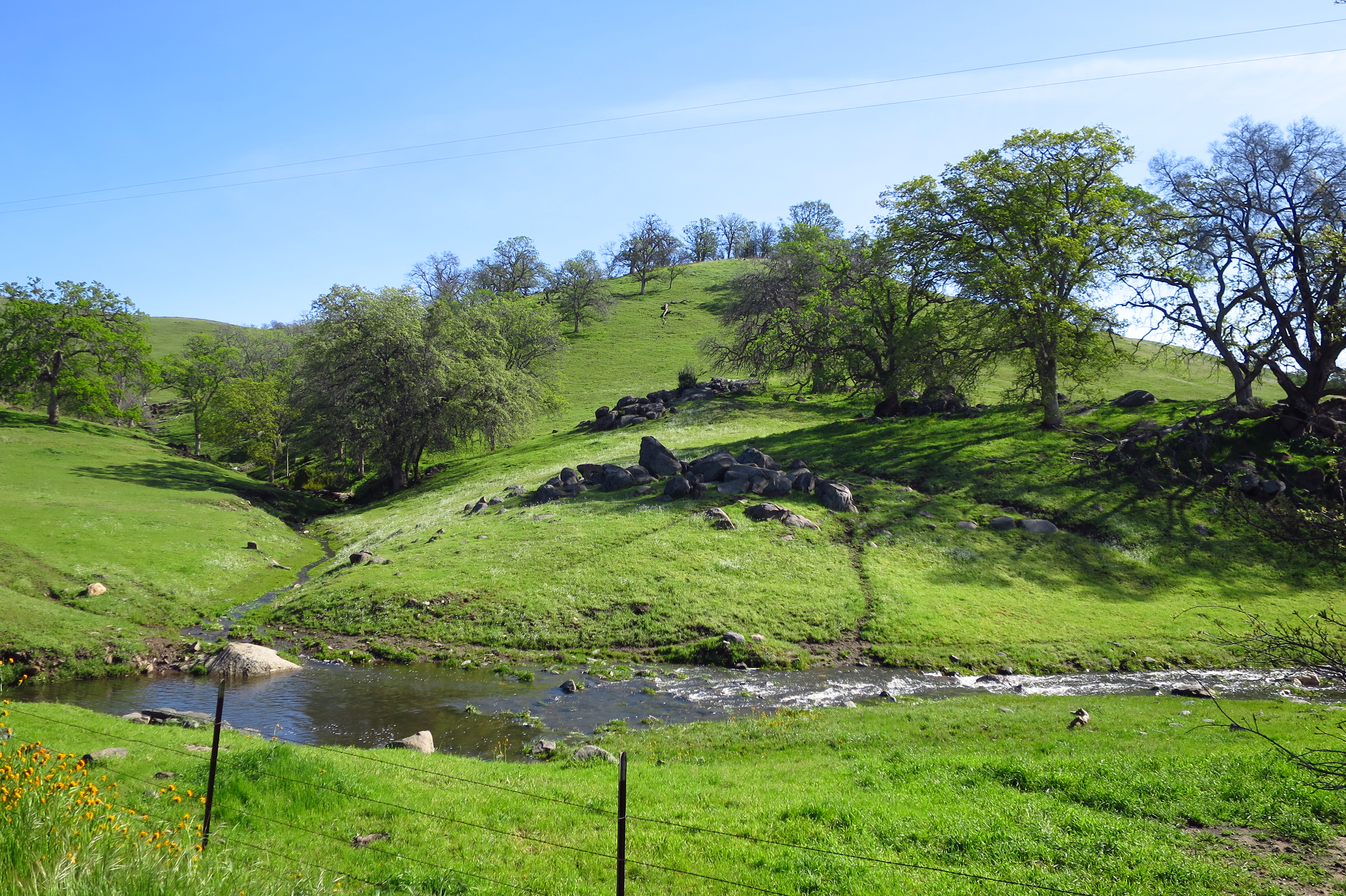
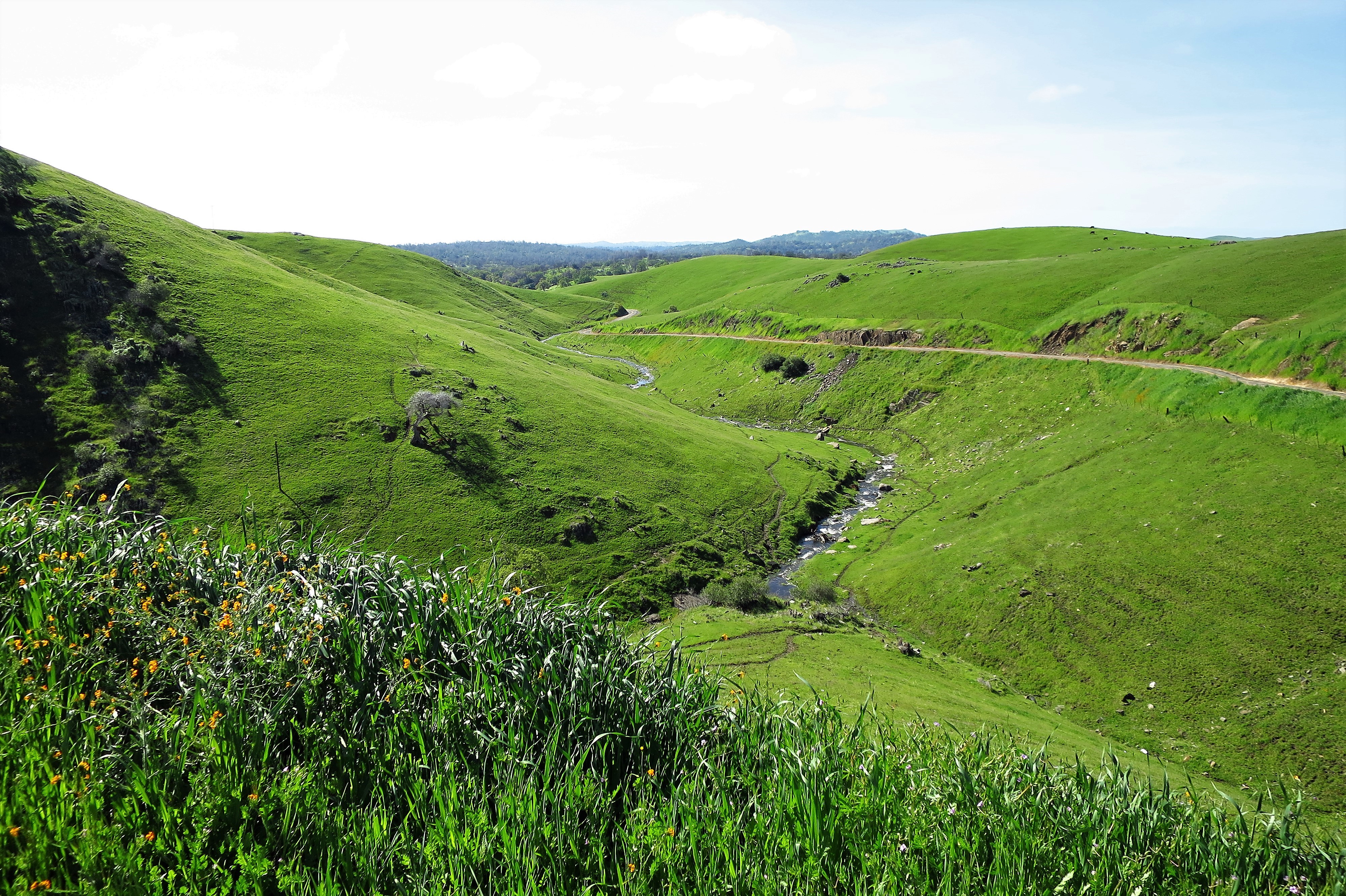
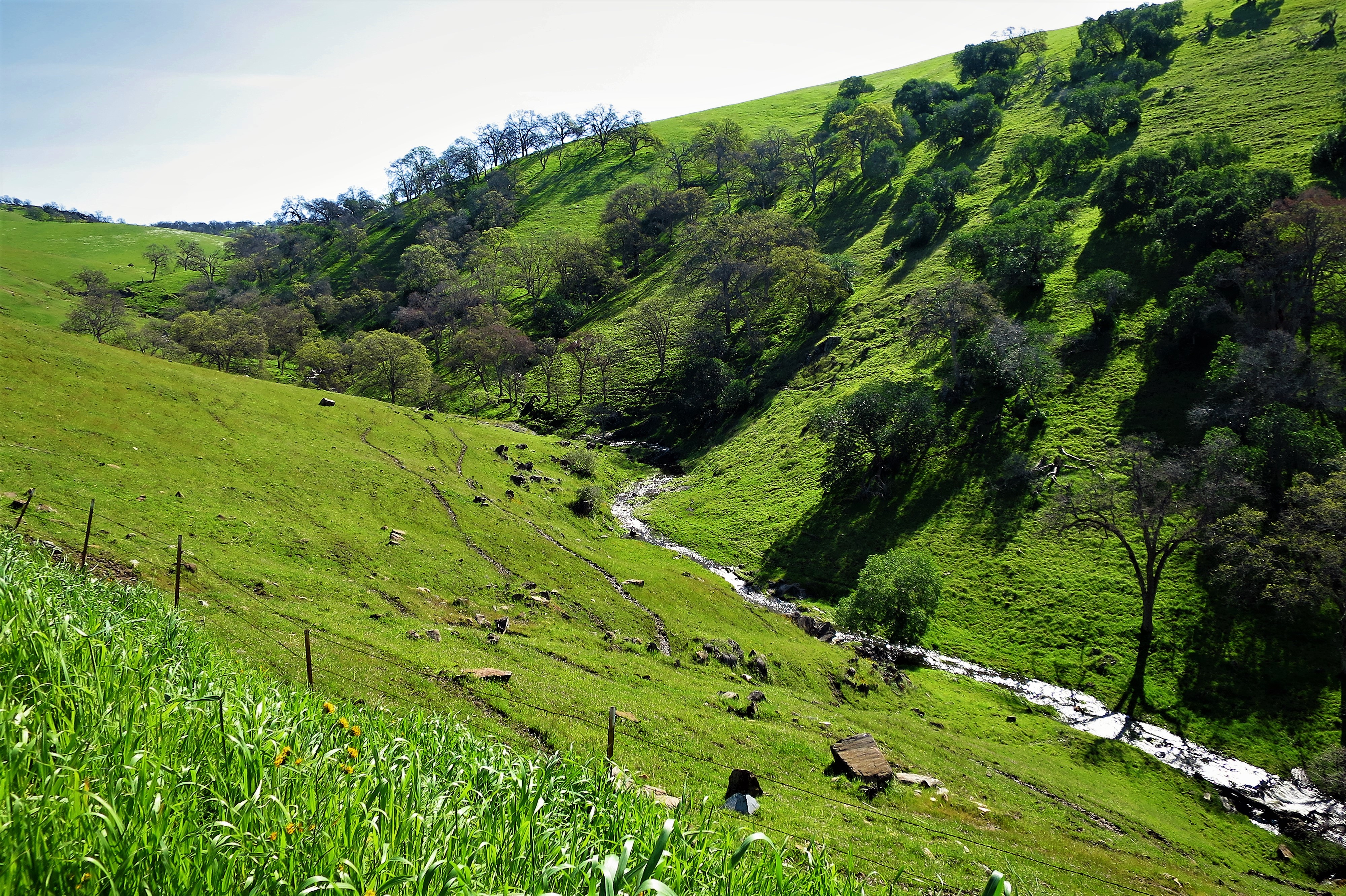
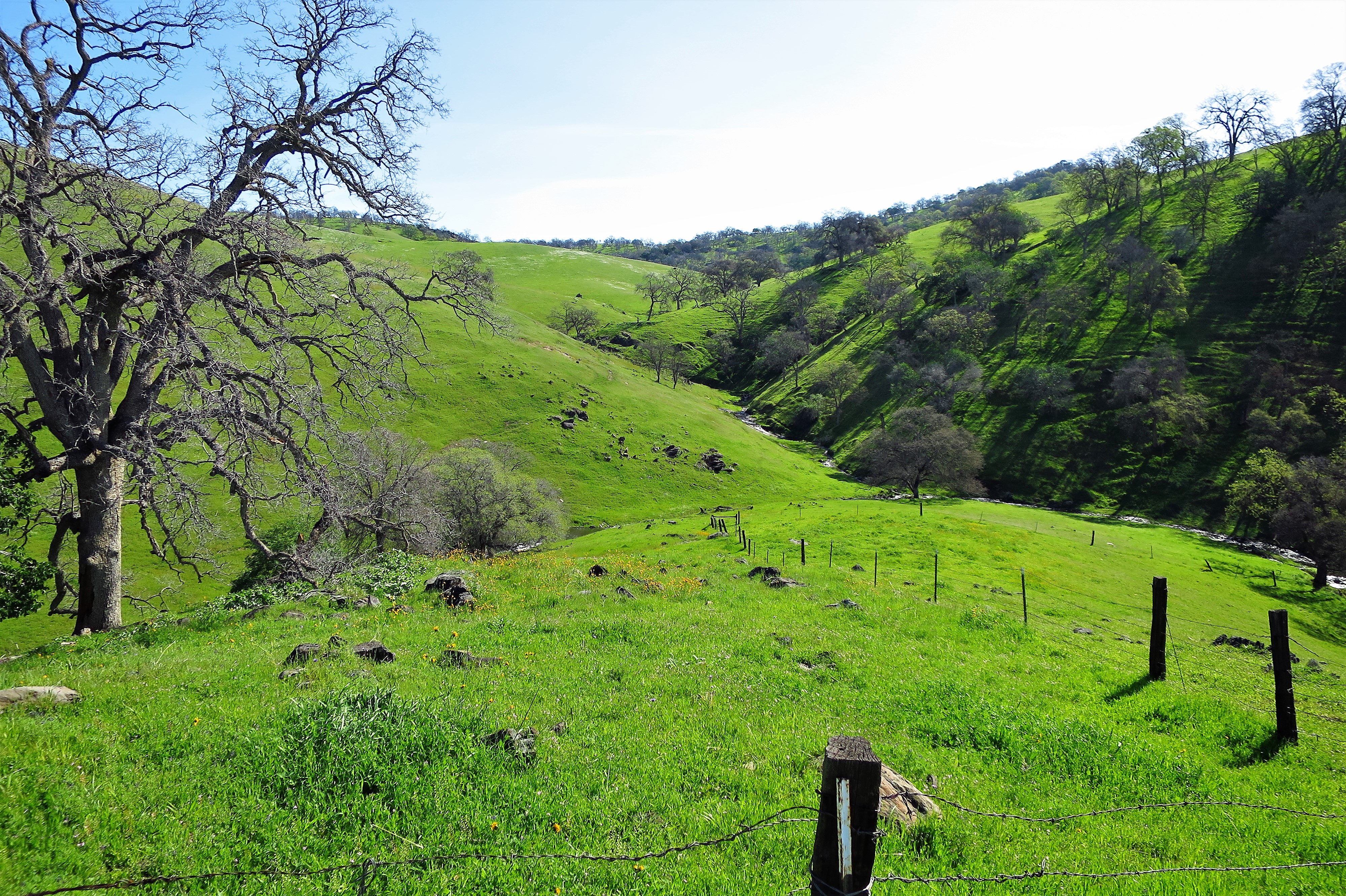
To get here, start from the San Joaquin Valley raisin towns of Fresno or Madera on a clear March morning (as I did, back in March 2016). Then, put away the road map and turn on Google Maps. Change the settings to “avoid highways” and follow the roads uphill. Here’s what your climb will look like:

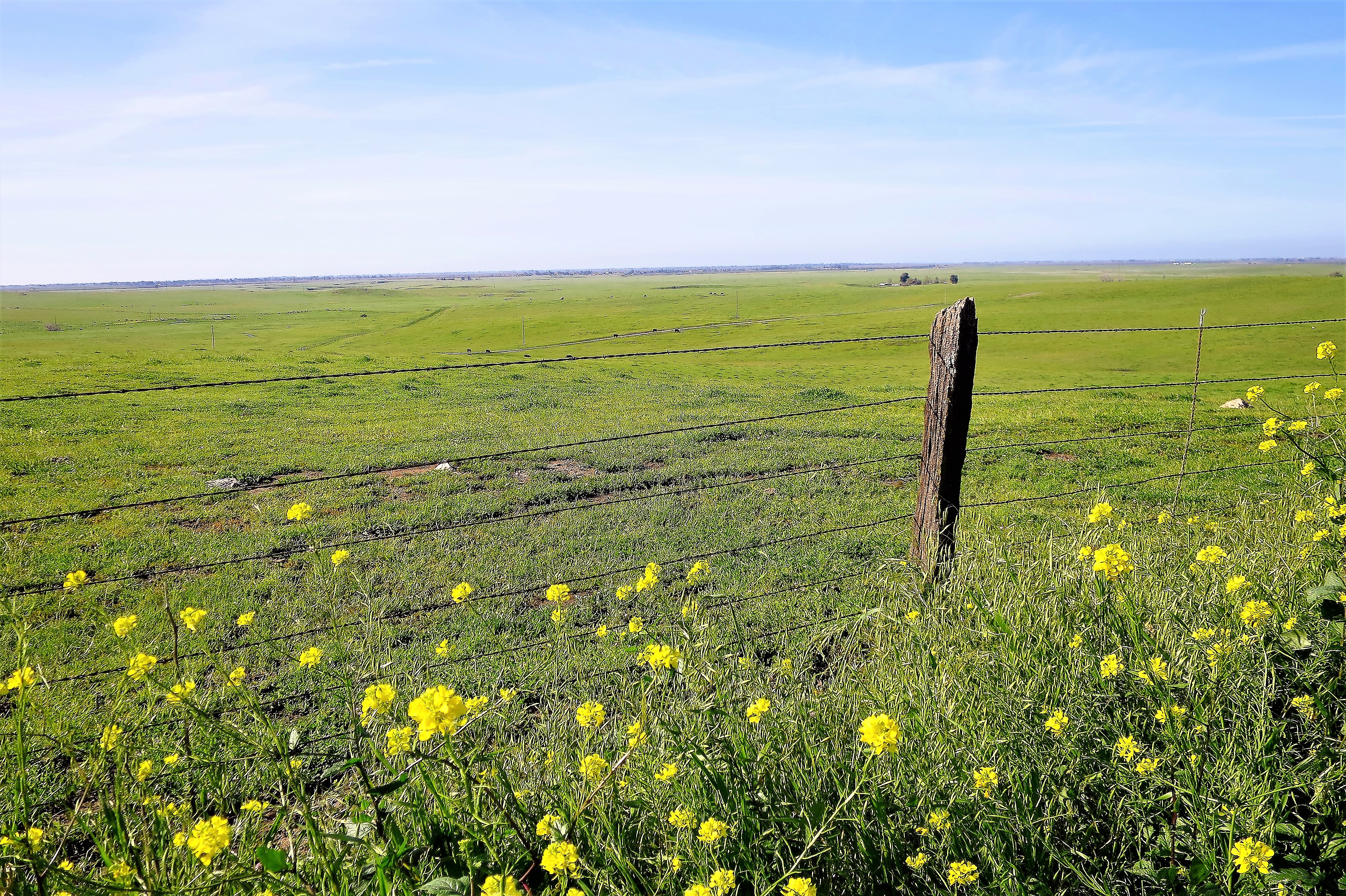
Climbing above the San Joaquin Valley (Madera County, California)
Country road, Madera County
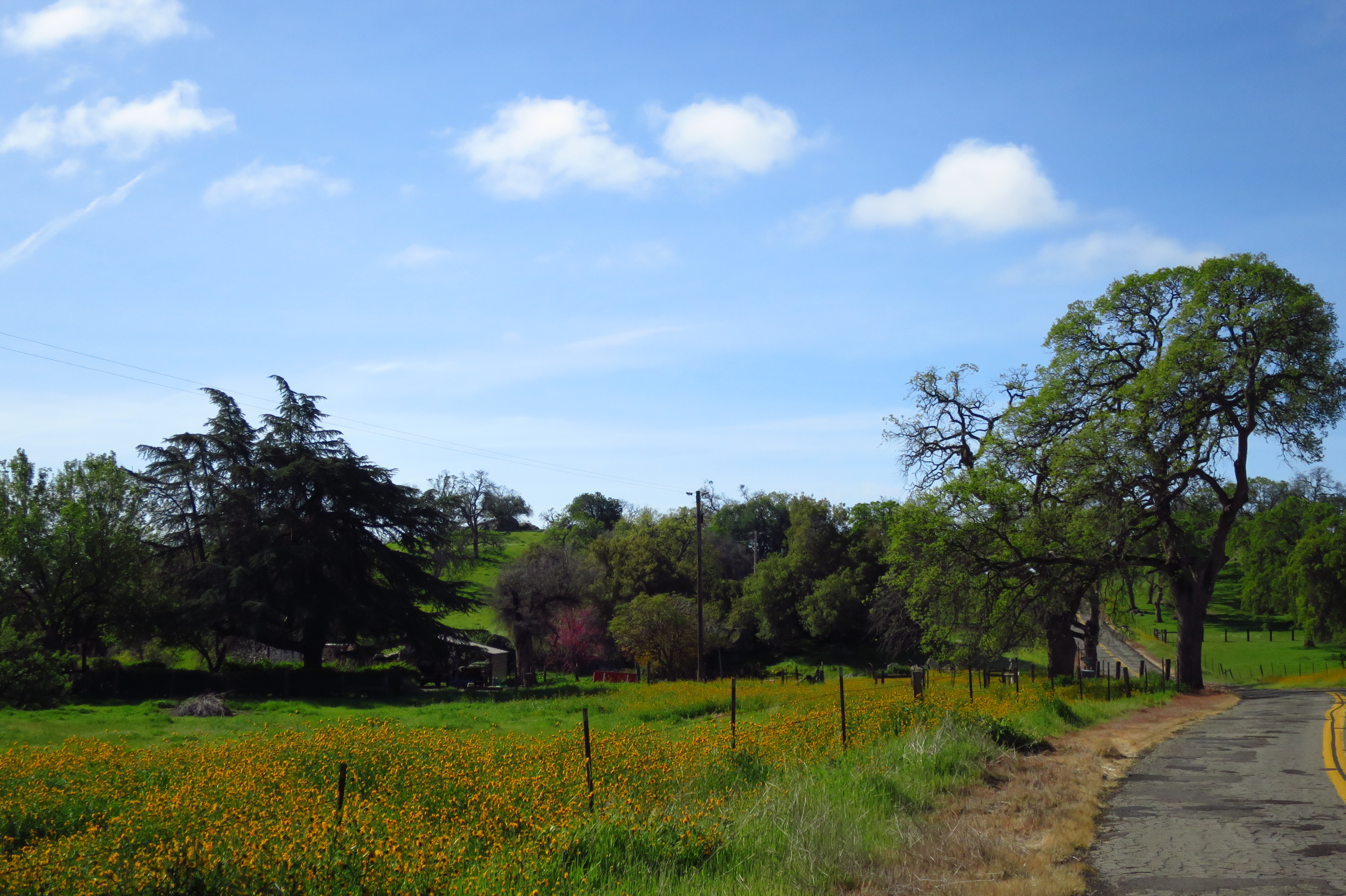
Isolated ranch hours, Madera County

Entering Mariposa County:

Old Farm house, Mariposa County
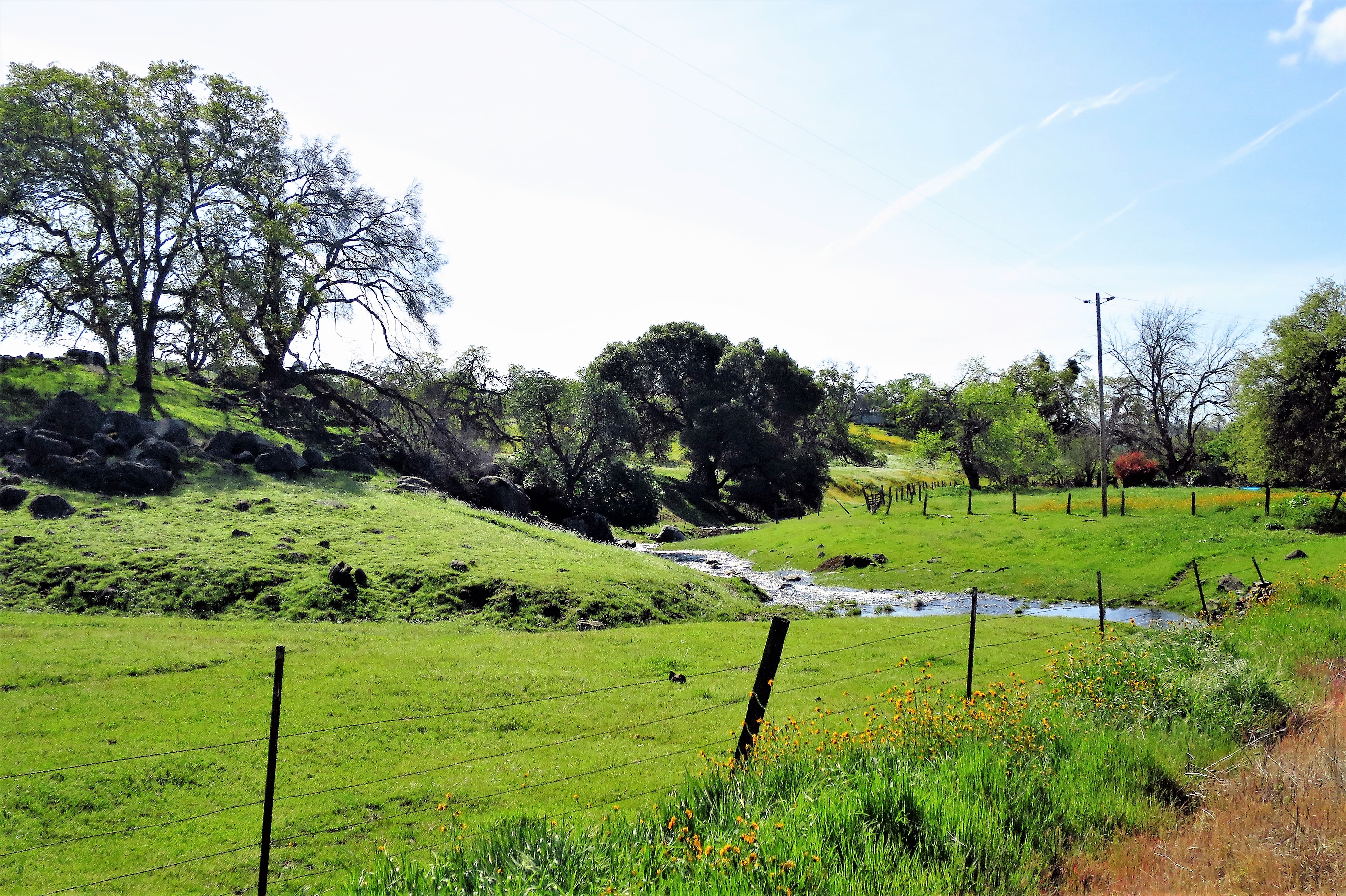
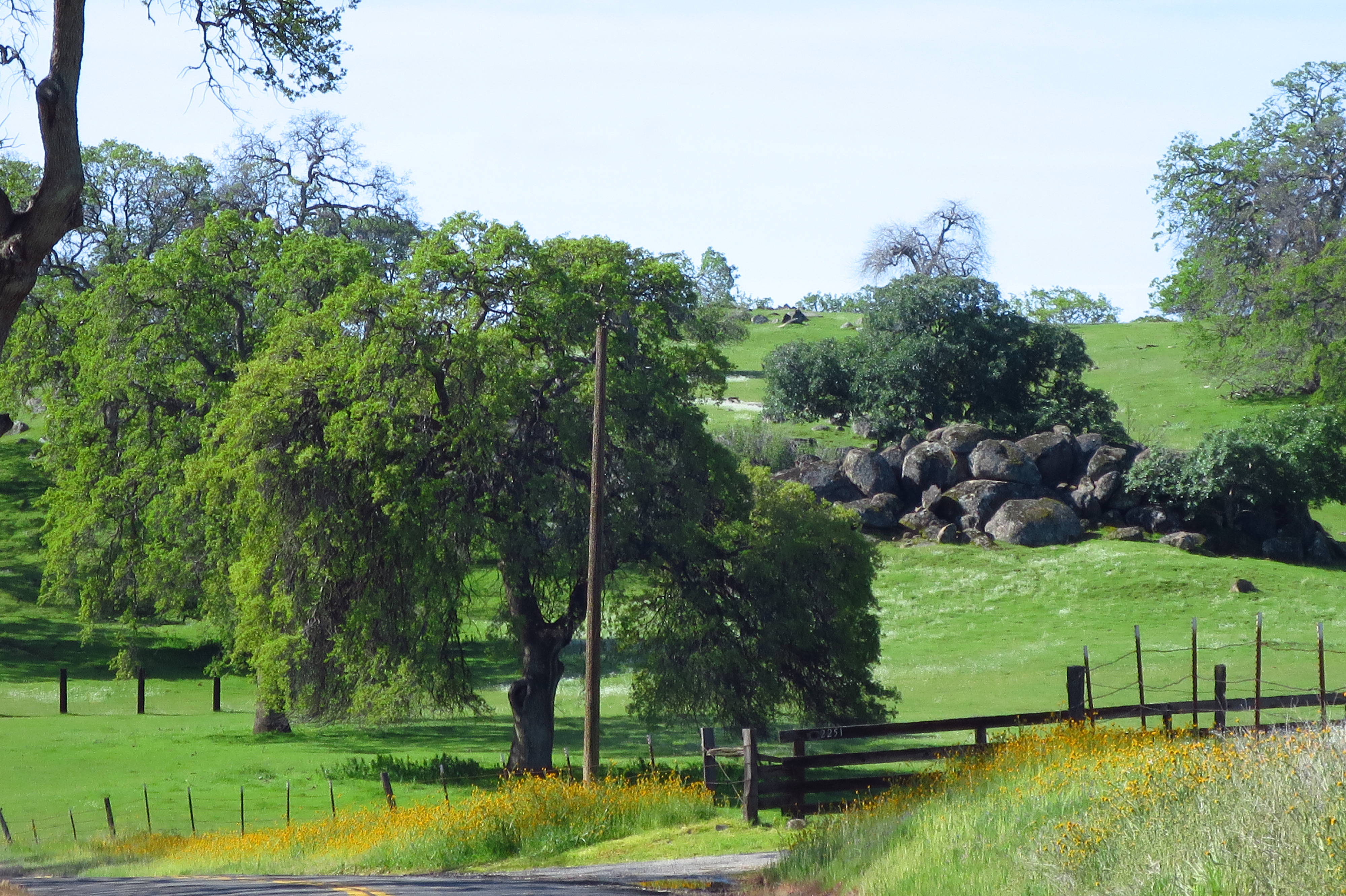
Oak Trees, ranches, and Sierra spring run-off

The climb gets steeper as you get higher into the Sierra, but the grass is still as green as if it were Ireland.

Sierra Nevada foothills, Mariposa County, California
Spring freshet, Mariposa County

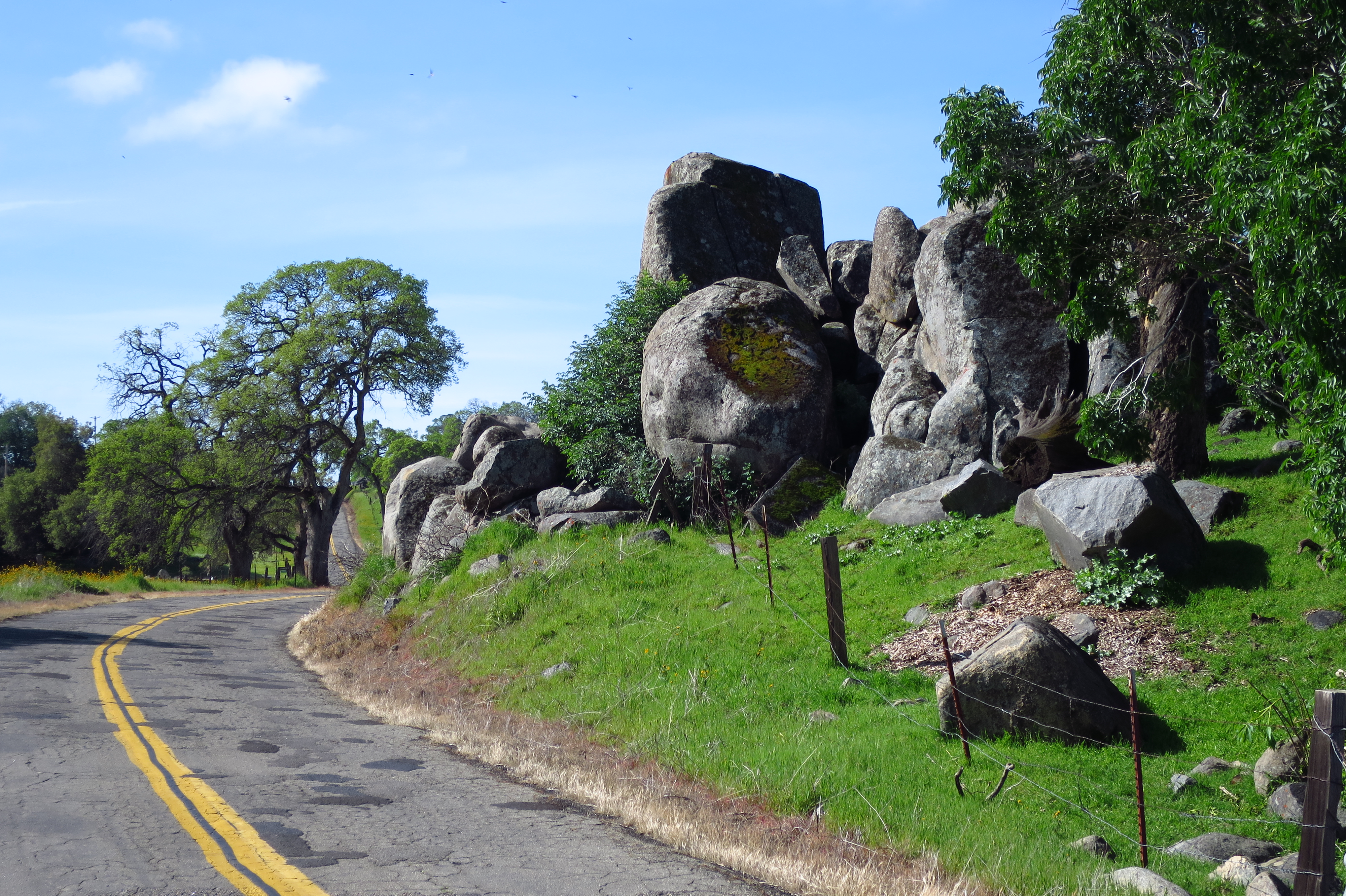
The road twists around granite boulders as you climb higher into the mountains.

Mariposa County

Finally, you arrive.

Downtown Mariposa, California along the “Central Yosemite Highway”

I remember coming up to Mariposa for the first time back in the 90s with my then-girlfriend. She pointed out that Mariposa means “butterfly” in Spanish. She knew of what she spoke.

Mariposa, California

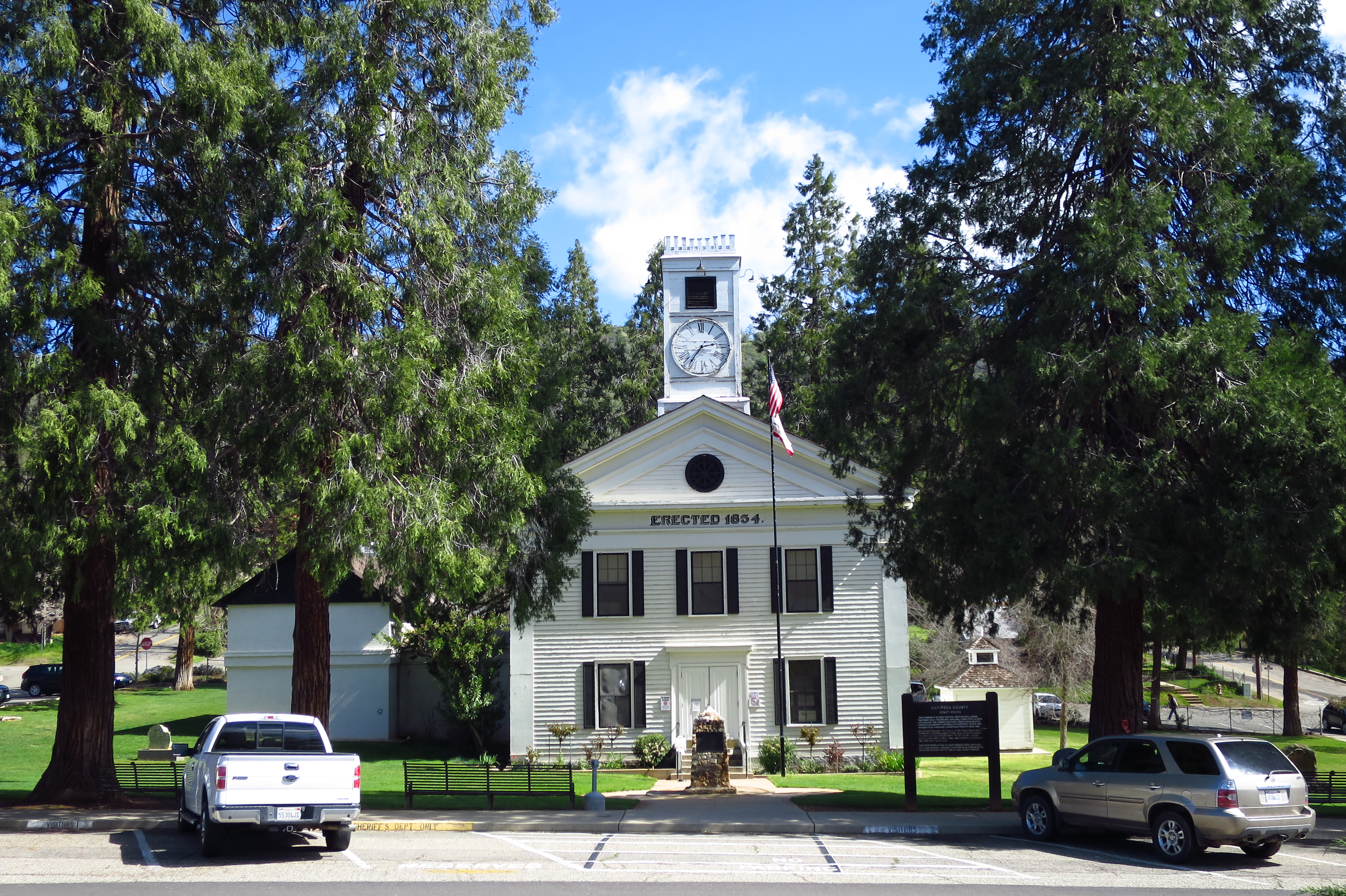
Mariposa is an old gold mining town and the seat of Mariposa County. The old courthouse was built in 1854, was the scene of some landmark mining cases, and is still in use today. It’s the oldest county courthouse in the state of California. It may be even older than the two Sequoia trees which guard the front entrance.

Mariposa County Courthouse.
Mariposa County Courthouse

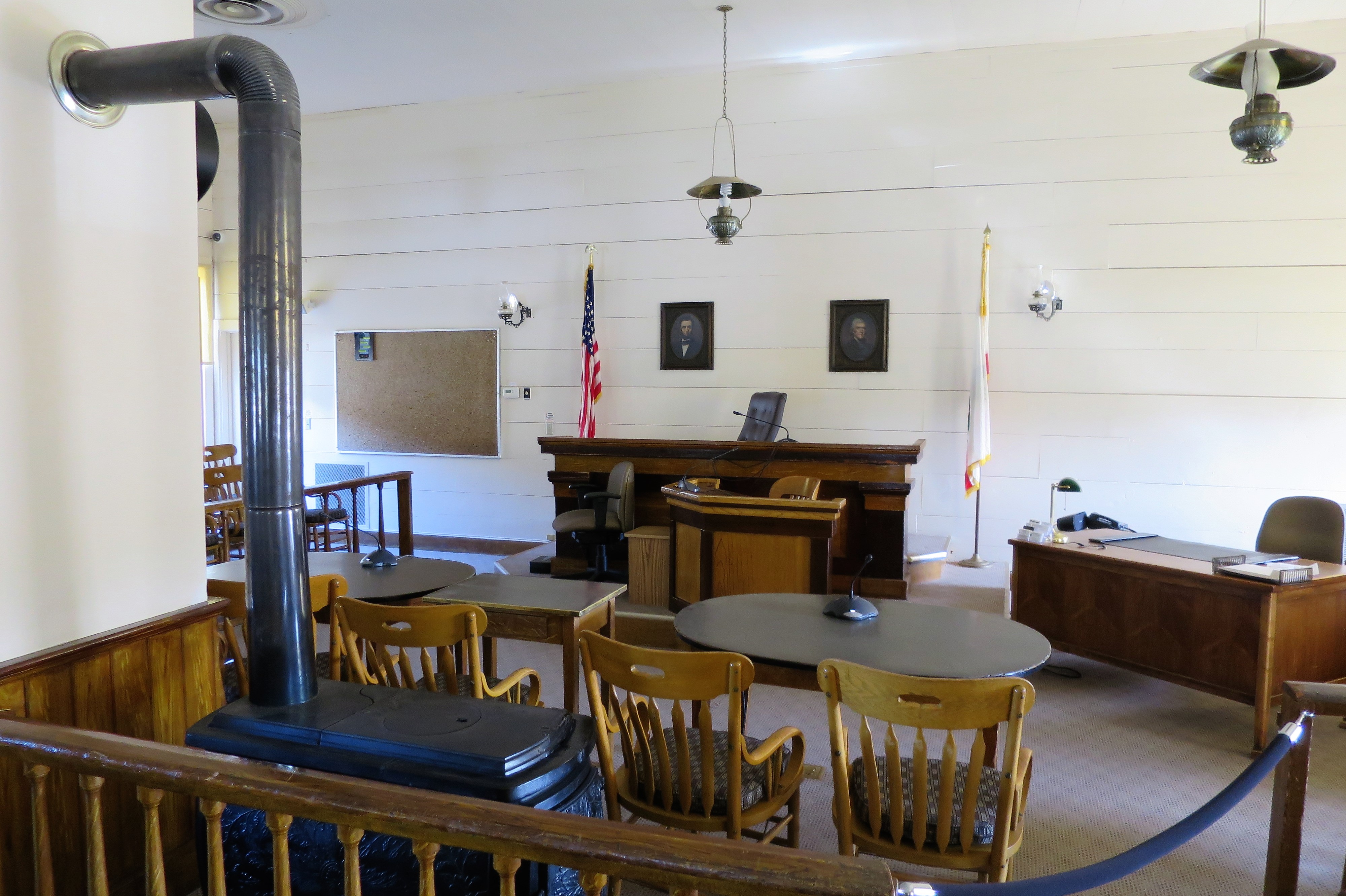
The courthouse has only one courtroom. Portraits of Lincoln and Jefferson are the only adornment on the wall behind the Judge’s seat, which is odd considering that judges, lawyers, and juries were meeting here before Abraham Lincoln was even elected President. I’m told that the old stove still provides primary heating for the courtroom.

Main courtroom, Mariposa County Courthouse

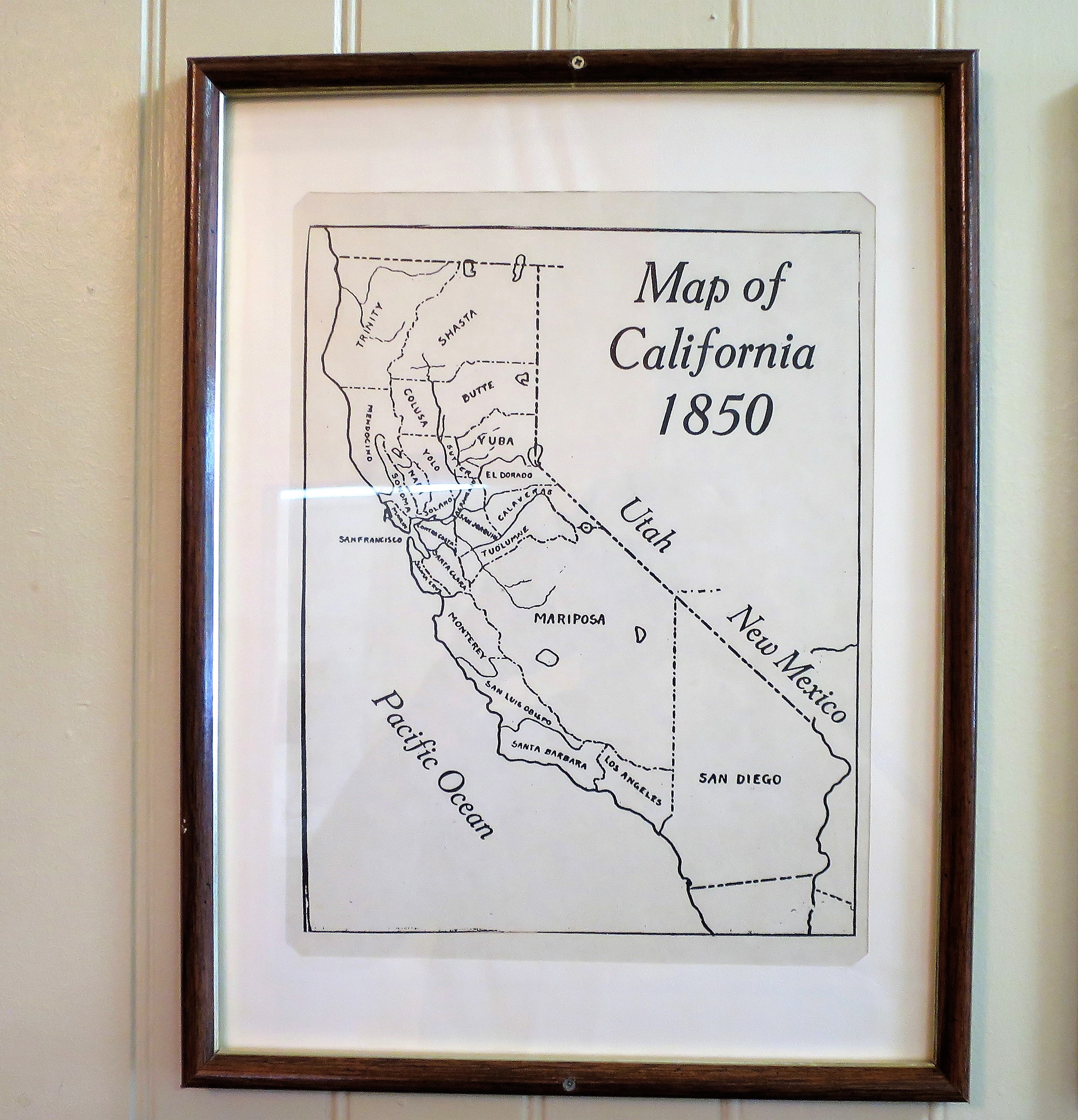
Mariposa County was once huge, covering most of central California but has since been carved into many other counties. Its namesake butterflies are actually only found in the San Joaquin Valley below the mountains, now part of other counties.

Want to stay in town? The 5th Street Inn looks nice.

5th Street Inn, Mariposa, California
Christian Science Church, Mariposa

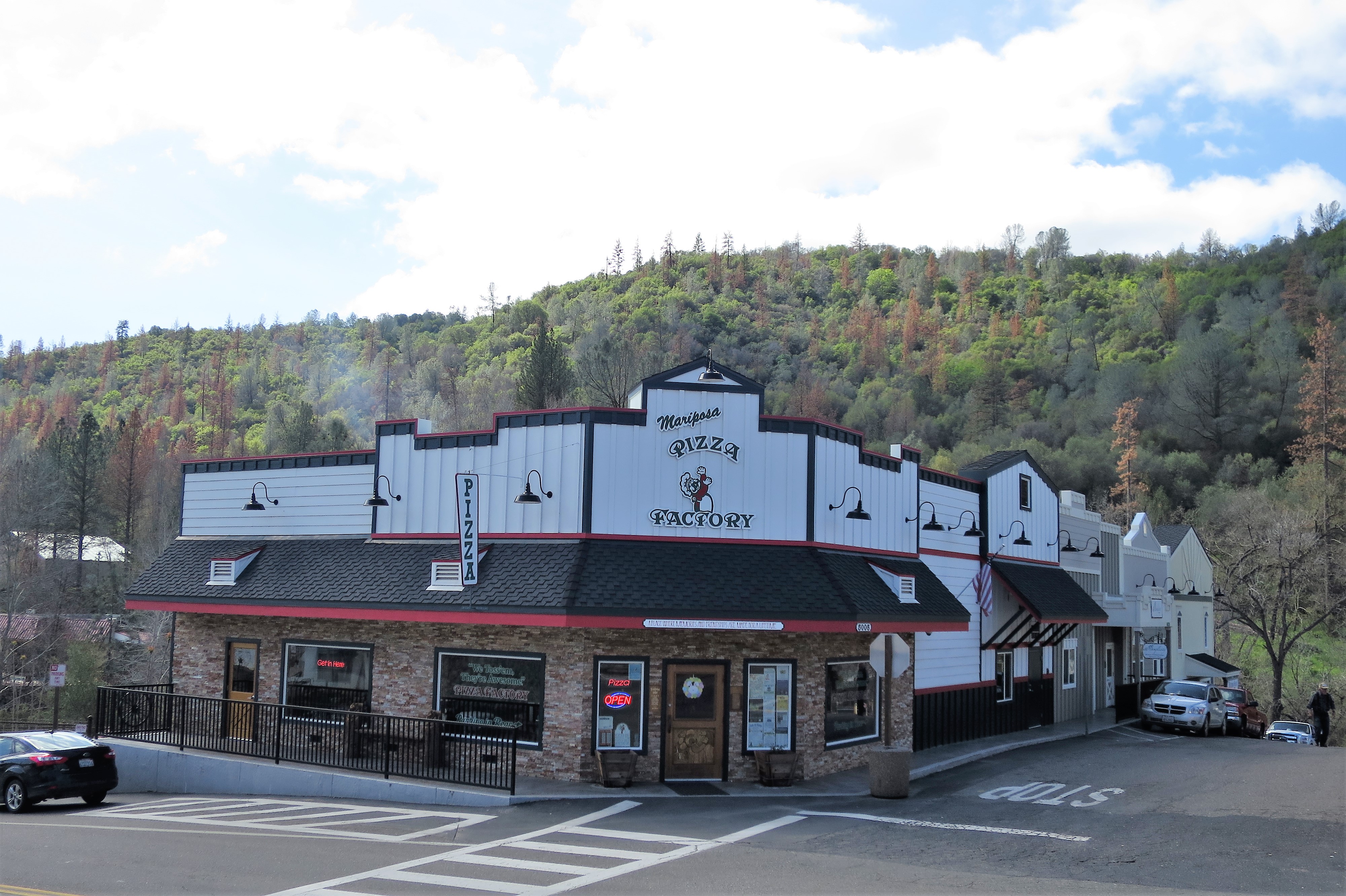
Here’s where the locals eat — the Pizza Factory. It was busy when I was there. Good food, spacious seating. Here policemen, firemen, and other local residents enjoy a respite from seasonal tourists.

(Mariposa) Pizza Factory

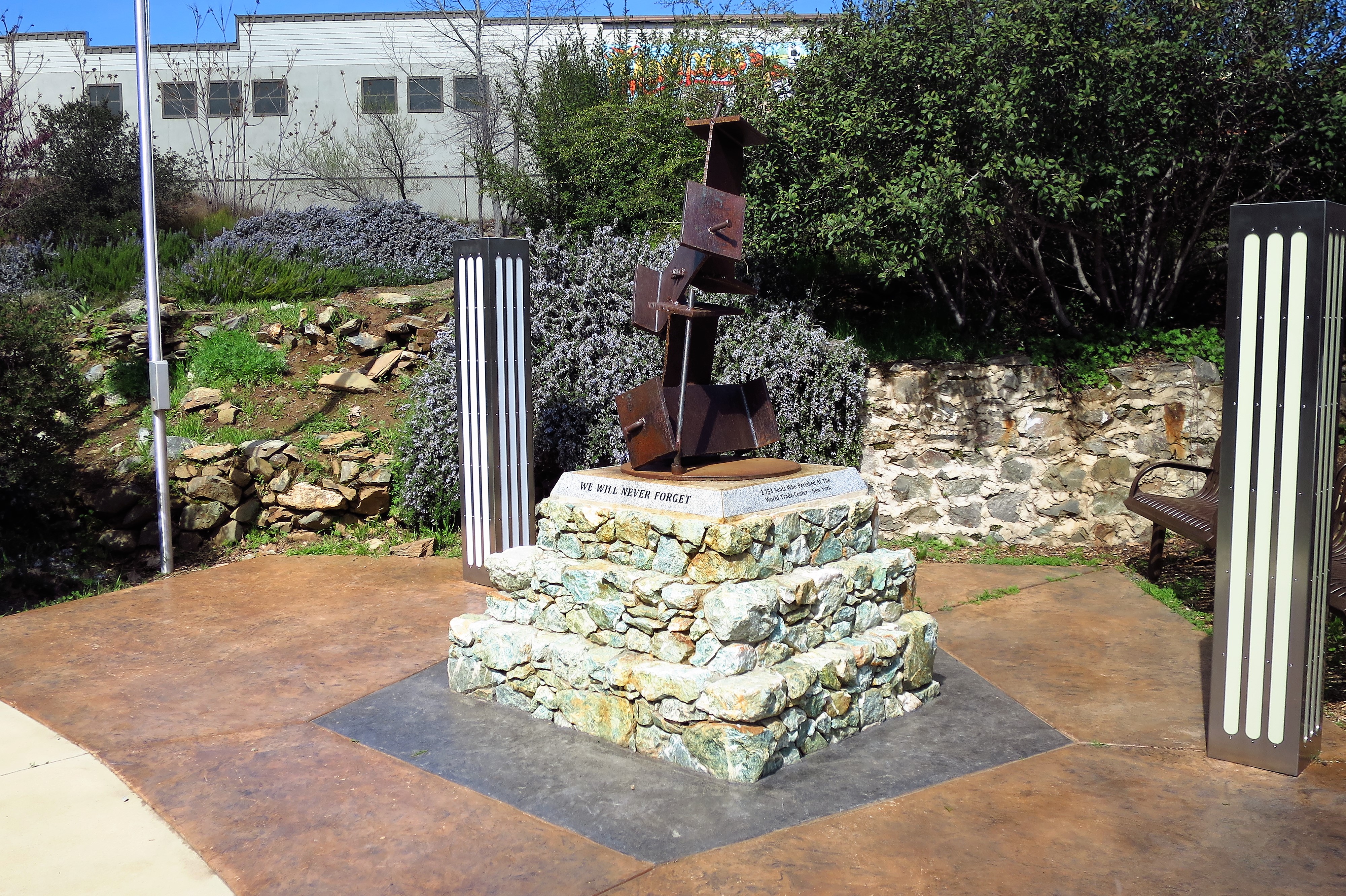
Just to remind you that you’re still in America, there’s this:

9-11 Memorial, Mariposa, California

All photos were taken by the author. Photos were taken in March 2016.


A list of all photo posts from the American County Seats series in TimManBlog can be found here.

I’m trying to travel to all of America’s county courthouses, and each month a post about my visit to the most interesting county seats. It’s only a hobby — but donations are greatly appreciated to help defer my costs.
Thanks,
Tim

One-Time
Monthly
Yearly

Make a one-time donation

Make a monthly donation

Make a yearly donation

Choose an amount

¤5.00
¤15.00
¤100.00
¤5.00
¤15.00
¤100.00
¤5.00
¤15.00
¤100.00

Or enter a custom amount

¤

Your contribution is appreciated.

Your contribution is appreciated.

Your contribution is appreciated.

DonateDonate monthlyDonate yearly

Kingman, Arizona — Caravans of Cars and Camels

February 24, 2019

Even though January has turned into February, it remains the year 2019 and so my 2019 New Years’ “Goals”, or Resolutions, still apply. One post per month I resolved — I wrote down the goal on paper and even worse, I posted my intentions on Facebook. Now that promise is forever on the internet, and there can be no excuses. So herewith is the February 2019 installment featuring an old friend — warm, sunny Kingman, Arizona.

Welcome to Kingman, Arizona

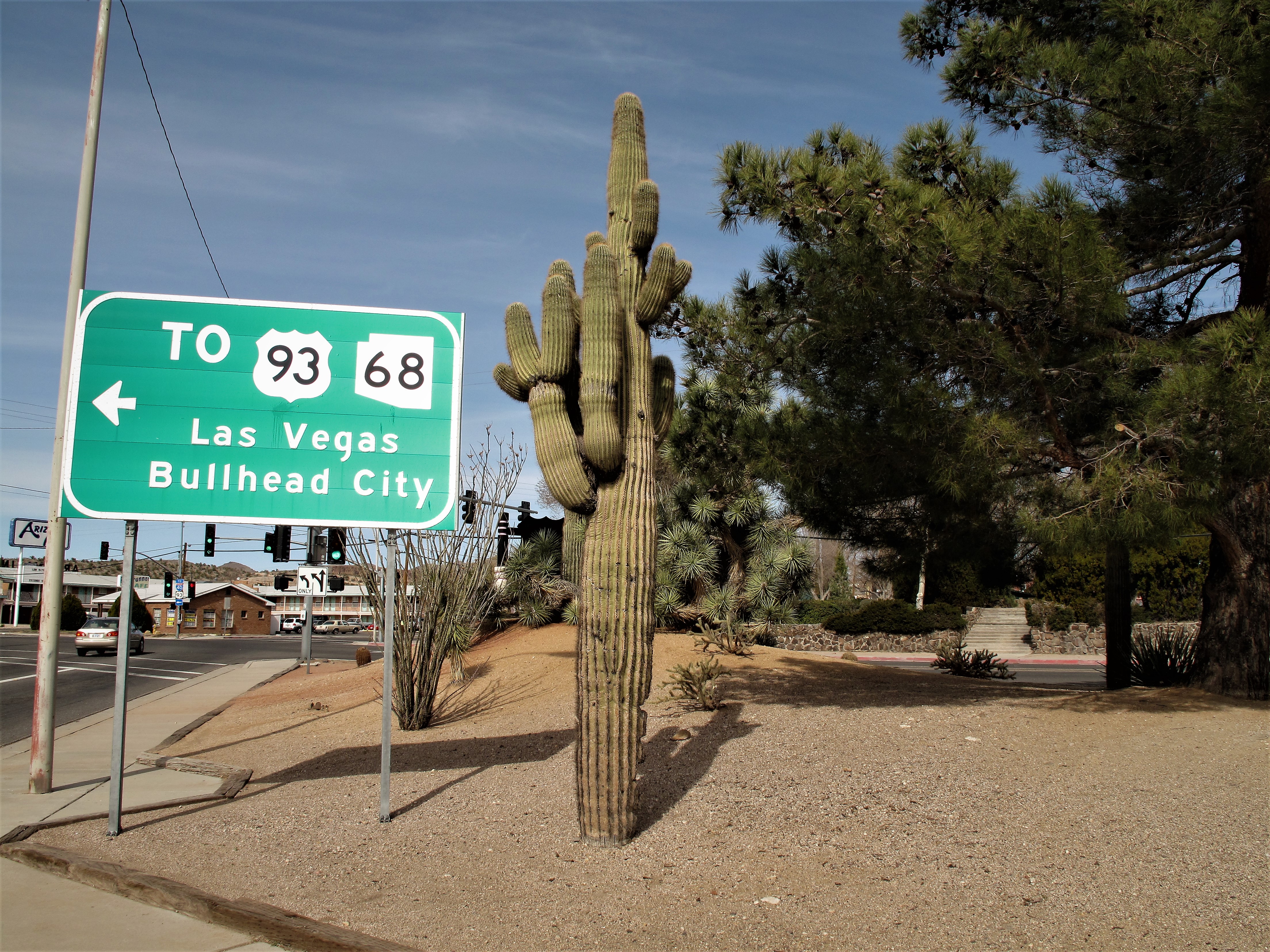
I’d seen Kingman several times before. Kingman is a crossroads.  Looking eastward from Los Angeles (where I lived during the 1980s) Kingman is the gateway to the rest of the country. I drove through Kingman to get to the Grand Canyon, Amarillo, Kentucky, and to my parent’s home back in Pittsburgh. If you’re traveling north and south instead of east and west, the long desert highway that is US 93 intersects the I-40 in Kingman, about halfway between Las Vegas and Phoenix. 

At first, I saw the town as a hot, dusty Arizona truck stop, but I wasn’t the first caravan to come through.

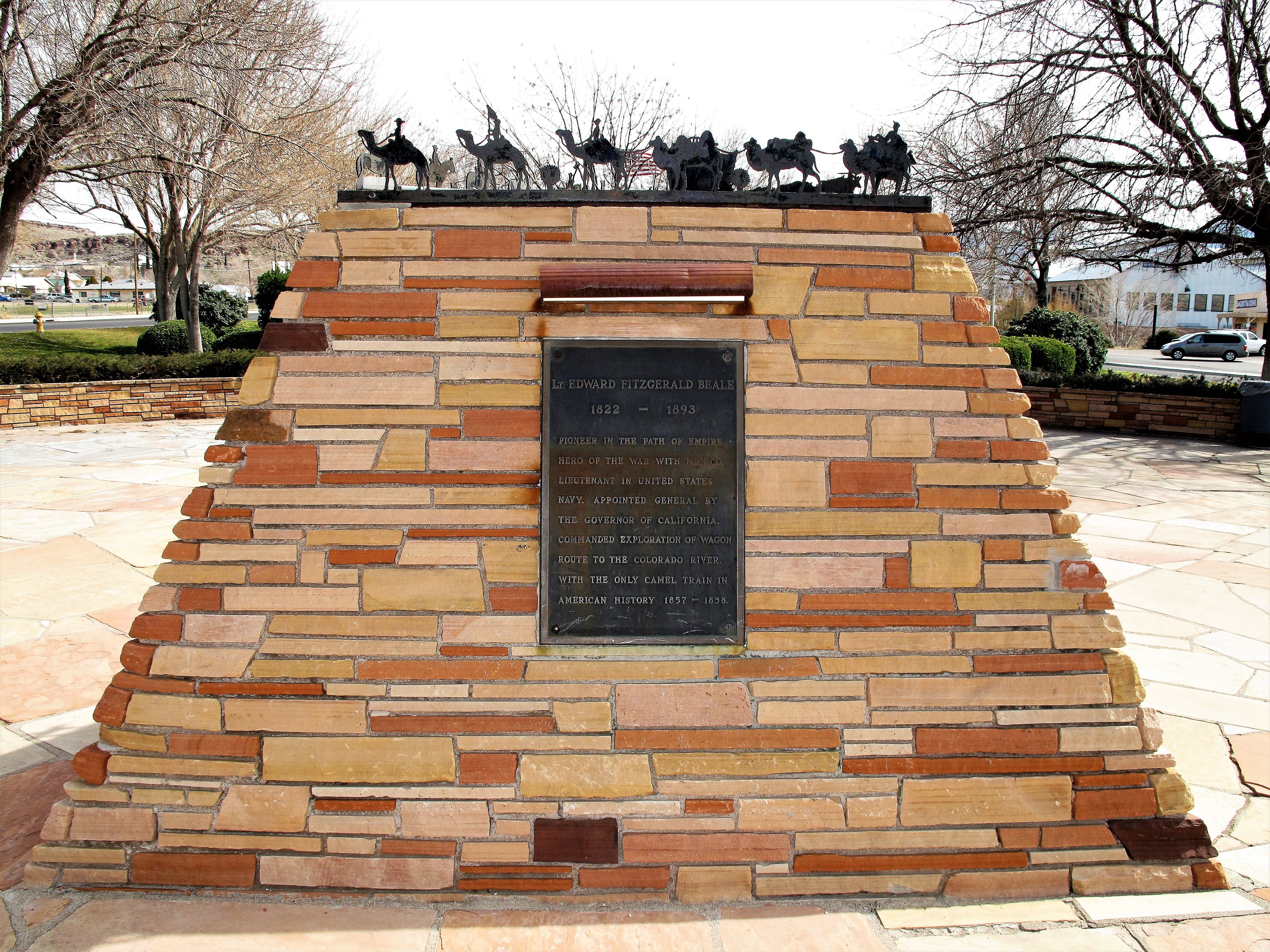
Lieutenant Edward Fitzgerald Beale, commanding a caravan of camels, blazed a wagon route through Northern Arizona Territory back in 1857-58. Beale Street in Kingman is named for him. (But apparently not Beale Street in Memphis. Wikipedia has Beale’s resume.)

Beale is remembered here:

Lt. Edward Fitzgerald Beale, 1822-1893. Pioneer in the Path of Empire. Hero of the War with Mexico. Lieutenant in the United States Navy. Appointed General by the Governor of California. Commanded exploration of wagon route to the Colorado River with the only camel train in American history, 1857-1858.

Beale’s wagon route soon became a railroad route. Mining sprang up in Kingman and then receded. As cars followed trains, Route 66 followed the railroad route, then Interstate 40 replaced US 66. Even with the mines gone, Kingman is forever a crossroads and will never disappear.

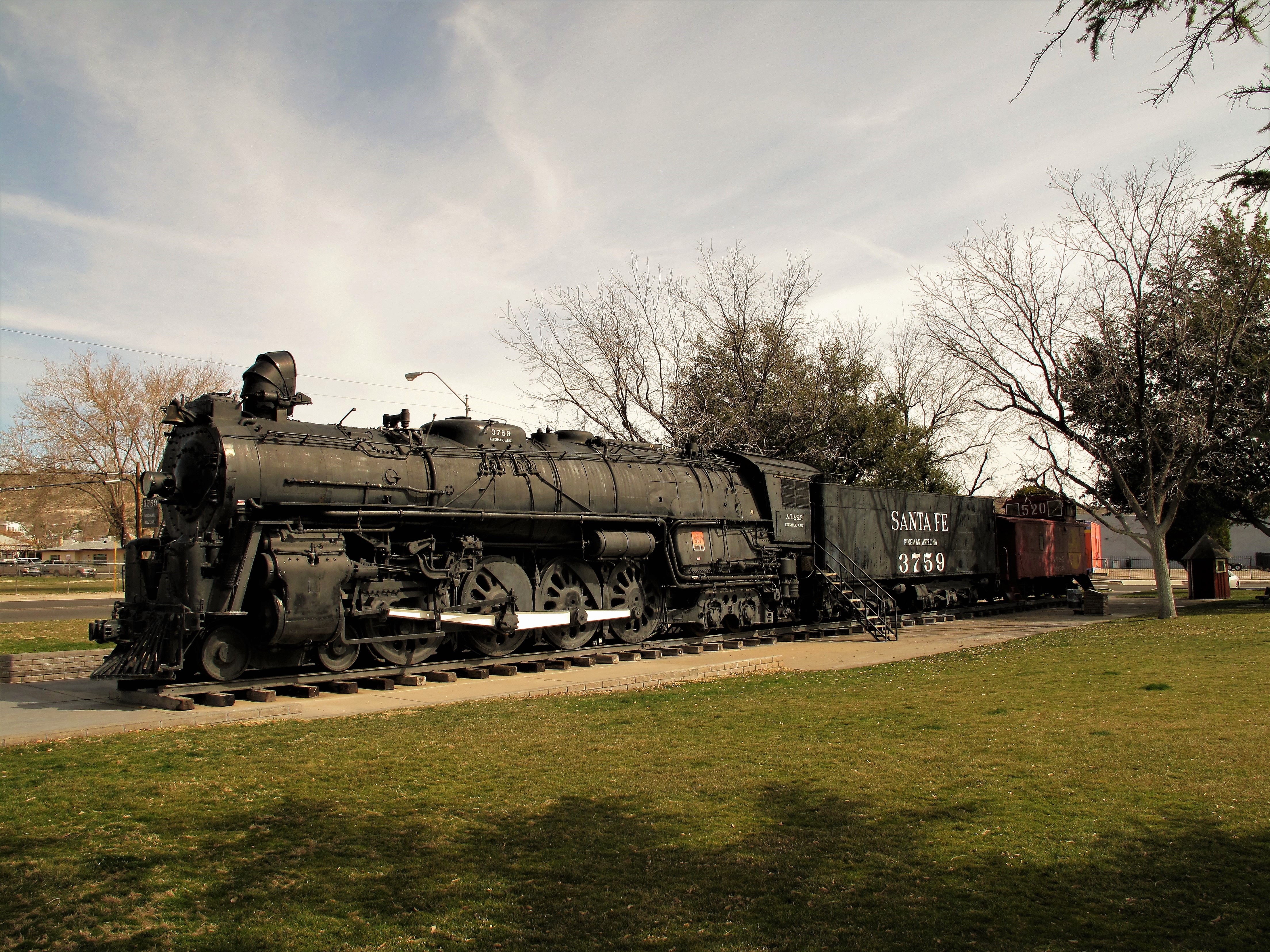
An old Santa Fe locomotive in town park

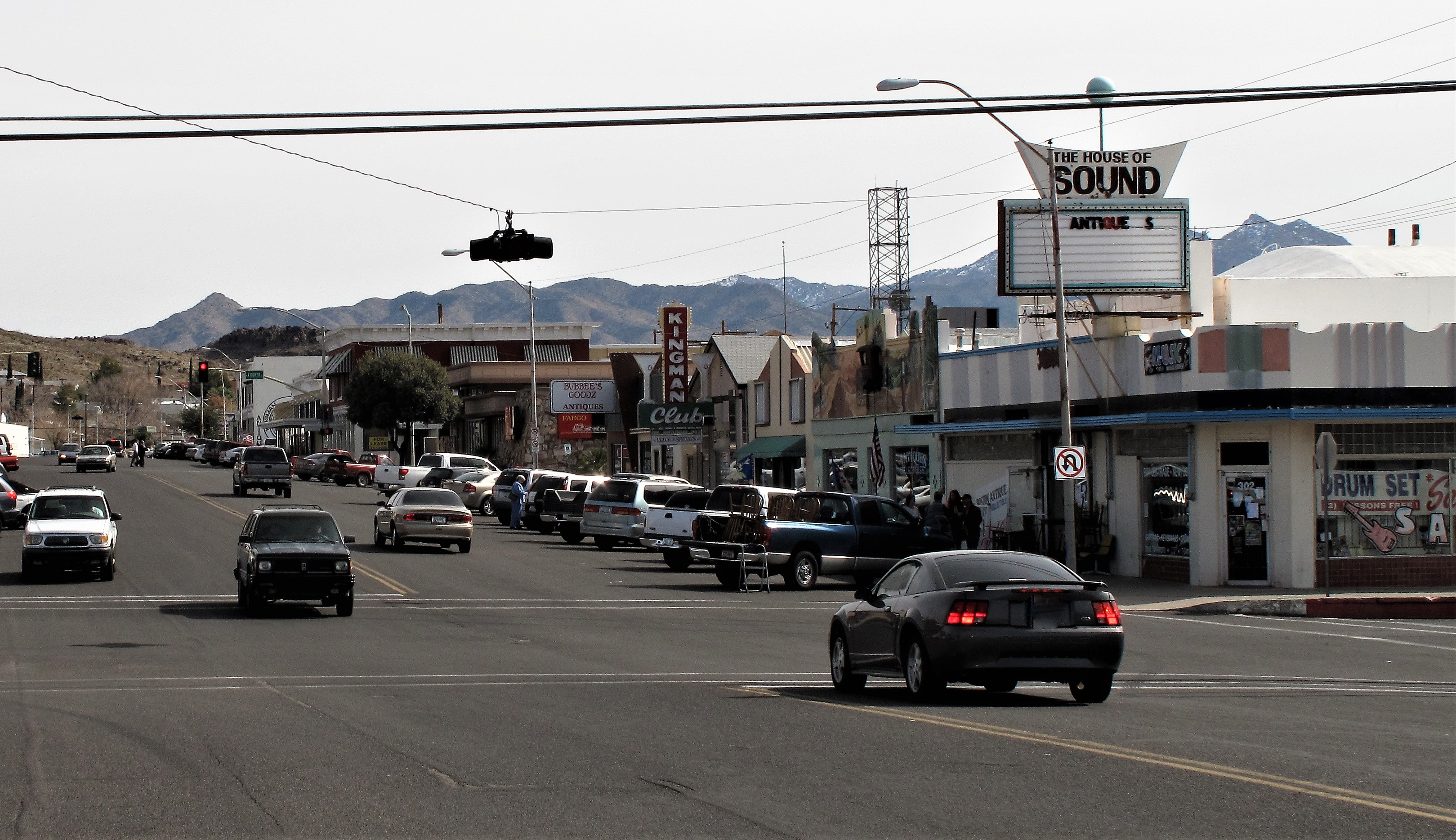
Unless you get off the Interstate you won’t notice the snow-covered rocky cliffs above the historic buildings along old Route 66. Kingman has a few nostalgic hotels here, some old bars, and so forth.  The Beale Street Brews coffee house brings life to this street, along with the Red Neck Pit BBQ next door (now Floyd and Company Real Pit BBQ). Here are a few buildings and street scenes:

Snow-speckled mountains above old Route 66 in Kingman
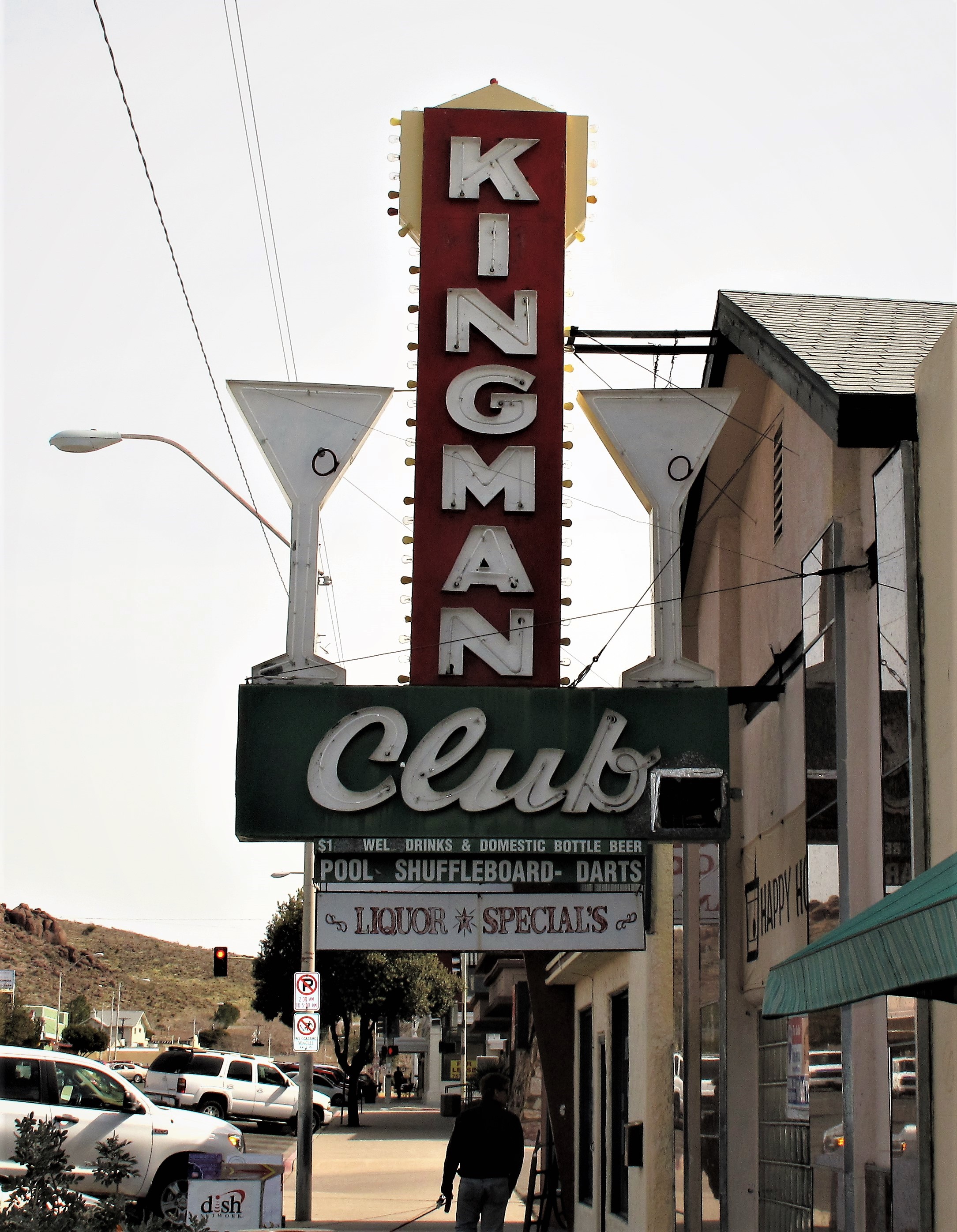
The old Kingman Club (I wonder if Jack Kerouac drank here?)
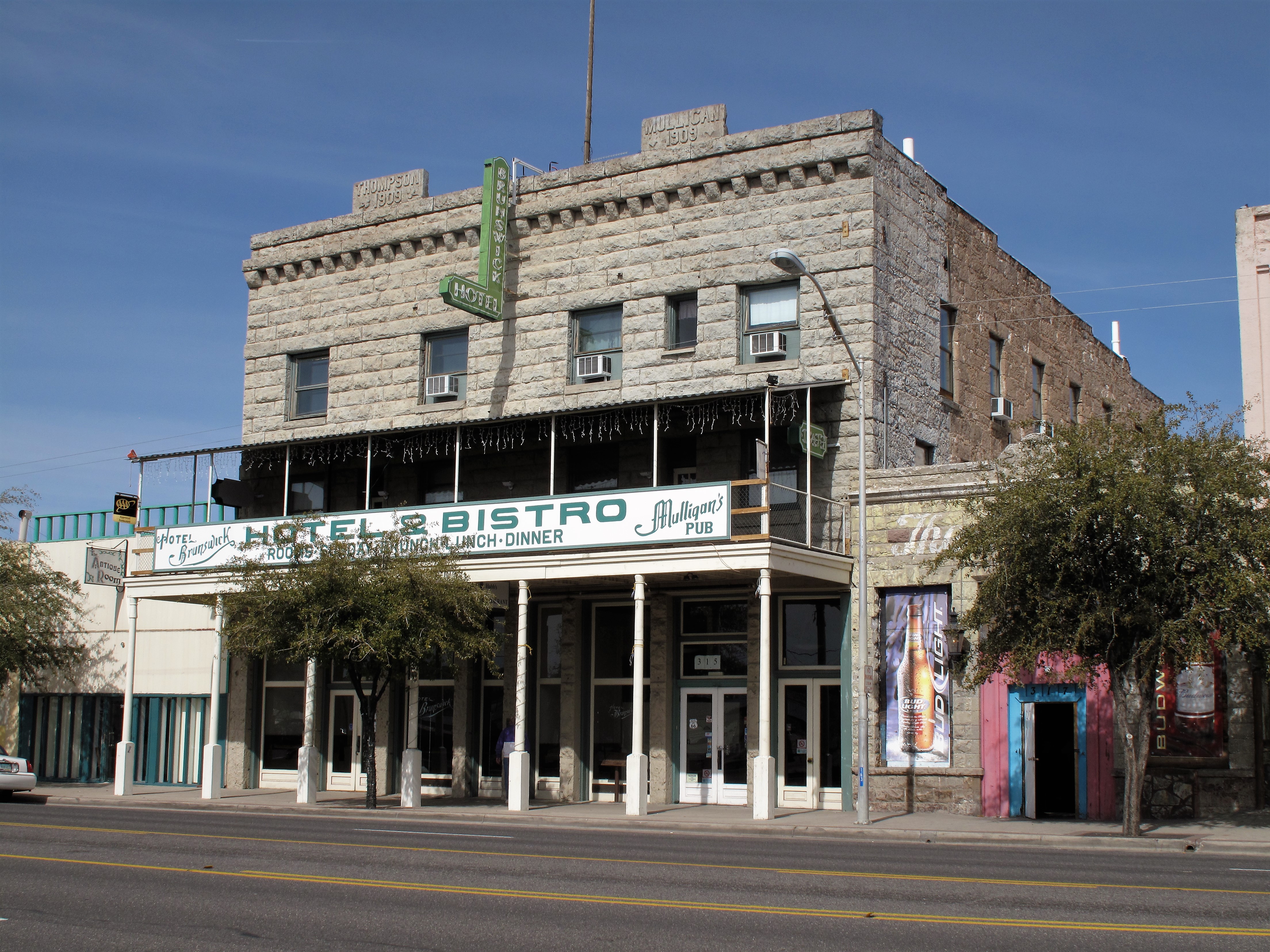
The old Brunswick Hotel (now “Hotel Brunswick Suites”) Route 66, Kingman

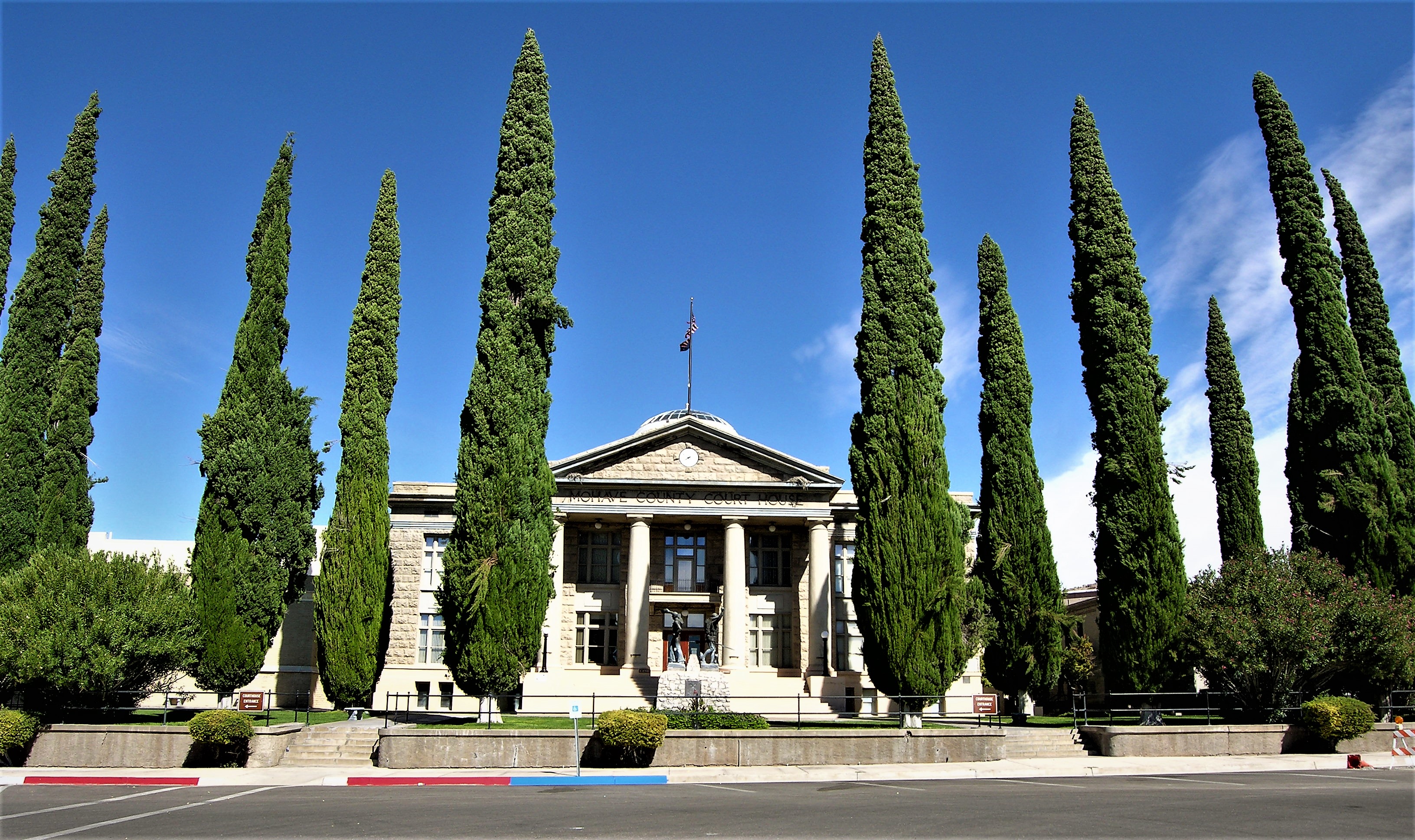
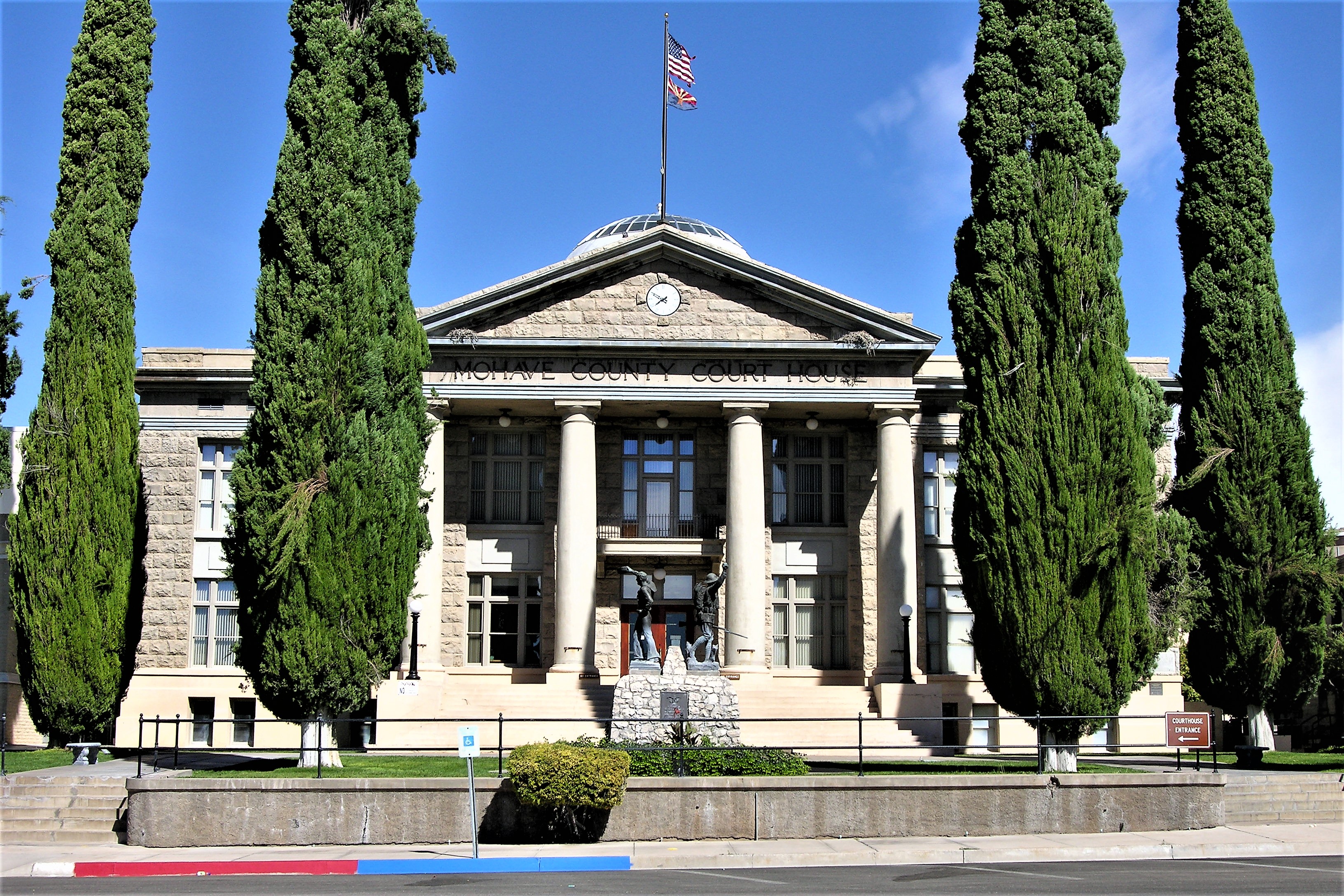
A few blocks off Beale Street the Mohave County Courthouse stands like a Roman temple above the forum.  Built in 1914 of local gray stone, it emerges behind a line of tall, thick juniper trees.  The trees are three stories high; the courthouse is only two, but the cupola adds maybe another story and a half.  The building stands at the top of Fourth Street, looking down on Kingman from above – a good place from which to administer Justice. 

Mohave County Superior Court, Kingman, Arizona

As the courthouse was built in 1914, the front statue was likely added a few years afterward, following the end of World War I. This particular design — a doughboy holding a hand grenade aloft in his right hand — is a common design for World War I memorials seen throughout the country.

World War I Memorial

Finally, some more examples of old stone construction:

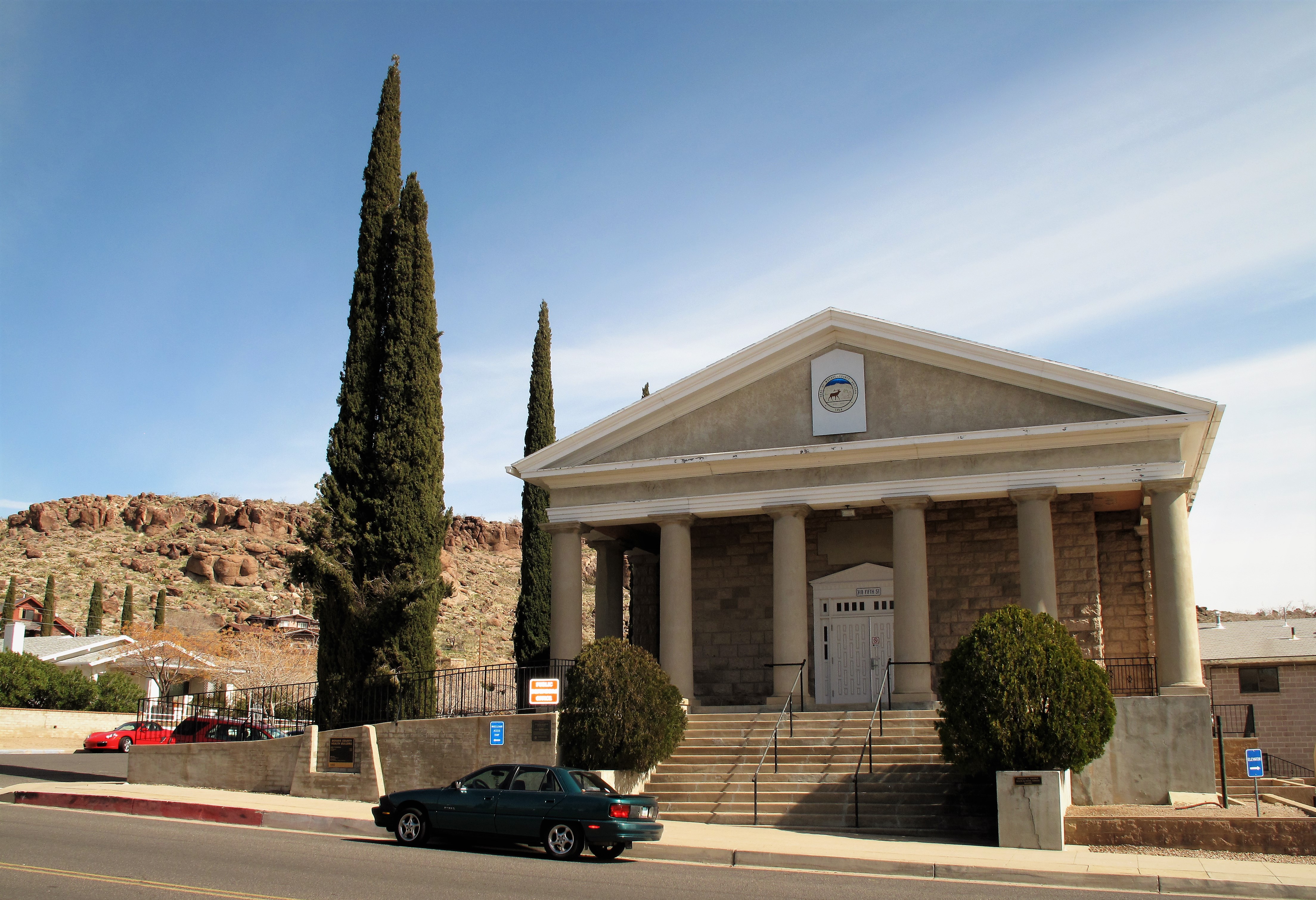
Mohave County Health Department (old building, scenic view)
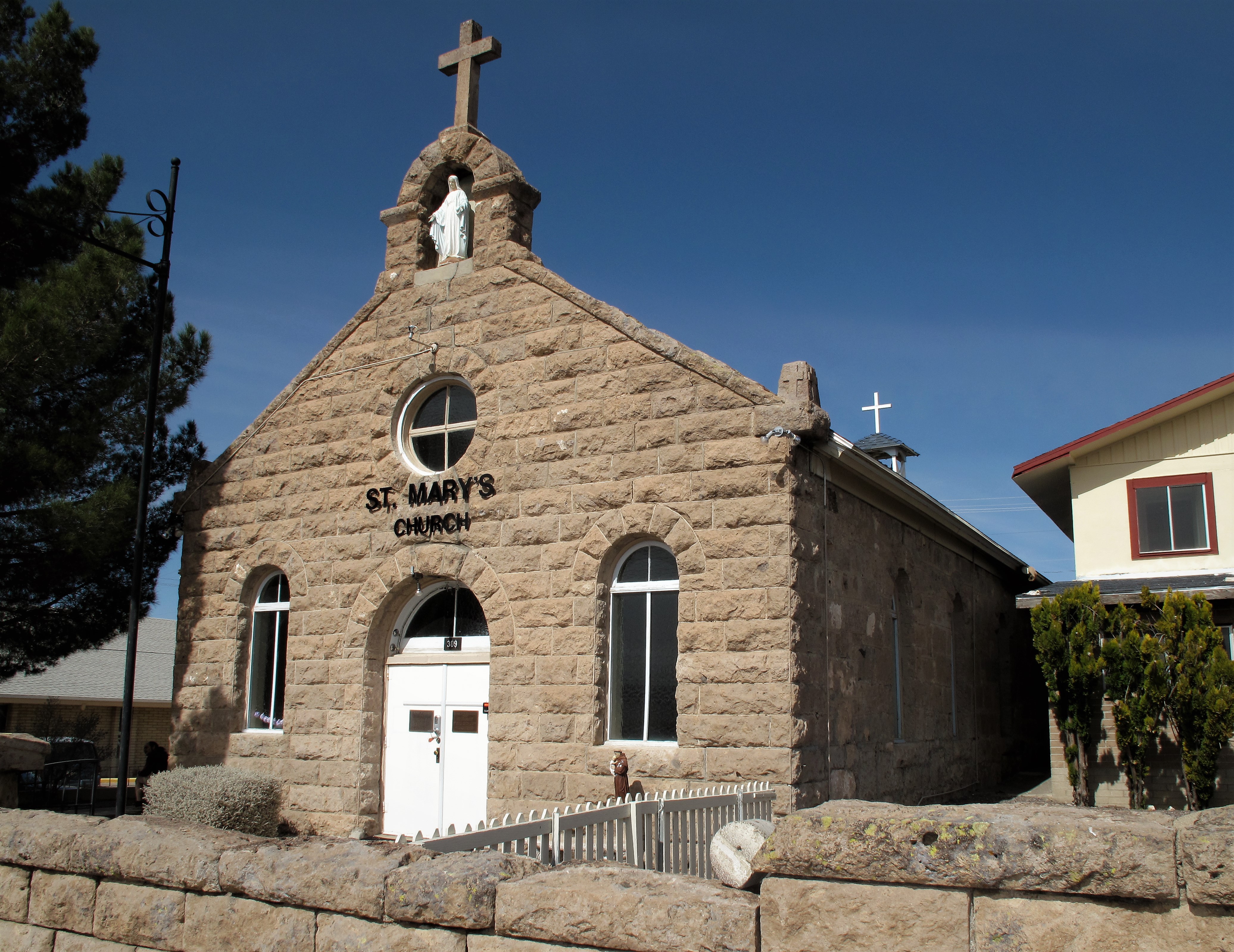
St. Mary’s Roman Catholic Church, Kingman

I hope you enjoyed Kingman and are enjoying your February. March is just around the corner…

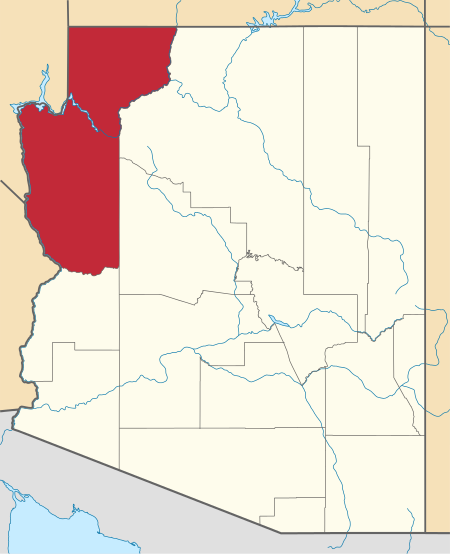
Mohave County in the state of Arizona

All photos by the author. Photos were taken in February 2010, except for the courthouse photos which are from October 2005.

A list of all photo posts from the American County Seats series in TimManBlog can be found here.

I’m trying to travel to all of America’s county courthouses, and each month a post about my visit to the most interesting county seats. It’s only a hobby — but donations are greatly appreciated to help defer my costs.
Thanks,
Tim

One-Time
Monthly
Yearly

Make a one-time donation

Make a monthly donation

Make a yearly donation

Choose an amount

¤5.00
¤15.00
¤100.00
¤5.00
¤15.00
¤100.00
¤5.00
¤15.00
¤100.00

Or enter a custom amount

¤

Your contribution is appreciated.

Your contribution is appreciated.

Your contribution is appreciated.

DonateDonate monthlyDonate yearly

January in Baraboo, Wisconsin

Baraboo — Home to the Ringling Brothers’ Circuses

January 27, 2019

One of my 2019 New Years’ “Goals”, or Resolutions, was to resurrect my old blog on which I haven’t posted since the summer of 2017. One post per month I resolved — and I wrote down the goal on paper and even worse, I posted the resolution on Facebook. Now the promise is on the internet which means it’s forever. No excuses anymore.

Since it’s the month of January why not some photos from the past January? Back in 2009 I was working on a consulting contract in Green Bay, Wisconsin, and spent my weekends traveling the frozen roads of the Badger State. I wandered into snow-covered Baraboo on Saturday, January 10, 2009. It’s a nice place. Check it out — I think you’ll like it.

I approached Baraboo through a geologic feature called “The Narrows.” There are old glacial hills here next to the metamorphic rock, both of which seem far out of place in the dairy state.

The Narrows, granite rocks and hills beyond. Read the sign for some interesting geologic info.

Once beyond the Narrows gateway, I found a busy downtown Saturday morning even though piles of snow banked the sidewalks and the temperature hovered in the upper teens. Parked cars took almost every space. Restaurants and coffee shops were busy. Even the galleries (whose mere existence demonstrates that the town attracts some tourist trade) saw traffic on a cold, post-Christmas day.

Saturday traffic in Baraboo, Wisconsin
Courthouse Square Tavern in the old Dickie and Ashley building, probably built in the 1880s
More Baraboo Courthouse Square shops. The Al. Ringling Theatre is at the far left.

From Wikipedia:

“The city was the home of the Ringling Brothers. From 1884 to 1917 it was the headquarters of their circus and several others, leading to the nickname “Circus City”. Today Circus World Museum is located in Baraboo. A living history museum, it has a collection of circus wagons and other circus artifacts. It also has the largest library of circus information in the United States.”

The AL. Ringling Theatre, built by the Ringling Family

Baraboo was named for an 18th Century French voyageur Barabeauy. However, German influences are more apparent here than in French. Notice the names — Ploetz Furniture has a building in the square. Burkhalter Travel is next door, and the famous Ringling Brothers (originally Rüngling) were descendants of a harness maker from Hanover, Germany.

I ate lunch at the Garden Party Café above the “Corner Drug Store,” which locals said has been around since the mid 1800s. The Garden Party’s walls were covered with paintings for sale and decorative flower pots. Most of my fellow diners were weekend tourists like me.

The Corner Drug and environs, Baraboo, Wisconsin

The Sauk County Courthouse is the centerpiece of this downtown scene. Out of sight of ACLU scrutiny, rural Wisconsinites decorate their courthouse grounds with Christmas Manger scenes, and they’re a little slow to take them down in frigid January.

Christmas Manger scene outside the Sauk County Courthouse
Sauk County Courthouse, Baraboo, Wisconsin

Sauk County was founded in 1846, Baraboo in 1852. Old enough to have Civil War memories: “Erected to the Memory of Sauk County soldiers in the War For the Union”

Union soldiers memorial, Sauk County Courthouse
Sauk County in the state of Wisconsin

Thanks for reliving old memories with me. Please excuse the dim photos taken on an overcast day — but Saturday is the best day of the week regardless of the weather, right? Here are a few extra snapshots to finish off:


A list of all photo posts from the American County Seats series in TimManBlog can be found here.

I’m trying to travel to all of America’s county courthouses, and each month a post about my visit to the most interesting county seats. It’s only a hobby — but donations are greatly appreciated to help defer my costs.
Thanks,
Tim

One-Time
Monthly
Yearly

Make a one-time donation

Make a monthly donation

Make a yearly donation

Choose an amount

¤5.00
¤15.00
¤100.00
¤5.00
¤15.00
¤100.00
¤5.00
¤15.00
¤100.00

Or enter a custom amount

¤

Your contribution is appreciated.

Your contribution is appreciated.

Your contribution is appreciated.

DonateDonate monthlyDonate yearly
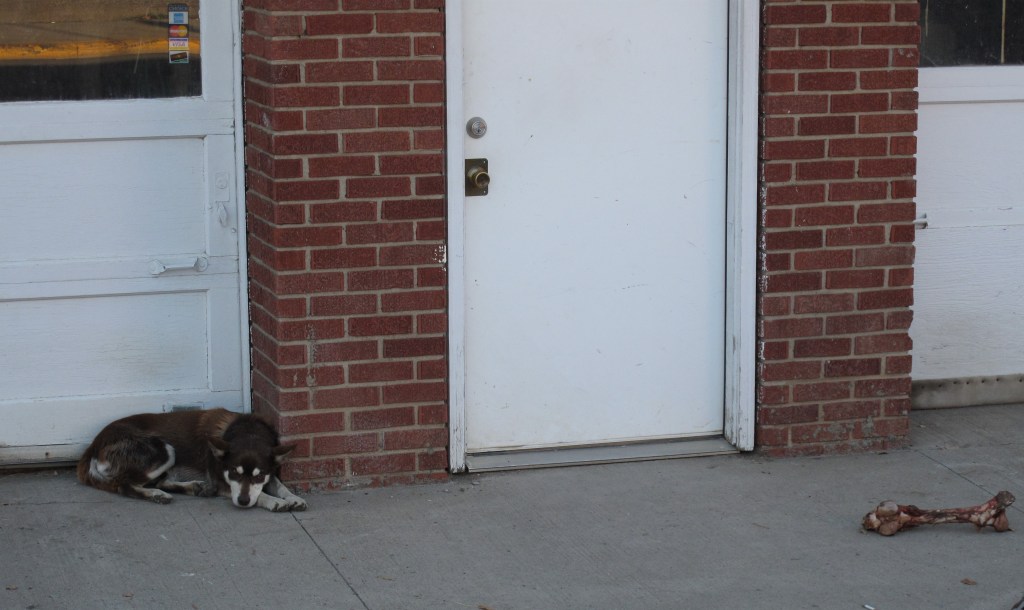
Keep Calm and Look Far

IMG_3792

August 16, 2017

Keep calm and look far.  

Such a grand vista. A long, straight, gently undulating highway, traversing seemingly endless beaver ponds and pastures to join the far horizon below a boundlessly pleasant summer sky. 

The American prairie makes us look far.

Gazing ahead you foresee a great drive, maybe in a car or on a bicycle.

But suppose you were all alone and badly injured and had to crawl this road instead of driving it. Would you be able to keep calm, keep your head down, pull yourself elbow over elbow again and again until you’ve met the distant horizon, not knowing how far that might be?

Long ago a man did just that. He was a fur trapper and mountain man. The locals remember him to this day.

This is Bison, South Dakota, population 333.

IMG_3789

Here are some of the principal town establishments:  The Bison Bar, County Title office…

IMG_3780 adj

…the Bison Community Center, American Legion Post 255, the Bison Senior Citizens center. Structures (and people) are plain yet sturdy, built to withstand the strong winds and heavy snows of the Northern Plains.

IMG_3785 adj

The Jack and Jill grocery store dominates local commerce. I walked in at 10:00 on a Wednesday morning and noticed a handwritten sign posted on the front door. It said simply:

“We will be closed from 10:45 to 12:30 for the funeral.”

Whose funeral? Someone from the store? A prominent man-about-town? Who?

IMG_3790 adj

The sign didn’t say. Apparently, it didn’t have to; if you live in town, you will already know. They say that in small towns everyone knows your business. That may be true, but on the other hand, everyone misses you when you’re gone.

The Perkins County Courthouse occupies a prominent corner block on Bison’s Main Street.  Perkins County boasts a total population of 2,982.  Donald Trump won 83% of the vote here in 2016. Pretty good for a New Yorker.

IMG_3781
Perkins County in the state of South Dakota

Bison High School:  “Home of the Cardinals” — because the “Bison Buffaloes” would invite derision. While school mascot names are fun, the obelisk in front of the school teaches a serious lesson.

IMG_3787 adj

This is a monument to mountain man Hugh Glass, whom I mentioned at the beginning.

IMG_3786 adj

Here’s the text of the monument:

Hugh Glass. Hunter with Ashley’s fur traders, mauled by a grizzly bear while camping at the forks of Grand River north of Bison in 1823. Left for dead, he survived, crawled south between present towns of Bison and Meadow, hiding from Indians by day, to Fort Kiowa 150 miles away.  Dr. John Neihardt tells the tale in “The Song of Hugh Glass.”

Keep calm and look far. Hugh Glass reached his destination after crawling on his elbows for 150 miles. If we must, we can do the same.

These are tumultuous times. Yet like Hugh Glass, we cannot stop here to re-suffer the past. America still has great places ahead of us and great achievements to offer mankind if we keep a level head “with firmness in the right, as God gives us to see the right.” Keep calm and look far — persistence will conquer distance.

IMG_3791

(Note: Since visiting Bison I’ve learned that the Jack and Jill grocery store has apparently changed hands and been renamed the Bison Food Store.)


A list of all photo posts from the American County Seats series in TimManBlog can be found here.

I’m trying to travel to all of America’s county courthouses, and each month a post about my visit to the most interesting county seats. It’s only a hobby — but donations are greatly appreciated to help defer my costs.
Thanks,
Tim

One-Time
Monthly
Yearly

Make a one-time donation

Make a monthly donation

Make a yearly donation

Choose an amount

¤5.00
¤15.00
¤100.00
¤5.00
¤15.00
¤100.00
¤5.00
¤15.00
¤100.00

Or enter a custom amount

¤

Your contribution is appreciated.

Your contribution is appreciated.

Your contribution is appreciated.

DonateDonate monthlyDonate yearly
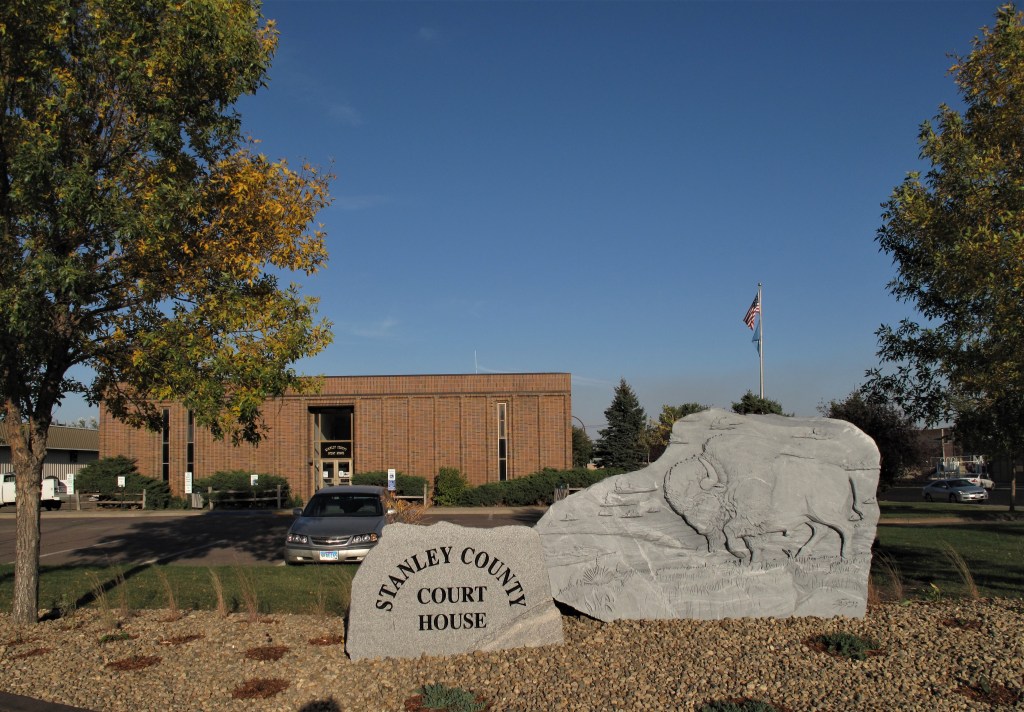
February in Walterboro, South Carolina

February 26, 2016

This week the political media frenzy swirls through South Carolina like a transient storm.  Last Saturday the GOP held its presidential primary here and this Saturday the Democrats hold theirs.  As pundits dissect this state, wielding the scalpels of scientific polling and demographics, I thought it fitting and proper to provide a glimpse beneath the hullabaloo.

Colleton County in the state of South Carolina

Along Washington Street in the small Palmetto State town of Walterboro, banners on the streetlamps proclaim it “The Front Porch of the Low Country.” Walterboro is 40 miles from the ocean, 50 miles from Charleston, and far, far away from northern climes shivering through February squalls.  It seems peaceful here, very quiet, quiet enough to catch the slow creaking of an old red wood rocking chair.

IMG_2303

Sidewalks in town are paved with a conglomerate made of white seashells over which I would not want to walk barefoot. (This may be purposeful — I doubt the local merchants want you to enter their shops in bare feet.)

IMG_2315

Of course, you must smile and say hello to each and every one you pass by; they will certainly offer it to you expecting the same in return.

Even though some old storefronts have changed hands over the years, the general atmosphere feels familiar, and so the former Farmers and Merchants Bank is now the Old Bank Christmas and Gifts shop. The fixture clock was almost certainly the town meeting place back in the day.

IMG_2312
Old Bank Christmas and Gift Shop

I had lunch at the counter of Hiott’s Pharmacy down the street. The Coca-Cola dispenser on the counter is a classic and probably worth some money as an antique but they don’t seem to know that — or perhaps they don’t care.

A few old-timers sat with me at the counter, and I enjoyed listening to them — accents uncorrupted by the standardized pronunciations one hears today on national newscasts.  The Southern accent is strong here, but the formality of their manners is even stronger. Tags of “Yes Sir, No Sir, Yes Ma’am, and No Ma’am” punctuated their conversations like dance steps and created a kind of rhythm, a cadence, reminiscent of a high school marching band or a cheerleader squad’s holler-back routine.

Just a peek around the corner leads to the First Baptist Church and its tall white steeple. Each rural South Carolina town must have one of these. If you’ve only seen such churches in photos, then you’ve missed the best effect — the majestic old oak tree covered in Spanish moss. Blue sky, white steeple, and green leaves are standard fare in these parts even in February, but wonderful to one visiting from the snowy Rocky Mountains.

IMG_2320

The Colleton County Courthouse complements the rest. This is a two-story whitewashed building with two half-spiral staircases at the main entrance. As with most Southern courthouses, a granite Confederate statue dominates the grounds. Live oak trees spread their wide branches on either side of the building.

IMG_2297
Colleton County Courthouse. Walterboro, South Carolina
IMG_2299
Colleton County Courthouse

Beneath the small-town quiet, Colleton County has a combative history commensurate with its South Carolina heritage — the Nullification Crisis of 1832, and a hotbed of secession.

IMG_2304

I chatted briefly with a few folks as I took photos of the courthouse. Around here, although people won’t ignore you, they’re not mistrustful.  They do understand humor. Carrying my camera and cell phone in one hand, I asked the guard at the courthouse entrance if these items were allowed inside. He answered me with perfunctory precision:

“Prohibited items are knives and pistols and rifles.  Do you have these?”

“Well…not all three,” I deadpanned.

He let out a belly laugh and let me pass through the metal detector as I held my camera and phone to one side for him to see.  We’re all just folks.

IMG_2317
East Washington Street business district, Walterboro, South Carolina

A list of all photo posts from the American County Seats series in TimManBlog can be found here.

I’m trying to travel to all of America’s county courthouses, and each month a post about my visit to the most interesting county seats. It’s only a hobby — but donations are greatly appreciated to help defer my costs.
Thanks,
Tim

One-Time
Monthly
Yearly

Make a one-time donation

Make a monthly donation

Make a yearly donation

Choose an amount

¤5.00
¤15.00
¤100.00
¤5.00
¤15.00
¤100.00
¤5.00
¤15.00
¤100.00

Or enter a custom amount

¤

Your contribution is appreciated.

Your contribution is appreciated.

Your contribution is appreciated.

DonateDonate monthlyDonate yearly
Post Navigation