”The classic liberal,” Reagan wrote, “used to be the man who believed the individual was, and should be forever, the master of his destiny. That is now the conservative position. The liberal used to believe in freedom under law. He now takes the ancient feudal position that power is everything. He believes in a stronger and stronger central government, in the philosophy that control is better than freedom.”
— From “Where’s the Rest of Me?” 1965
Remember this passage. Remember it each time Obama complains tonight that some Romney policy would “leave you on your own.” When Obama says that he affirms what Reagan accused liberals of believing — that “control is better than freedom.”
When you mention “Nebraska” to someone from America’s left or right coasts they will freely associate this term with the words “corn” or “CornHuskers” (the college football team), or perhaps tornadoes or blizzards. What is often forgotten is that Nebraska’s Platte River Trail was the emigrant superhighway of the 19th Century carrying travelers from the East to the West Coast destinations of Oregon and California. Back then traffic went exclusively from East to West, yet I’ve found that in our day the emigrants have been retracing their steps.
Founded in 1855 on the banks of the Missouri River near the mouth of the Platte, Plattsmouth is a fair-sized small town, still relatively vibrant even though it lies far off today’s interstate highways. Back when rivers were America’s highways Plattsmouth was a popular steamboat moorage and trading post. Its downtown streets were lined with merchants selling goods downriver while also outfitting westward emigrants on the overland trails. According to local historian Dale M. Bowman, “The area that is now lower main street was the staging point for the South Platte Trail of the Oregon Trail. For approximately 18 years an average of 12,000 pioneers per month headed west on this trail.” (Early History of Plattsmouth)
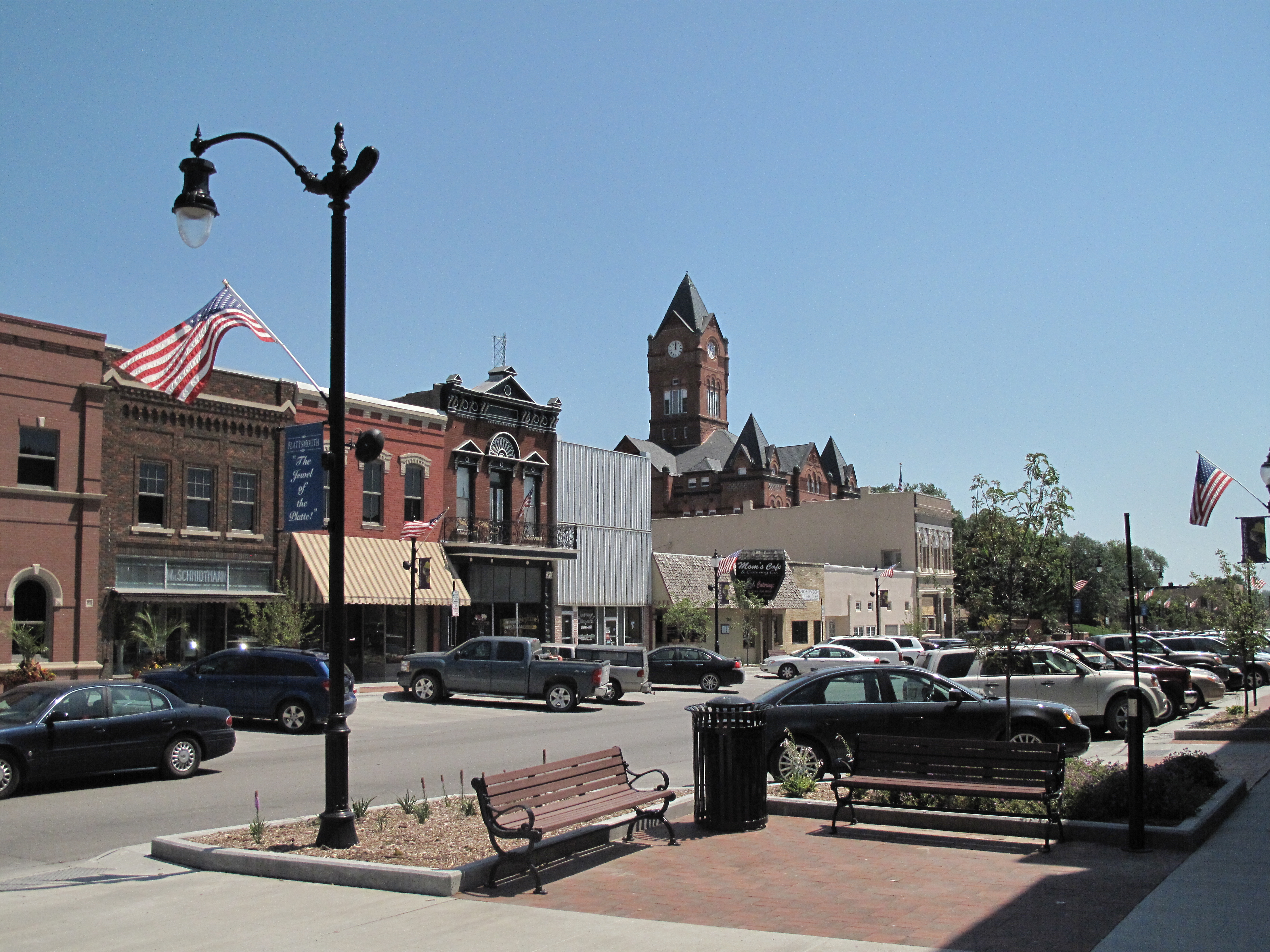
The business district of Plattsmouth looks much as it did a hundred and fifty years ago. The red-bricked architecture has been preserved and the red-bricked side streets provide complementary color.
Main Street Plattsmouth with courthouse tower in background
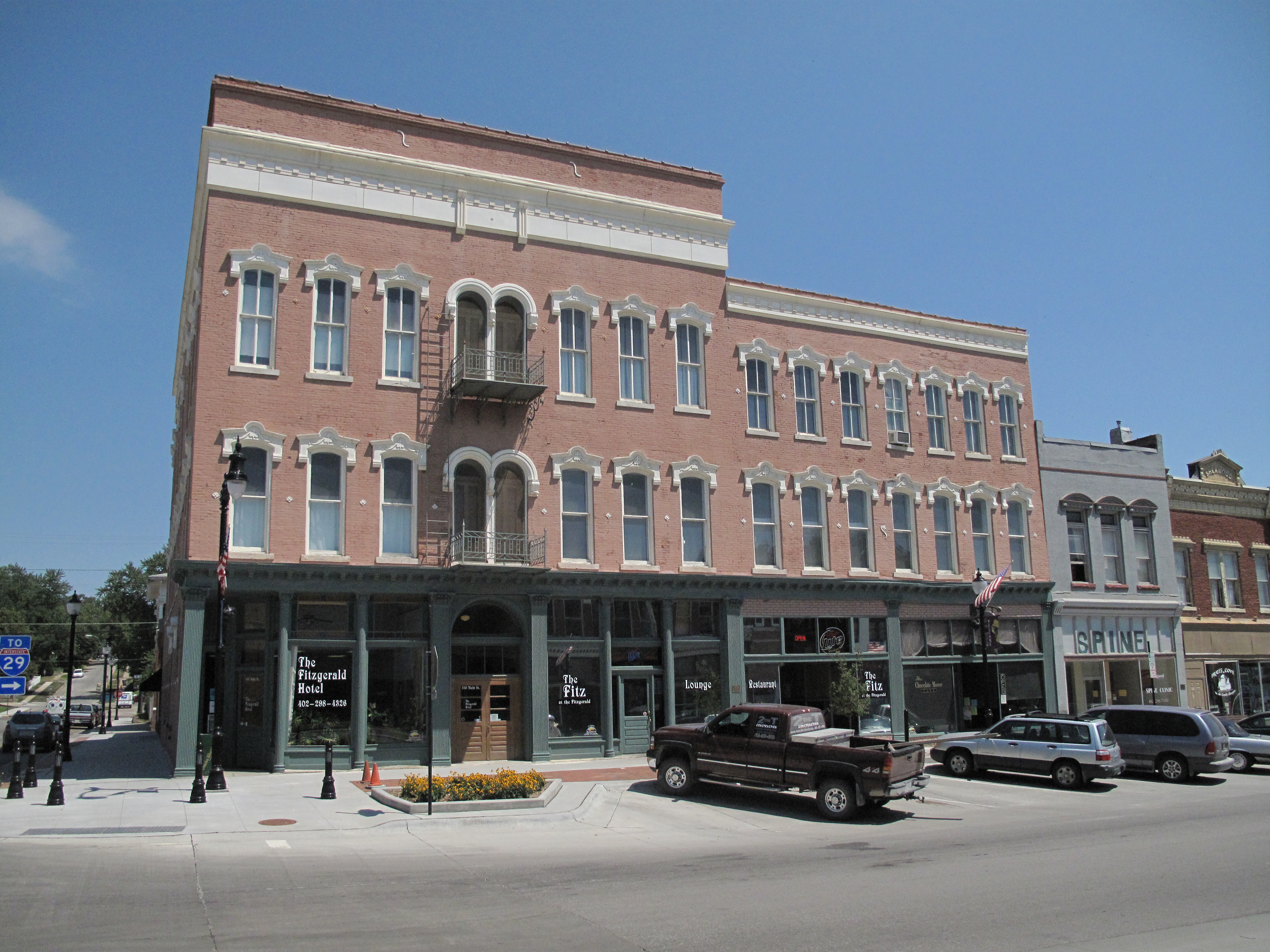
The storefronts are open. The old hotel — The Fitzgerald — is open for business as well.
The Fitzgerald Hotel (“The Fitz”)
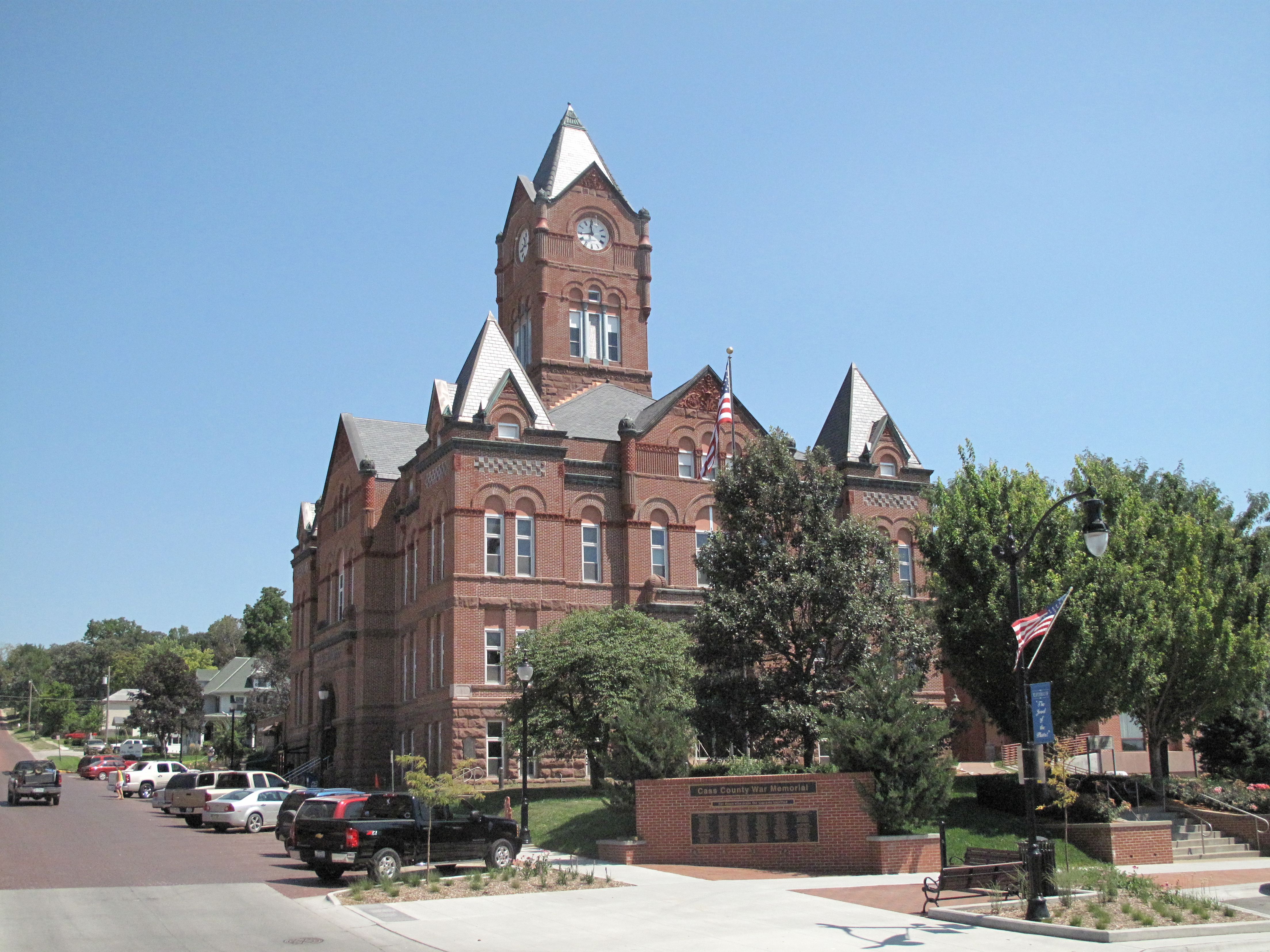
The 1892 Cass County Courthouse towers above the streets of Plattsmouth like a Bavarian castle above its village. This grand and ornate style of architecture was common in its time; it provided small frontier towns with a feeling of strength and permanence.
Cass County Courthouse. Plattsmouth, Nebraska
Inside the courthouse, old black and white photographs document the town and county’s history. There have been numerous devastating floods.
Cass County in the state of Nebraska
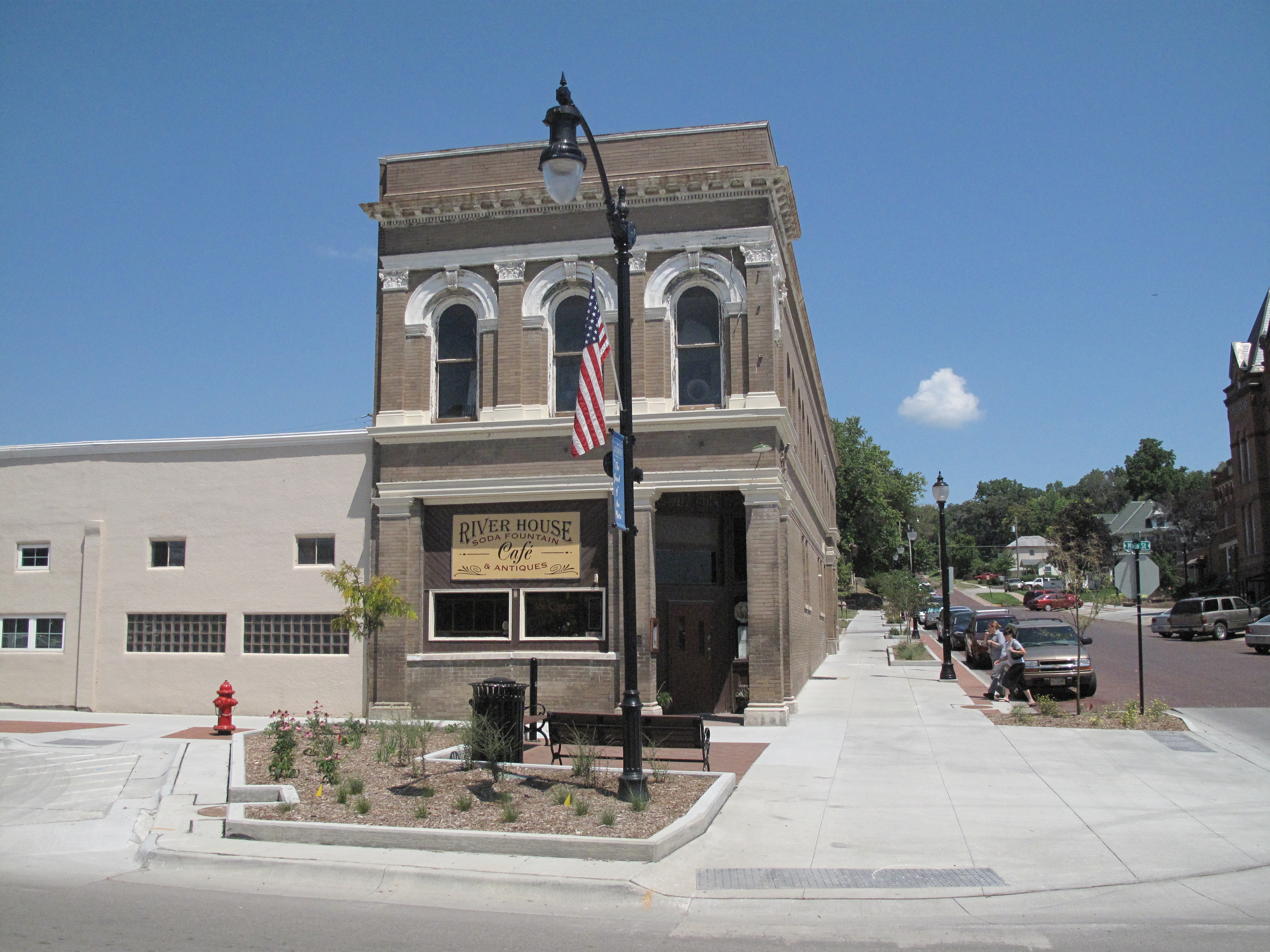
By noon it was hot and I was hungry, so I found the River House Soda Fountain and Cafe and stepped inside. Obviously, this old building was once a riverport saloon — there was a long bar, fixed barstools, and a pressed-copper ceiling. Riverboat captains had drunk here. So had emigrants — anxious to find their fortune in the West yet hesitant enough of the upcoming dangers to take one last draft in a civilized tavern before moving along.
But that was the past. The new owners had turned the River House into a combination antique store, sandwich shop, and soda fountain. Free wifi available. A dozen others were already being served as I sat down at the old oak bar. I ordered a root beer float and an Italian sandwich.
The River House Soda Fountain & Cafe
Looking around, I could see that the River House was run by a young mother with her two daughters. (The great majority of small-town cafes I’ve seen are run by women, not men.) Mom was directing traffic. Her mid-teens daughter was the main waitress, enthusiastically taking lunch orders. Then there was a younger girl, perhaps 7 or 8 years old, scurrying this way and that, trying to help Mom any way she could.
I flagged down “Mom”, a youngish-looking woman, and asked if there was a place where I could charge my camera battery.
“Sure, right here,” she said pointing to an outlet behind the bar.
“Thank you. That’s great.” I handed her the battery but added, “please don’t let me forget it here.”
“No, no of course not,” she assured me but added teasingly “this battery does look a lot like the battery I use for my camera. If you were to leave here without it…”
“I guess I’ll just have to take that chance,” I added playing along.
“So where are you from?” she asked.
“Colorado,” I answered. “Just travelling this week. Did you grow up here in Plattsmouth?”
“Oh no. I’m from California.”
“Ah, a California refugee,” I shot back.
She didn’t reply, but instead gave me a wistful smile which I read as ambivalence about having left the Golden State.
I went on. “There are a lot of Californians just like you moving back to the Midwest. I met a pair of California refugees in a small town in Kansas. They were an older, retired couple. They bought an old bank building and a cafe next door. They’ve turned it into a bed and breakfast and restaurant.”
She was interested. She asked me about the particular town. I thought for a bit and came up with “Oberlin. Oberlin, Kansas.”
We talked a bit more about how there were so many well-preserved towns in the Midwest before she had to attend to some other customers.
I had my sandwich and my root beer float which hit just the right spot. The food is usually really good in these kinds of places and the River House was no exception.
I retrieved my camera battery, paid the bill, said thank you, and headed back outdoors into the hot afternoon. I don’t know what brought them here to Nebraska from California, heading from West to East along the old California Trail. Perhaps there are no longer good opportunities in California. Or perhaps she wanted a small-town atmosphere to raise her daughters. Perhaps taxes are too high or regulations too strong. Or maybe it was something else.
But logic tells us that whatever terrible thing the California refugee is fleeing, that thing must be more dangerous to them than Nebraska’s tornadoes or blizzards.
Nebraska corn. The brown “silk” at the eartips mean harvest time is near.
A list of all photo posts from the American County Seats series in TimManBlog can be found here.
I’m trying to travel to all of America’s county courthouses, and each month a post about my visit to the most interesting county seats. It’s only a hobby — but donations are greatly appreciated to help defer my costs. Thanks, Tim
This morning, the Supreme Court agreed that the individual mandate of Obamacare is not Constitutional under the Commerce clause of the U.S. Constitution. In short, Congress may “regulate” commerce but it may not “create” commerce by compelling us to make certain purchases.
However, the Supreme Court went on to say that, nevertheless, the individual mandate of Obamacare is Constitutional if it is viewed as a tax. Very well then, if the Supreme Court says it’s a tax then I will respect that. It’s a tax, and all Americans must carry health insurance or the IRS will compel them to pay this tax.
What does this mean?
It means that Obama raised taxes in a recession. He raised taxes on the butcher, the baker, and the candlestick maker. He raised taxes on the Middle Class. He raised taxes on small business owners who create the majority of jobs in this country; consequently those jobs may never be created. He raised taxes on the student with a part-time job. He raised taxes on the day laborer. He raised taxes on the poor. He raised taxes on everyone. It is the largest tax increase in American history.
It also means Obama lied in his 2008 campaign. He said no one making less then $250,000 would see their taxes increase. That’s a lie. In 2009 Obama swore up and down that the mandate was not a tax. But that’s a lie as well. We’ve all been deceived. To save his honor, to prove he is not a liar, Obama must announce that he will sign a repeal of Obamacare since it has now been declared a tax. But I won’t be holding my breath for that to happen.
Abraham Lincoln said that ultimately, the people rule. Ultimately a Republic cannot rely on the wisdom of its high officials but must instead rely on the wisdom of its people. In this way the Court’s decision may be a Godsend. It will force the American people to act. It is now up to the people’s votes this November to repeal this foolish and life-destructive tax.
Pete Spiliakos provides a nice review of Solicitor General Verrilli’s attempts to defend Obamacare in front of the Supreme Court this past week (“What Part of ‘Because I Said So’ Don’t You Understand?”). Most tv and print pundits say the government’s lawyers (Verrilli) did a poor job defending the law in front of the court and many blame Verrilli personally. In the final analysis however
…Solicitor General Verrilli did his pitiful tap dance about how the health care market is “different” and how the federal government has the power to compel you to buy health insurance but not a cell phone or burial insurance. And the result was that the more conservative Justices pounded him into the ground. The problem wasn’t Verrilli. It was the quality of his arguments.
From the day it passed I assumed Obamacare would be struck down by the courts as an unlawful abuse of Congressional power. Article I of the Constitution enumerates the specific powers of Congress; the power to force purchases on people is not among that enumeration.
Although Article I grants Congress the power to regulate interstate commerce, that power does not extend to forcing people to participate in commerce — so that they can then in turn be regulated! Here I’m reminded of the climactic scene in Clint Eastwood’s “Unforgiven.” Eastwood’s character points a rifle at a frontier journalist who sputters “certainly you wouldn’t shoot an unarmed man!” Eastwood then points to a gun lying on the floor and growls “See that rifle there? Pick it up!” That’s the Pelosi-Reid Congress at work — Join the national health market so we can regulate you! Or else!
A proper judicial review should thwart such an abuse of power. In doing so the Court would exercise its proper role of oversight first used in Marbury vs Madison over 200 years ago. That’s judicial review in its proper place. In case you’re wondering, should the Court strike down Obamacare it could not be justly accused of judicial activism — the judicial exercise of power not found in the Constitution. Remember forced bussing of school children back in the 1970s? That was judicial activism. Obamacare is simply an unlawful abuse of power which needs to be vacated.
For a more practical (rather than legal) explanation of why Obamacare (or any other centralized planning solution to health care) is a foolish idea please see Walter Russell Mead “The Health Care Disaster and the Miseries of Blue.”
Finally, I think it’s important to remember why Obamacare is key to November’s election. The health care law is President Obama’s signature legislation. It’s also the perfect archetype of all he stands for: central planning, centralized government control of markets and industries, all supposedly for the benefit of the people yet in actuality at the people’s great expense and for the benefit of those who fund and support the party in power. In an age of rapid technological advancement such policies are the exact opposite of the direction that America should take for the protection of individual freedom and the protection of individuals against the tools available to those who would seek despotic power.
All four remaining Republican candidates are running against Obama by running against Obamacare and the implications of Obamacare for government power. Although Mitt Romney is the frontrunner he has failed to close the deal largely because of his association with “Romneycare” in Massachusetts. Rick Santorum has said that the danger posed by the implications of Obamacare compelled him to enter the Presidential race (see “Rick Santorum — The Servant“). His stump speeches focus on freedom and resonate with the crowd (See Daniel Henninger’s “Santorum and Freedom“). Gingrich and Paul are also strong opponents of the law.
I’m not in the prediction game; I’m lousy at picking football games against the spread and I won’t try to handicap the Supreme Court vote. I just know how they should vote.
During this election year our major political figures make speeches every single day. As winter caucuses turn to spring primaries these addresses can become small and tedious. They are often filled with jabs at an opponent’s gaffes made yesterday but certainly to be forgotten tomorrow, or delivered solely for the purpose of posturing on some particular issue. Therefore I thought it might be useful at this time to step back and consider a larger view of the health of American politics.
On January 27, 1838, Abraham Lincoln addressed the Young Men’s Lyceum of Springfield, Illinois on the subject of “The Perpetuation of our Political Institutions.” The Lyceum was a kind of debating society, a sort of voluntary educational institution of the prairie. Lincoln was 27 at the time he gave this speech. His biographers quote it often. Here I’ve excerpted some passages which I find most poignant these eight score and fourteen years later.
As a subject for the remarks of the evening, the perpetuation of our political institutions, is selected.
…We find ourselves under the government of a system of political institutions, conducing more essentially to the ends of civil and religious liberty, than any of which the history of former times tells us. We, when mounting the stage of existence, found ourselves the legal inheritors of these fundamental blessings. We toiled not in the acquirement or establishment of them — they are a legacy bequeathed us, by a once hardy, brave, and patriotic, but now lamented and departed race of ancestors. Their’s was the task…to possess themselves, and through themselves, us, of…a political edifice of liberty and equal rights; ’tis ours only, to transmit these…undecayed by the lapse of time, and untorn by usurpation — to the latest generation that fate shall permit the world to know. This task of gratitude to our fathers, justice to ourselves, duty to posterity, and love for our species in general, all imperatively require us faithfully to perform.
How, then, shall we perform it? At what point shall we expect the approach of danger?…Shall we expect some transatlantic military giant, to step the Ocean, and crush us at a blow? Never! All the armies of Europe, Asia and Africa combined…with a Buonaparte for a commander, could not by force take a drink from the Ohio, or make a track on the Blue Ridge, in a trial of a thousand years.
At what point then is the approach of danger to be expected? I answer, if it ever reach us, it must spring up amongst us. It cannot come from abroad. If destruction be our lot, we must ourselves be its author and finisher. As a nation of freemen, we must live through all time, or die by suicide.
I hope I am over wary; but if I am not, there is, even now, something of ill-omen amongst us. I mean the increasing disregard for law which pervades the country; the growing disposition to substitute the wild and furious passions…Accounts of outrages committed by mobs, form the every-day news of the times…Whatever, then, their cause may be, it is common to the whole country.
…But, it may be asked, why suppose danger to our political institutions? Have we not preserved them for more than fifty years? And why may we not for fifty times as long?
…That our government should have been maintained in its original form from its establishment until now, is not much to be wondered at. It had many props to support it through that period, which now are decayed, and crumbled away. Through that period, it was felt by all, to be an undecided experiment; now, it is understood to be a successful one. Then, all that sought celebrity and fame, and distinction, expected to find them in the success of that experiment…Their ambition aspired to display before an admiring world, a practical demonstration of the truth of a proposition, which had hitherto been considered, at best no better, than problematical; namely, the capability of a people to govern themselves…They succeeded.
…But the game is caught; and I believe it is true, that with the catching, end the pleasures of the chase. This field of glory is harvested, and the crop is already appropriated. But new reapers will arise, and they, too, will seek a field…And, when they do, they will as naturally seek the gratification of their ruling passion…The question then, is, can that gratification be found in supporting and maintaining an edifice that has been erected by others? Most certainly it cannot. Many great and good men sufficiently qualified for any task they should undertake, may ever be found, whose ambition would aspire to nothing beyond a seat in Congress…but such belong not to the family of the lion or the tribe of the eagle. What! Think you these places would satisfy an Alexander, a Caeser, or a Napoleon? Never!…Is it not unreasonable then to expect, that some man possessed of the loftiest genius, coupled with ambition sufficient to push it to its utmost stretch, will at some time, spring up among us? And when such a one does, it will require the people to be united with each other, attached to the government and laws, and generally intelligent, to successfully frustrate his designs.
Distinction will be his paramount object; and although he would as willingly, perhaps more so, acquire it by doing good as harm; yet, that opportunity being past, and nothing left to be done in the way of building up, he would set boldly to the task of pulling down.
Here then, is a probable case, highly dangerous, and such a one as could not have well existed heretofore.
History shows that Lincoln’s ominous warnings were uncomfortably accurate. It is in fact more than reasonable — it is inevitable — that some Caesar or Napoleon will spring up among us; the only uncertainty being that man’s exact description and circumstances. I will look in particular for one who finds satisfaction in “pulling down.”
Peter Schweitzer has an excellent article on the recent controversy over the health care mandate requiring employers to provide contraceptives free of charge, free of copays. As one might expect, the driving force is money, not morals. I’ve copied the gist of the argument below. (read the whole thing here.)
You’ve heard of crony capitalism? Well this is America’s first example of crony contraceptives.
Forget for a minute the religious question and look at who wins big here: Big Pharma. This mandate is not really about condoms or generic versions of “the pill,” which are available free or cheap in lots of places. This is about brand-name birth control drugs and other devices that some consumers swear off because they are too expensive. The Health and Human Services (HHS) mandate requires health-insurance companies provide contraceptive coverage forall “FDA approved contraceptive methods.” It does not insist on generics. And it does not offer any cost containment.
What’s more, the mandate prevents health-insurance companies from having copays or deductibles for the benefit. This is the perfect set up for Big Pharma. Since the drugs will be paid for by a third party (insurance companies, who will pass the cost on to employers and the rest of us), the consumer won’t worry about the price. Expensive brand names will no doubt see demand rise.
So how does Big Pharma get such a sweet deal? Read on:
It’s important to point out that among President Obama’s biggest financial backers are precisely the Big Pharma companies who benefit from the mandate. Sally Sussman, head of government affairs for Pfizer, is one of his biggest campaign bundlers, who co-hosted a fundraiser for Obama on Thursday night. Pfizer sells numerous contraceptives that now must be covered by health-care plans. Obama’s financial ties to the pharmaceutical industry run deep. During the 2008 presidential campaign, he collected three times more in contributions from pharmaceutical manufacturers than John McCain, according to the Center for Responsive Politics. And he will no doubt win the money race again during this election cycle.
There’s more:
Back in the nation’s capital, Big Pharma has spent a lot of money over the past couple of years, keeping an army of lobbyists employed. As Tim Carney of the Washington Examiner pointed out last year, since the Obama administration took office, “the drug industry’s $635 million in lobbying exceeds that of Wall Street and the oil and gas industry, combined.” And the lesson seems to be clear: it is money well spent. Not only did they get largely what they wanted from Obama’s health-care-reform law (no caps on drug prices, no reimportation from Canada); now, President Obama’s mandate is broadening the market for their products. With drug prices so high, the best way it can increase demand for its products is to get the federal government to mandate payment for it.
Of course, also consider the following, but remember that crony capitalism on the federal level causes far greater damage than can be done on the state level:
President Obama’s not the only one who has mandated certain health-care requirements for the benefit of companies with which he has close ties. Back in 2007, Texas Gov. Rick Perry signed an executive order that required school girls in Texas be vaccinated with Gardasil, which fights against a sexually transmitted virus linked to cervical cancer (the full cost of the three-shot vaccine is $360). Again, forget the culture war politics for a second. Instead of looking at the bedroom, follow the money to the corporate boardroom: Gardasil is produced by pharma giant Merck, whose chief lobbyist in Texas at the time had been Perry’s chief of staff. Merck was a campaign contributor, and had also made contributions to the Republican Governors Association while he headed that organization. Again, a corporation supports a politician who in turn issues a mandate that creates a bigger market and larger profits for its product.
Obamacare is all about Crony Capitalism. So is Obama’s energy policy — subsidizing major donors through those donors’ green energy companies. Barack Obama’s Presidency is as fraught with failure as Jimmy Carter’s was, but at the same time it is as corrupt as Richard Nixon’s.
“Santorum: Separation of Church and State Not Absolute”
That’s the headline coming out of an interview between Presidential candidate Rick Santorum and George Stephanopoulos on ABC’s “This Week”.
(video of both today’s ABC “This Week” interview and NBC’s “Meet this Press” interview here.)
Santorum’s exact quote was:
“I don’t believe in America the separation of church and state is absolute,” Santorum told host George Stephanopoulos. “The idea that the church can have no influence or involvement in the operation of the state is absolutely antithetical to the objectives and vision of our country. This is the First Amendment. The First Amendment says ‘free exercise of religion,’ that means bringing everybody, people of faith and no faith into the public square.”
(decently in-depth story quoted above can be found here.)
The Constitution guarantees every American what they deserve — the ability to exercise their religion freely. So Santorum is absolutely correct in his statement, and he extends his respect outside of his own religious persuasion to “people of faith and no faith”.
However, the media, seeking a big story, (and perhaps his opponents as well) will likely try to spin this statement into something dictatorial. Don’t participate. Save the thrill of feeling scared for the latest Wes Craven movie or even an old Alfred Hitchcock black and white flick. That way you can enjoy entertainment for entertainment’s sake without falling for some broadcaster’s sales pitch.
In Santorum’s words :
the First Amendment says ‘free exercise of religion,’ that means bringing everybody, people of faith and no faith into the public square.
Again, he’s correct. That’s what freedom of speech and religion are about. Freedom of religion means speaking your mind in a pluralistic society. It applies to politicians as well.
The Associated Press version of the story (link here) badly misquotes Santorum by leaving out the word “absolute”. The AP actually ran the story under the deceptive but more titillating headline “Santorum says he doesn’t believe in separation of church and state.” The Associated Press has a near monopoly on print news stories in this country, so they often unabashedly distort their coverage — sometimes out of bias and sometimes simply to drive sales.
Finally, as we all know, the term “Separation of Church and State” is a phrase coined by Thomas Jefferson in a personal letter. The phrase does not have the force of law because it does not appear in the Constitution itself. Instead, the First Amendment bars the “Establishment” of religion using these words:
Congress shall make no law respecting an establishment of religion, or prohibiting the free exercise thereof; or abridging the freedom of speech, or of the press; or the right of the people peaceably to assemble, and to petition the Government for a redress of grievances.
I ask that you consider the difference between “establishment” of religion (prohibited) and “separation of church and state” next Christmas when we have our annual spate of lawsuits about whether decorated spruce trees on public property are “Christmas trees” or “holiday trees”. What foolishness! Christmas trees have never established any religion nor forced any citizen to worship or not worship in any way shape or form.
We can avoid the “establishment” of religion in America but we cannot, in any practical way, “separate” church and state. That is because we cannot “separate” our religious thoughts and opinions from our understanding of right and wrong and good and bad. These ideas are intertwined at their very roots. Absolute separation is not only undesireable as Santorum said, it is impossible.
February 25, 2012 (If you like my posts, you can support this site with a donation via Paypal, Visa, Amex, Mastercard, or Discover by using the form at the bottom of this post. Thank you.)
The Michigan primary is next Tuesday. Since political talk can sometimes become dry I thought I’d combine a travel post with some thoughts about the upcoming contest. In fact, my first blog post was such a combination — “Mennonite Pastries Banned in Cimarron Kansas” — and I thought it came out well, photos and all, so here goes. (All photos are my own, taken in February 2009.)
Manistique, a town in Michigan’s Upper Peninsula along the Lake Michigan shoreline, is so small that it reminds me of an Alaskan town, or what I imagine an Alaskan town might look like. Few of the buildings here are as tall as two stories and there are just a couple of those. Streets are lined with piles of shoveled snow that can dwarf the cars parked next to them. In fact, in the wintertime snowmobiles become as common a means of transportation as cars. When I was here in February 2009 the noontime temperature struggled to reach 17 degrees, and that was on a sunny day.
Manistique, Michigan, February 2009
At the turn of the 20th Century Michigan’s Upper Peninsula (known as the “U.P.”) was famous for its Jacobsville red sandstone, a burgundy red stone in demand worldwide. Architects loved to use Jacobsville for the facades of their best structures since artisans could carve intricate designs into the stone without compromising its strength. Jacobsville was used in the Tribune Building in Chicago and at the original Waldorf-Astoria in New York among many other places. Manistique has one such Jacobsville building — it originally housed a prominent bank but now a home health agency occupies the first and second floors.
Corner bank building, Manistique, Michigan, February 2009
Manistique is the seat of Schoolcraft County. The courthouse here is a fairly new ranch-style building that does not photograph well. The only markers are the county’s war memorial in front of the adjacent sheriff’s office.
Schoolcraft County Courthouse, Manistique, Michigan, February 2009
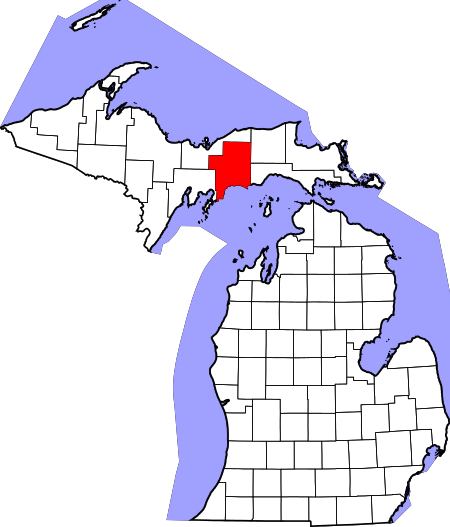
Schoolcraft County in the state of Michigan
Behind the courthouse, I saw two official Schoolcraft County Sheriff’s Department snowmobiles parked in a trailer. So — the local police chase ne’er-do-wells on snowmobiles! Can you imagine if Hollywood was to make a tv show called “The U.P.”? These cop snowmobiles would be on the opening credits tearing paths through the wilderness with sirens blaring and emergency lights blazing red and blue over the snow trails! Wouldn’t that put Erik Estrada’s old CHiPs motorcycles to shame?
Official Schoolcraft County Sheriff’s Department Snowmobile Cruisers (“Sheriff” emblem on visor)
I ate lunch at the Cedar Street Café and Coffee House. This is a fine place, built into one of the refurbished older business buildings in the old town business district. Such cafes are becoming common in small Midwestern towns. Yet they shouldn’t be called “mom and pop” places because typically they are run entirely by women entrepreneurs. The inside decor was inviting — festive Mardi Gras beads bedecked the wooden tables while oil paintings (for sale by local artists) decorated a wall of exposed brick. Painted on the opposite wall was a country mural covering over 20 square feet from the hardwood floor to the antique pressed metal ceiling. By the way, the sausage gumbo here was just fantastic — rich brown gravy with chunks of sausage and spices over rice. Of course, I don’t know if any Louisianan would call it “gumbo” but being authentic doesn’t matter if you’re just plain good.
What’s interesting about Manistique politically is that it sits in the heart of former Democrat Bart Stupak’s 1st Congressional District, most of which was on Michigan’s Upper Peninsula. The majority of the people in the U.P. are the descendants of German and Polish immigrants who came here in the late 19th century to work the iron mines and rock quarries. It is a heavily Catholic, heavily Democratic, working-class region. Bart Stupak has represented the district since 1993. Obama won this district 49%-48% in 2008.
Yet Michigan’s 1st District went Republican in the elections of 2010 for the first time since 1933. Here’s what happened. During the Congressional debate over Obamacare in 2009, Stupak led a group of pro-life House Democrats wary of passing Obamacare since they feared the bill would mandate government funding of abortions. They held out for a while, but long story short Stupak and his gang finally caved to pressure from Speaker Nancy Pelosi and voted for the legislation. In return for their votes, they were given a pledge that Obamacare would not fund abortions, but the pledge turned out to be phony and Bart Stupak became very unpopular with his Catholic, working-class constituency. Stupak decided to retire rather than run for re-election in 2010 and has since taken up the lobbyist’s trade.
In Tuesday’s primary, the focus will be on Romney versus Santorum, although Ron Paul will get some votes. Gingrich isn’t campaigning in Michigan, choosing instead to concentrate his energies on upcoming primaries in the South.
Romney is the home state guy, of course. Mitt’s father George Romney was Michigan’s governor for many years. That will mean a lot. Residents of the U.P. (called “Yoopers”) are proud to be from Michigan. Local radio broadcasts Detroit Tigers games, not the Milwaukee Brewers even though Milwaukee is a shorter drive than Detroit for most yoopers.
At the same time, these are exactly the kind of voters Rick Santorum is banking on. They are Catholic, working-class, rural, Democratic historically but not afraid to switch parties. Michigan’s is an open primary, meaning that registered Democrats can cross party lines to vote in the Republican primary. This might boost Santorum’s turnout in the U.P., and apparently, his campaign has picked up on this possibility and has scheduled a Santorum campaign rally in the U.P.’s largest town of Marquette. (Info here. The link was good as of 2/25/12)
The Michigan Primary will put to the test two competing opinions of Santorum’s campaign strategy. On one side is demographics expert Henry Olsen of the American Enterprise Institute. (Henry is an old graduate school colleague of mine — he’s a very bright guy and has an unstoppable hook shot.) He wrote a piece a few weeks ago called “Two Decades Too Late” in which he described Santorum’s campaign strategy as an attempt
…to resurrect the Reagan general-election strategy of 1980 — first and foremost, to win over the conservative base on fiscal and social issues by portraying himself as a man of principle, the only candidate who will not waver.
But, according to Olsen, Santorum’s strategy is doomed to failure because the demographics of 1980 have changed during the past 30 years — a resurrection of the coalition with the old “Reagan Democrats” is no longer possible. In a nod to the timeliness of Olsen’s piece, the archetypes of the 1980 Reagan Democrats were Michigan voters. We’ll see how many Reagan Democrats turn out for Santorum Tuesday night.
On the other side of the strategy, argument is Jeffrey Bell, an “early supply-sider” and author of the forthcoming book, “The Case for Polarized Politics.” In a recent interview with James Taranto of the Wall Street Journal (“Social Issues and the Santorum Surge“), Bell argues that social conservatism is a winning strategy for the GOP because its appeal is strongest amongst not the wealthy but the working class:
Mr. Bell notes that social conservatism is largely a working-class phenomenon: “Middle America does have more children than elite America, and they vote socially conservative, even though they might not necessarily be behaving that way in their personal life. They may be overwhelmed by the sexual revolution and its cultural impacts.”
Mr. Bell squares that circle by arguing that social conservatism is “aspirational” and “driven by a sense in Middle America that the kind of cultural atmosphere we have, the kind of incentives, the example set by the government, is something that has to be pushed back against.”
In an ironic twist, Santorum has become identified with the social issues mostly because of the media’s portrayal of him as such. He has not actually campaigned on contraception, abortion, or gay marriage. I can personally attest to this fact as I’ve attended four Santorum events and at none of them were these issues part of the candidate’s speech. Not once.
So, Michigan will be a test. Romney has the home-state advantage while Santorum tests his campaign strategy. We’ll see what happens in Manistique.
Snow-bound church, Manistique, Michigan, February 2009
A list of all photo posts from the American County Seats series in TimManBlog can be found here.
I’m trying to travel to all of America’s county courthouses, and each month a post about my visit to the most interesting county seats. It’s only a hobby — but donations are greatly appreciated to help defer my costs. Thanks, Tim
Donations to TimManBlog
Use this form to make donations to support this site. Paypal, Visa, Mastercard, Amex, and Discover cards are accepted. Donations can be made in increments of $5.00; increase the number of units to increase the donation amount.
On some days I feel at a loss for words. At those times I try to find a good book, hoping that the glibness of its author might transfer such talent to me.
I found a letter from a young man, aged 23, seeking office for the first time. He addressed a public letter to his electors, the people of Sangamo County, Illinois. He concluded it as follows:
But, Fellow-Citizens, I shall conclude. Considering the great degree of modesty which should always attend youth, it is probable I have already been more presuming than becomes me. However, upon the subjects of which I have treated, I have spoken as I thought. I may be wrong in regard to any or all of them; but holding it a sound maxim, that it is better to be only sometimes right, than at all times wrong, so soon as I discover my opinions to be erroneous, I shall be ready to renounce them.
Every man is said to have his peculiar ambition. Whether it be true or not, I can say for one that I have no other so great as that of being truly esteemed of my fellow men, by rendering myself worthy of their esteem. How far I shall succeed in gratifying this ambition, is yet to be developed. I am young and unknown to many of you. I was born and have ever remained in the most humble walks of life. I have no wealthy or popular relations to recommend me. My case is thrown exclusively upon the independent voters of this county, and if elected they will have conferred a favor upon me, for which I shall be unremitting in my labors to compensate. But if the good people in their wisdom shall see fit to keep me in the background, I have been too familiar with disappointments to be very much chagrined. Your friend and fellow-citizen,
New Salem, March 9, 1832
Indeed every man has his peculiar ambition. With my only voice I ask that the good people choosing their preferred candidates next Tuesday and the following Tuesday, and again in November, weigh the peculiar ambition of the men and women on their ballots, and ask themselves which among those listed has “no other [ambition] so great as that of being truly esteemed of [his] fellow men, by rendering [himself] worthy of their esteem.”
Since I’ve been travelling the past few days I haven’t been able to write much. What I have been able to do is to check the musings of another obscure blogger who goes by the moniker The Sage of Mt. Airy. I’ve never met “the Sage” but through friends I hear he is a retired military man who later became a professor of medieval philosophy for a while, and then retired a second time. Nice resume.
In “The Real Cost“, the Sage pulls the covers off the recent mortgage shake-down of five large banks by the Obama administration:
But first folks, please understand that no bank will ever pay any part of the $25 billion settlement. Basic economics: It’s their customers who will pay; it’s only their customers who can pay.
Let me be clear. If Obama ordered Archers-Daniels-Midland to give everyone “free” corn on the cob it wouldn’t really be free. Their customers would pay for it. Let me be clear. Some would praise the President for “helping alleviate hunger” or some such, but it wouldn’t really be free. Let me be clear: You Got Fooled Again.
Announced around the same time as the $25 billion sleight of hand was what the Wall Street Journal’s “Best of the Web Today” called the Abortifacient Shell Game (topic occurs halfway down the article):
“If a woman works for an employer that objects to providing contraception because of its religious beliefs, the insurance company will step in and offer birth control free of charge,” ABC reports.
It’s not clear who will “step in” if the institution self-insures, and in any case this sounds like something of a swindle. Unless insurance companies have access to magical abortifacient trees, somebody has to pay for this stuff. One way or another the benefits will be priced into the cost of insurance, and even if insurers give Catholic institutions a discount and pass the cost on to everybody else, the former will still be purchasing a package of benefits that includes what they find abhorrent.
Let me be clear. Insurers can’t “step in” and give away things for free. Let me be clear: that’s as basic an economics lesson as “there is no free lunch.” Insurers do not have access to “abortifacient trees.” Let me be clear: You Got Fooled Again. First Amendment be damned.
So Meet the New Boss: Lord of the Banks, Lord of the Insurance Companies, Lord of the Car Companies, Lord of the Churches, Lord of Religious Correctness, etc. etc. We heard all about him 40 years ago and we all swore We Won’t Get Fooled Again.
Rather than electing one New Boss after another to rule over one industry after another (while the bottom line is I pay for it all anyway) — I’d prefer “A Servant.”







 TimManBlog